
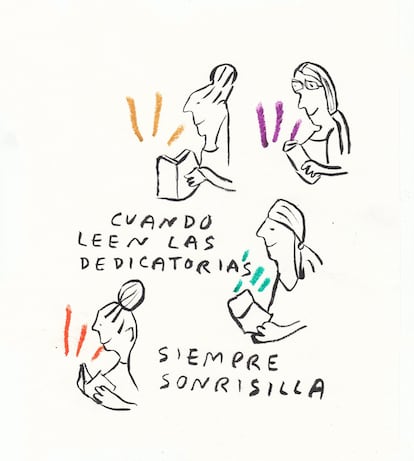
A room of your own by Victoria Woolf was the first copy given away in the A las Olvidadas initiative, by the Teta y Teta association, which for eight years has delivered books to prisons so that they reach the hands of women deprived of liberty. Through a call on social networks they ask: “What book would you give to a woman who is in prison?” This Wednesday they presented the first sociological report of the project, which analyzes the more than 12,000 dedicated books that have been delivered over the years to 23 prisons in the country. ”This is a study that analyzes what is sent and what is not sent, and what things are said and how they are said in the dedications,” explained Sabela León, researcher of the report together with Beatriz Marín.
Marina García, spokesperson for Teta y Teta, guided the event at La Casa Encendida in Madrid, which lasted an entire day. In his words he highlighted three figures: only 7% of the prison population are women; Of them, 80% are mothers and 88% have suffered sexist violence. “Only seven out of every 100 people who are serving sentences are women, with their needs, their fears, their guilt, with their specificities,” he said. Only in Madrid, Barcelona and Ávila are there completely female centers. Women serving sentences in the rest of the country are divided into 41 male centers where they have their own modules, in which “the space and everything that happens in that prison is not designed for them, who are the minority.” In 10 provinces they do not have a women’s module, so prisoners from those locations are sent away from their families and support networks.
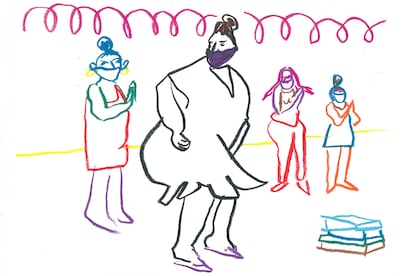
In this context, the initiative was born, García stressed: “To the forgotten is revolutionary because it is an initiative only for them in a system that is designed only for them.” When they make calls through social networks, they do not give instructions or request specific genres. They only ask that it be something designed and dedicated for these women. Once people send the books and before they arrive at the prison, the team documents the titles and dedications. Two members of the project take the copies to the prisons, accompanied by illustrators who record the activity (any audiovisual recording is prohibited inside) and an artist who does a small closing show. “We hold a cultural event in which they are the center, they participate, they read the dedications. It is a cultural event within the prison, not a social intervention,” García explained.
Hugs, dear and wife
The books they send would be classified into four large shelves, León has portrayed. The first would be that of female genealogy and shared experiences, “those that tell and deal with stories starring women who have experienced complex situations of violence”, for example, Like water for chocolate, The spirit house o The time between seams. The second would be that of critical and feminist thought, where there are manifestos or essays on feminism such as We should all be feminists, A room of your own o How to educate in feminism. On the third shelf would be self-help books such as The monk who sold his Ferrari, How easy everything is and how much we complicate it o Find your vitamin person. Finally, the classic and great books would appear best sellerslike One hundred years of loneliness o The shadow of the wind. In these four categories of books, the team has identified four different intentions of the giver: identification with characters, criticism of this structural experience of being a woman, help to cope better with the situation of confinement, and evasion as is through novels.
The study has also analyzed 372 dedications to identify the most used words and the position from which the person giving the book is positioned. As for the most repeated words – where they lead book and I hope -, the team has highlighted hug, dear o women“words that are not normally associated with the imagination about prison.” These dedications, they have assured, give back to those who receive them the uniqueness that the prison system has taken away from them. They have also identified semantic transformations, where the word changes its meaning depending on the context. With hugfor example, which appears in approximately 30% of the dedications, “given the impossibility of physical contact, books function as a delayed hug,” says the report, and they cite one of the dedications: “I don’t know how to wrap a hug and a kiss, so I’m sending them to you in book form.”
The place from which the dedication is written has three categories: symmetrical (70.35%) which can be horizontal / sororo or respectful desire / accompanies; neutral (15.9%); and asymmetrical (13.75%), with a direct imperative, conditional or lesson tone, or implicit correction. The vast majority of the dedications are placed face to face, without differences and with empathetic ways that share the same experience, as one of them said: “With my best wishes that, by knowing our reality better, we can together contribute to improving ourselves and our environment.”
When comparing the reading and book purchasing habits of the general Spanish population and the genres that are given away through the initiative, in both the novel leads, but in the case of those donated, the percentage of essays and poetry —12% and 9%— is higher than in general consumption —6.7% and 2.5%. The report says regarding poetry: “The function it fulfills within the walls adds a dimension that the data does not capture: the inmates use it as raw material for their letters, as a borrowed language with which to communicate with their partners, suitors and family. The library becomes a node of the affective network that confinement tries to interrupt.”
The team has been struck by the fact that erotic novels do not make up 1% of the books they receive, and in many prisons it is one of the most requested genres. “It is closely related to the way penitentiary centers operate, where there is no space for that intimacy, for sexuality. The body is controlled a lot. In the situation of confinement, a book can be much more than a book,” García explained. This has made the team reflect on what they understand by cultural rights. “Perhaps the right to pleasure or to know oneself through culture, as can be the case with the erotic novel,” and they have questioned that perhaps next time, in the next cultural intervention, instead of thinking about Simone de Beauvoir they should focus on 50 shades of gray.
An advance in cultural rights
The initiative has already been replicated in France, Mexico, Honduras, Colombia, Switzerland and Panama. The success has been such that A las Olvidadas has added other projects around literature and language. Now they have a feminist reading club at the Extremadura Penitentiary Center; created Estaripéa glossary of women’s prison slang with more than 50 words created and designed by them; and Live Archive, a cultural mediation proposal with funding from the Women’s Institute so that women deprived of liberty can access the archive of these 12 years: the books with their dedications, the motivation letters from the donors and the letters they write themselves. Through all these projects, García has assured, the exercise of their cultural rights is guaranteed.
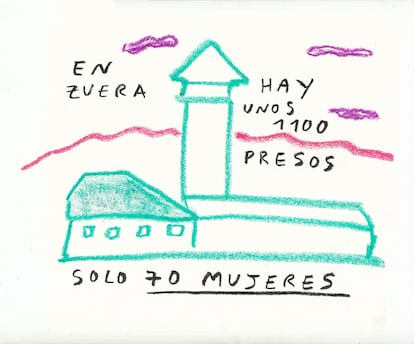
The impact it has had on women has been demonstrated in a letter they sent from the Soto del Real prison about their experience with A las Olvidadas: “The day we were notified, through Miss Lourdes, that we were going to be the objects of a book donation, we thought: ‘What a strange thing, only women.’ “They didn’t have this restlessness, the feeling that something belongs to us, that it is exclusively for us in a place where machismo is present at every moment.”