
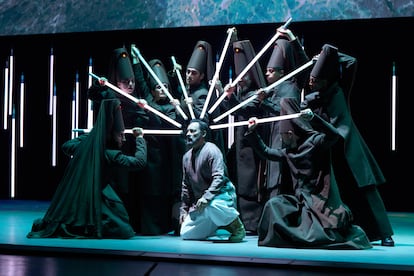
Paco Azorín heads his note of intentions for this new production of Aidaby Giuseppe Verdi, with a motto attributed in the program to Stanley Kubrick and dated 1968, the year of 2001: a space odyssey: “Feeling the experience is what is really important, and not the ability to verbalize or analyze it.” Hard not to subscribe. It is even more difficult not to notice that Azorín does, time and time again, exactly the opposite.
After a brief, violent and noisy theatrical introduction without music, conceived as a representation of oppression, the prelude presents an unusual character: Odysseus, the eternal traveler, played by the excellent tightrope walker David Marco. He lives on a desert planet in the year 3001, where he finds the famous alien monolith from Kubrick’s film, transformed here into a beam of white light. When you touch it, you understand its mission: to demonstrate that love defines the deepest part of the human being. To fulfill it, go back to the splendor of Ancient Egypt, around 1500 BC.
The Murcian stage director, set designer and illuminator must be recognized for the courage to renounce the Egyptian postcard and look for an intellectual background in Verdi. But this proposal ends up opting for its most problematic aspect. Conceived with the participation of the Peralada Festival, it closed the Maestranza season last Saturday and will later travel to ABAO Bilbao Ópera, the Tenerife Auditorium, the Municipal Theater of Santiago de Chile and the São Carlos in Lisbon.
The prelude comes into serious contradiction with both Verdi’s music and the film from which the production seeks to be inspired. The diaphanous violins in the high register symbolize the sweetness, delicacy and dreamy nature of Aida, the Ethiopian slave in love with the Egyptian commander Radamès. They then contrast with the marble march of the cellos, the embodiment of priestly authority. There is already the central conflict of the opera, designed to be heard with the curtain down. Nor does Kubrick’s message have to do with love. The only character capable of expressing feelings is the computer HAL 9000, and the strength of the film continues to lie in its mystery: no one knows what the monolith means.
Azorín recovers the monolith-shaped light beam in the final scene as a visual framework of transcendence, the threshold that Aida and Radamès cross when they die, walled up. The duo Oh goodbye earth It ascends while the earth closes in on them, but the director superimposes the unnecessary presence of the tightrope walker, who figuratively extracts their hearts and deposits them on a scale. Love outweighs violence and oppression. A conclusion that the production insists on underlining until any ambiguity is dispelled.
What is seen between both extremes barely helps to take off. The poor direction of the actors prevents the characters from being outlined, while the continuous stage interference hinders even the ballets of this ideal synthesis between the grand opera French and Italian melodrama. The simple set, built with stairs and cages, is dominated by Pedro Chamizo’s video panels, covered in colorful Egyptian motifs. Ana Garay’s costumes avoid conventional exoticism, although she introduces disconcerting nods to Kubrick, such as the priestly caps topped by a luminous red dot in allusion to HAL 9000. Everything is too explained, verbalized and analyzed. Just what Kubrick fought against in his film.
One of the best moments of the production came at the beginning of the third act, after the break. The night on the banks of the Nile is evoked with minimal means: the neons that previously served as swords now suggest vegetation, while a circular beam of light acts as the moon. In that intimate atmosphere the two great musical and theatrical flashes of the night emerged. First, the romance of Aida O my homelandwritten by Verdi in 1872 for Teresa Stolz on the occasion of the Milanese premiere. Then, the duet between the slave and her father, Amonasro, who vehemently forces her to use her beloved Radamès to find out the Egyptian military plans. It is the betrayal that will precipitate the tragedy. But Azorín then makes another of the dramaturgical errors of his production: he makes Amonasro come out of hiding during the cabaletta of the duo of lovers and thus deprives their appearance of any effect.
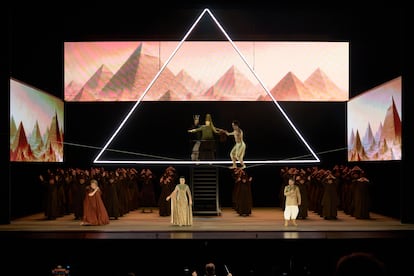
The soprano Marigona Qerkezi, debutant at the Maestranza, became O my homeland in the best of the night. The Kosovo singer, who took on the role for the first time in A Coruña in 2023, exhibited technical power in one of Verdi’s most demanding arias. He adjusted the breathing, dynamics and length of each phrase without losing fluidity or naturalness. His attractive and powerful voice easily reached the high C that Verdi wrote as the peak of the character. The Italian baritone Ernesto Petti, also a debutant in the Sevillian theater, was a good Amonasro, to whom he provided a more sinister profile than usual.
The other protagonist of the cast was the tenor Alejandro Roy as Radamès. He pushed Asturian began very excited and with hardly any possibility of a half voice, although he showed brilliance in the high third, as he made clear in the B flat that crowns his famous romance in the first act, Celeste Aida. But Verdi wrote that ending for a broadcast with bel canto roots, capable of attacking the note in pianissimo and dyingsomething that Roy found impossible. Her singing was, in general, quite inexpressive and did not find its first nuances until the consoling final duet with Aida, Oh goodbye earth.
Nor did it convince mezzo-soprano Ketevan Kemoklidze as Amneris. The Georgian singer who became a Spanish citizen, who triumphed with this character in Oviedo less than two years ago, showed marked changes in color in her voice, excessive vibrato in the high register and chest bass pushed with little musical sense. He made up for it with dedication in his duet with Radamès at the beginning of the fourth act.
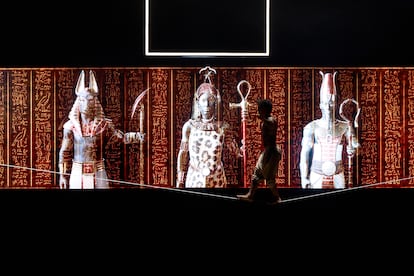
Among the supporting cast, the South Korean bass Insung Sim stood out as high priest Ramfis, above the Spanish Manuel Fuentes as the King. The tenor Néstor Galván and the soprano Patricia Calvache fulfilled the roles of the Messenger and the High Priestess. The Choir of the Teatro de la Maestranza offered a brilliant performance and stood out for its impasto and volume in the final secondespecially in the famous hymn Glory to Egypt.
The director Daniele Callegari, another debutant at the Maestranza, proved his stripes as a Verdi specialist. But his work from the pit stood out more for imposing order and protecting voices than for illuminating memorable moments. The only real spark coincided, again, with the third act, in O my homeland and the duet between Aida and Amonasro. It was also when he demanded the most from the Royal Symphony Orchestra of Seville and some imbalances emerged, insufficient to cloud the acceptable performance of the ensemble.
Azorín promised a trip from which we would return transformed. We return from this, rather, over-informed: with the feeling that each symbol has been explained to us twice without letting us experience any of them. Despite everything, the real Aida survived, hiding in the third act, in the Nile and in Qerkezi’s voice, proof that Verdi’s opera resists almost anything. The Maestranza season thus says goodbye with more determination than magic, under a monolith that promised much more than it finally delivered.
‘Aida’
Music by Giuseppe Verdi Libretto by Antonio Ghislanzoni, based on a script by François Auguste Ferdinand Mariette reworked by Camille Du Locle.
Manuel Fuentes, low (The King); Ketevan Kemoklidze, mezzo-soprano (Amneris); Marigona Qerkezi, soprano (Aida); Alejandro Roy, tenor (Radames); Insung Sim, low (Ramfis), Ernesto Petti, baritone (Amonasro); Nestor Galvan, tenor (A messenger); Patricia Calvache, soprano (The High Priestess).
Maestranza Theater Choir (Director: Íñigo Sampil)
Royal Symphony Orchestra of Seville.
musical direction: Daniele Callegari.
stage direction: Paco Azorín.
Maestranza Theater, June 20. Until June 28.