
That Rocío from more than 40 years ago, Manuel Calvillo had an epiphany. He, a young gay man of just 18 years old from the small town of Zahara de la Sierra (Cádiz), moved heaven and earth to meet his great diva, Rocío Jurado (Chipiona, Cádiz, 1943-Alcobendas, Madrid, 2006): “For me she was a goddess, I ate her with my eyes. She has always reminded me a lot of my mother.” That fleeting and affectionate encounter was followed by the revelation. Calvillo decided to consecrate all his alter ego transvestite, La Peligro, to her and, suddenly, her idol became her muse. Hundreds of heels and more than a dozen wigs later, La Peligro maintains its pact, but La Jurado has already left, just 20 years ago. The myth that he then became upon his death now moves towards immortality.
“Only great myths go fallow and then resurrect. It happened with Camarón and it happens with Rocío, because they are associated with a cultural revolution. Upon her death, she became an instant myth, but time was needed for new generations to appreciate her,” reflects Alexis Morante, film director and author of the documentary series The biggestwhich will premiere on Movistar Plus on June 25. His eldest daughter, Rocío Carrasco, collaborates in the production, who has provided fragments of a never-published autobiography. “I live it with great pride,” says the universal heir to Jurado’s legacy, in reference to the heterogeneous and diverse interest that her mother’s life and work receives.
Of this interest generated by the chipionera, in addition to the documentary, a book of essays, Rocío Jurado. The voice that made us feel free (Dos Bigotes publishing house) and another compilation of texts, Rocío, 20 years with you (Sevilla Press) by journalist Marina Bernal. “This 20th anniversary could be the turning point in its definitive rescue,” says Carlos Barea, editor of the first book and master in LGTBIQ+ Studies.
But the fact that the myth of La Jurado is reborn in the younger generations does not exactly have to do with the fact that it sold 20 million records or achieved 150 gold and 60 platinum records. Nor that she was named the “Voice of the Millennium”, nor even that her funeral in Chipiona two decades ago, among flowers and thousands of people, paralyzed Spain in a moment so shocking that her daughter prefers “not to remember”. The first impact for young people is different: “It is due to their strong commitment to dissidents, feminism and the LGTBIQ+ collective,” says Barea.
In the culture of the meme and the short TikTok video, there is not a recent March 8 that does not resurface the cut of the artist snapping at a journalist about the “mental bra” for asking her about her bra size or the “I am a defender of women, not a detractor of men.” Just as there is no June that does not resurrect her “I am progay” or “the world of illusion” that she said she owed to the collective. “She came with that DNA. There was no other option for debate,” Carrasco argues.
“His messages are so ahead of their time that, in the present, we find them and they find us,” says journalist Andrea Quintero, daughter of Jesús Quintero and director of the foundation that bears his name. He granted his last interview to him, and in front of him, Jurado opened up so much that he pronounced more than one of those iconic phrases in front of his microphone. As soon as you delve into archives and newspaper archives, you soon discover that in those journalistic talks Rocío Jurado became great. “She was very fast, in interviews she displayed elegance, sophistication and mental quickness to answer anything. He had the ability to take the conversation to what he wanted,” says Barea.
Although there is one trait that guided the steps of the Cádiz native’s career, it was that kind of innate intuition to adapt her image and her music to the times. “From the beginning she had it very clear. Within her perception of what she wanted, she expressed it and carried it out,” explains Carrasco. “It is the hinge of the older generations and those that came later,” adds Barea. Born and raised in post-war Francoist Spain, she soon became clear that she was not going to be a bata de cola folklore, nor that she was going to give herself completely to the copla, a genre that she never abandoned, but that she did transition towards melodic song. “Although today it has become a classic, it was transgressive. He was constantly learning and eager to perfect,” says Bernal.
And from that tireless and intuitive search emerged such groundbreaking albums that even today impact those young people who, after discovering it through the meme, scratch a little more. Lady is perhaps the most luminous example. In 1979, Jurado dedicated a song as elegant as it was explicit to female masturbation —Love alone—, to infidelity —Lady—and to angry spite against a man—that man— that dwarfs the vendettas from the present of Shakira or Rosalía. “He was connecting with groundbreaking composers who had something to say and who were also ahead of their time,” says Morante. And so the artist transitioned from the brilliant copla author Rafael de León to the prolific Manuel Alejandro or Juan Pardo.
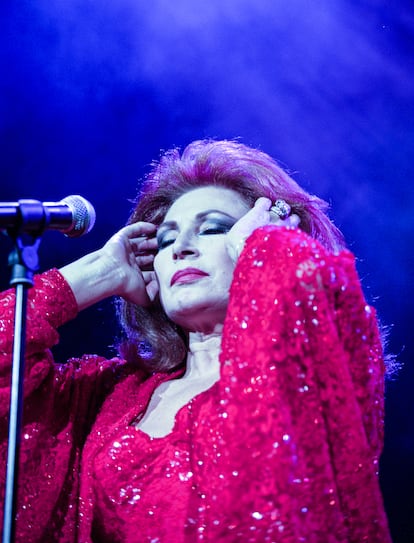
It is those lyrics that captivated the adolescent Calvillo, who imagined other worlds and other references while he developed in the lap of his modern grandmother María, a faithful follower of La Jurado. But there was more. The hairdresser confesses that he would remain enthralled in front of that television from the seventies and eighties while watching those gestures from “The Greatest” on a stage with which he more than made up for his more limited dancing skills: “The movement of the arms and hands bewitched me.” And Calvillo was not the only LGTBIQ+ person who felt challenged, both her generation and previous and future ones soon understood that this message was for them. Today, of the 12,500 visitors who annually visit its Interpretation Center in Chipiona, a majority are people from the group, as explained by the municipal institution.
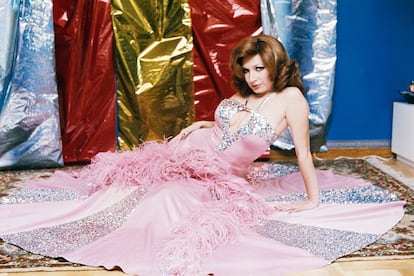
If we look at the definition of a drag queen As that artist who characterizes herself by exaggerating the traits of the female gender to act, it is not surprising that Jurado has been a muse of transvestism since she emerged on the music scene. That closest, simplest and smallest Rocío Mohedano—measuring 1.67 centimeters—also drew on her innate intuition to create a hyperbolic icon, recognizable in the distance on any stage. “He realized that there was a lot of folklore, so he had to stand out for his image,” explains Barea. And he did everything from direct control, far from the great conceptual production that today guides the steps of great artists. “She decided what she wanted,” says Carrasco.
From the sensuality of youth – there are her low necklines that scandalized the Franco regime and her famous sheet dress of subsequent protest -, Jurado went on to impossible backcombing, full eye shadow and dresses dripping with glitter, tulle wings and full-body capes, created by designers like Antonio Ardón. There was no end of year gala, live concert or even musical — Jetpremiered at the 1992 Seville Universal Exhibition—in which the name The biggest made all the sense. “She filled the stage, it was another level of sewing, of movement, a whole,” Calvillo values.
On the 20th anniversary of that massive funeral, it is difficult to imagine how this mythomaniac immortality will evolve. Barea trusts that, little by little, the memory of Rocío Jurado will definitively abandon those pages of the coated paper that were consumed with her and that she herself ended up detesting in life – her quote “I am not a gossip” is famous. “In recent years, perhaps the focus has been on how the family nucleus has been broken more than on the artistic legacy he left. I hope that changes.” Time will tell, as La Peligro will continue to honor her on and off the stage. “At the hairdresser there are days when I start backcombing and I make my hair very big until a client tells me ‘boy, you’re making me look like La Jurado’. I can’t help it…”, the hairdresser concludes, laughing.