
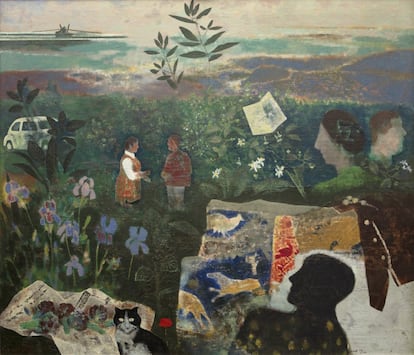
The death in Madrid of the painter, engraver and musician Manuel Alcorlo (Madrid, 1935) deprives Spanish artistic vitality of one of its most humane and talented protagonists. With a prodigious plastic imagination, he enjoyed such a broad artistic personality that he did not see himself assigned to or abducted by any pictorial school. His works combine a happy syncretism of styles unified by a legacy of erudition and classicist sensibility. The excellent draftsman, who was 91 years old, considered “drawing as an essential framework for Painting,” as he confessed. He knew how to deploy with pleasant ease all the kinetics that the tectonics of drawing provides to Art. A connoisseur Conventionalism would define him as a figurative painter with an expressionist style, to whose work he added flashes of refined surrealism.
Manuel Alcorlo was born in the lobby of the Hotel Inglés, the best in Madrid in its time, located in Plaza de Las Cortes, 11, a heartbeat from the Prado Museum, of which he would become a regular and fascinated visitor. Her father was a hotel waiter and her mother, with three other children, worked as a nanny for the owner’s children. Suffering from a limp that made him spend much of his childhood in bed, an avid reader since then, Manuel avoided the fate that, as a lame and poor child in the Spanish post-war period, awaited him: that of becoming a cobbler, a task to which crippled infants of the same social status were then forced, as he stated on different occasions.
At a very early age he began to draw on brown paper, whose rigid rusticity already succumbed to the enduring vividness of his genius as a draftsman. So much so that in a Franciscan school on Las Huertas Street where he studied, one of his teachers, trained at the Institución Libre de Enseñanza, upon realizing his talent, absolved him from studying Mathematics so that he could devote himself to drawing. He took it from life both in nudes at the Círculo de Bellas Artes in Madrid and at the Retiro Zoo or at the Museum of Artistic Reproductions, at the time located in the Casón del Buen Retiro. It was there that he was imbued with the serene grandeur of Greek and Roman statuary. Likewise, he acquired the love of immersing himself in museums, from where he would extract the information with which to increase the sensitivity that he began to freely pour into his works, oil paintings and engravings, characterized, at times, by updated social transcripts, peppered with humor and the finest irony. His artistic vocation, seasoned by an extensive literary training and a refined musical sensitivity, would crystallize in an expressiveness full of originality and freshness: those dimensions whose fusion religions call grace and secular thinking defines as pure vital harmony.
A student at the School of Arts and Crafts, then at the Royal Academy of San Fernando, his first exhibition dated back to his 20s. He did not sell a single piece then; but, shortly after, it was consecrated at the Ateneo de Madrid with another exhibition, this time successful. His credit gradually increased and his uniqueness attracted, even then, a devoted clientele.
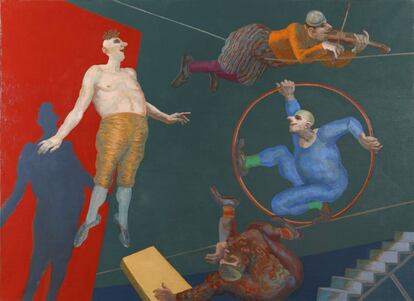
In 1960 Manuel Alcorlo obtained a scholarship as a pensioner at the Spanish Academy in Rome; Upon his arrival, he was so impressed by the beauty that he contemplated from his bright attic, that he was paralyzed for a time, barely able to pick up the brush. The Navarrese architect Rafael Moneo was his companion, with whom years later he would coincide at the Academy of Fine Arts of San Fernando. He agreed to it at the proposal of academics Luis García Ochoa, José Hernández and Antonio Gallego, with an entrance speech related to the artistic imagination of the poet and thinker Francisco de Quevedo. Alcorlo confessed himself indebted to Piero della Francesa, Andrea Mantegna and Francisco de Goya, to whom he professed unrestricted devotion. He was thoroughly familiar with German Expressionism and French Surrealism and Impressionism. He illustrated with superb engravings books by princes of letters in Spanish such as Guzmán de Alfarache, Jorge Manrique, Antonio Machado or Pablo Neruda, among others.
Delegate of Drawing at the Academy, he taught this discipline in courses during which, while his students drew, he played pieces by Bach or Mozart on the violin. The Japanese University of Nara required his services as a teacher and from there he brought the influence of the Japanese artists Hiroshige and Hokusai, from whom he took the pictorial love for flat colors and decorative staging, as the Madrid painter acknowledged in conversation with Vanessa García Osuna. As an engraver he considered himself a disciple of Dimitri Papageorgiu, whom he would help to settle in Spain. Alcorlo took his art to the main halls of Madrid, Rome and Vienna, among other European cities.
Work with symbolic load
“His works were endowed with a singular symbolic load,” according to his colleague and academic at the Royal Academy of Fine Arts of San Fernando, José María Luzón, with whom he met every Monday, for twenty years, in the 18th-century palace on Madrid’s Alcalá street; “He stood out for his affability, his natural friendliness and his good disposition.” And he adds: “as a draftsman, he was capable of achieving everything he set out to do with the line, with which he played, impregnating his works with a singular symbolism, absolutely excellent and his own.” For the cartoonist Manuel Junco, “he was an admirable figurative artist, taking on innovative challenges from classicism.” According to the cartoonist and painter Enrique Cavestany, president of the Association of Plastic Artists for six years, “Alcorlo was an endearing person, always willing to lend a hand in any collective initiative that was proposed to him,” he says. “His style was uncatalogable due to its originality, which went beyond the limits of any school. Despite the risk that figurative artists took of being eclipsed by the powerful innovative blow that the Spanish Art gave in 1958, El Paso group, Alcorlo created his own imprint thanks to his unique artistic personality because he was, in truth, an academic in the classicist sense of the term.”
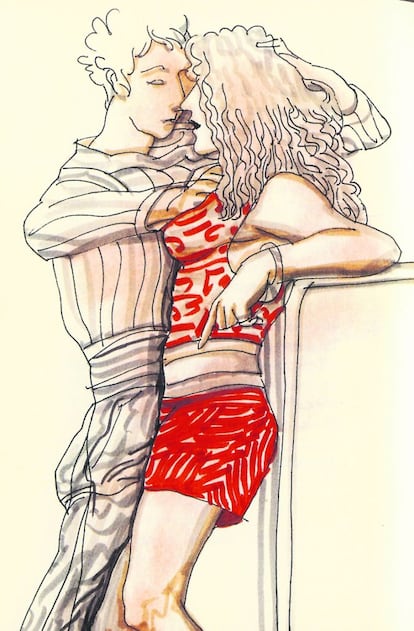
Among his most notable and close works are the fresco paintings on the ceiling and arches of the church of San Nicasio, an architectural jewel by Ventura Rodríguez, located in the Madrid municipality of Leganés. Despite his pronounced limp, Alcorlo spent six months painting them, perched on a scaffold seven meters above the floor of the temple. “Sometimes,” he confirmed to this journalist, “I tied the brush to the end of my cane so I could reach the farthest corners of the ceiling and arches.”
Manuel Alcorlo has been married to the painter Carmen Pagés for 58 years. She recognizes “the joy of having lived all this time by his side.” They have had two children, Paloma and Martín. In Cadalso de los Vidrios, where the couple spent time, the naive painter Berta F. De Pablo highlights the emotion she felt upon meeting them, “because of what I learned from both of them and because of the emotion that two painters like them aroused in me, who since I had the use of reason I wanted to dedicate myself to painting.” And he adds, “the portrait he made of my brother Enrique shows the greatness of Manuel as a prodigious draftsman.” In the painter’s studio, at 100 Hortaleza Street in Madrid, the entrance hall to the portal displays his self-portrait, a gift to his neighbors, effigyed in the same place where the work, two meters high, is exhibited. Already in his seventies, he wrote two books, The woman and the vampire (2010) and two years later, White Letter to Joan Guinjoan. Since the coronavirus pandemic, in 2020, his frenetic activity was reduced: due to a back ailment, he painted sitting in front of the easel. A journalist stated about him that, “his paintings and engravings always preserve the innocence of nascent religions.” By family decision, his funeral was held in the strictest privacy.