
Francisco de Zurbarán (Fuente de Cantos, 1598-1664) was an artist appreciated and valued during his lifetime, for whom the future held the enormous shadow of the Council of Trent and his two brilliant contemporaries, Diego de Velázquez and Bartolomé Esteban Murillo. The painter who used beauty to visually transmit the dogmas of a Catholic Church that launched the Counter-Reformation, to stop the Protestant threat, was swept away by the obscurantist legend that tarnished the Spanish Empire itself. And the desire of foreign collectors for the brilliant composition of Velázquez or the seductive naturalism of Murillo cornered a master to whom the National Gallery in London has now decided to do justice.
The exhibition Zurbaranwhich will remain open to the public in the British capital’s art gallery from May 2 to August 23, brings together almost fifty works by the painter from Extremadura (and a universal Sevillian, for his devotion and work for this city) and offers a contemporary and fair perspective of an artist who knew how to innovate and capture a religious symbolism that today represents a new artistic dimension.
Zurbarán works in the time after the Council of Trent. Much of the reason why all of his commissioned works are religiously motivated has to do with the Church’s express purpose of using art as a vehicle to spread the faith. I needed the paintings to be powerful, to hit the viewer. I needed to tell stories to people who couldn’t read. They had to have that visual force,” Francesca Whitlum-Cooper, a specialist in Late Spanish, Italian and French Painting at the National Gallery and one of the curators of an exhibition that has taken the museum team several years to have ready, explains to EL PAÍS.
The exhibition begins with an emblematic painting, The Crucified Christ, a work that the master gave to the Dominicans of the Convent of San Pablo el Real, in Seville, along with almost two dozen paintings with scenes from the life of Saint Dominic and other saints. Zurbarán carried out many other crucifixions throughout his career, but this first one established him as the artist whose work was claimed by all the religious orders of the city, the richest in the world at that time, as the Gateway to the Indies for trade with America.
The Christ appears illuminated, with an exquisitely detailed anatomy and a dying face, on a dark background that highlights the contrast of light and builds a powerfully modern and minimalist image. “Zurbarán is not an artist who spends too much time establishing a landscape or contextualizing his images. He is above all interested in the power of painting,” explains Whitlum-Cooper. The artistic chronicler Antonio Palomino says that the painting, which remained displayed with poor lighting in the oratory of the convent’s sacristy, led many believers who went there to think that it was a statue. Zurbarán learned early on both to sculpt and to paint, and his characters have a powerful three-dimensional presence that seduces and hypnotizes the viewer, despite the fact that his critics have always reproached the artist for his apparent inability (or lack of will) to provide dynamism to his compositions.
“They were paintings made for people who professed a strong Catholic faith, something that does not necessarily correspond to the public that now comes to the National Gallery. But the more I look at them, the more convinced I am that, whether you have faith or not, they are paintings that invite you to stop and spend some time in front of them,” defends the curator of the exhibition. “That makes them something magical in a world like the one we live in, unstoppable and noisy. They are static paintings. They are not like the works of Velázquez. They do not blink, they do not move. They are monumental. They force you to pause, a moment of silence and peace.”
Fabrics and still lifes
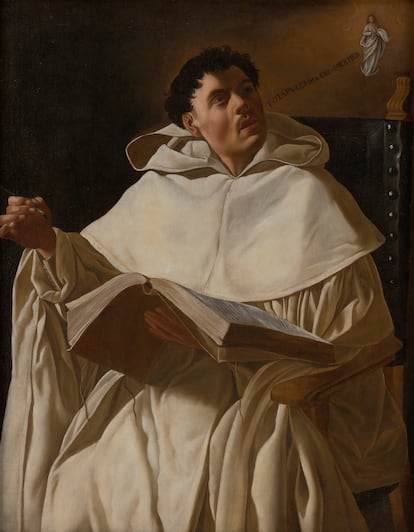
Zurbarán’s father was a fabric merchant, and his son acquired knowledge about the texture, colors, embroidery, folds and falls of fabrics that he later captured in his works in an exquisite way, both in the sobriety or poverty of the clothing of saints and monks and in the tinsel of saints and princesses.
He has been called the “Spanish Caravaggio”, because his central works, such as the different scenes of Saint Francis of Assisi meditating, participate in the technique of Italian tenebrism in which light and shadow build the architecture of the composition. But if the brilliant and quarrelsome Milanese painter, who was born 26 years earlier, sought to freeze dynamic scenes, Zurbarán pursues an immobile, eternal and inspiring beauty. Flee from the macabre, as his masterpiece expresses, Saint Serapiowhich reflects the martyrdom of the Mercedarian friar, tortured in Algiers in exchange for the release of Christian captives. He was dismembered and beheaded, but the artist chooses to depict a pure, sweet and peaceful figure of the martyr, whose tied hands and slightly swollen forehead are enough to symbolize his torment.
The exhibition dedicates a room to Zurbarán’s prodigious still lifes. His followers wanted to see the religious symbolism that, according to them, must necessarily be hidden in the paintings of an author dedicated to spreading the faith, but perhaps, suggests Daniel Sobrino, another of the exhibition’s curators, it was only a matter of demonstrating the extraordinary technical and artistic skill of his hands. “Because what we see in this painting that offers a perfect balance is what critics already discovered in the 1920s, and which they immediately associated with the paintings of Cezanne and Picasso: the purpose of reducing nature to its simplest and freshest elements,” explains Sobrino in front of Still Life with Lemons, Oranges and a Rose.
The room dedicated to still lifes also brings together the still lifes of Juan de Zurbarán, the painter’s son, who bordered on mastery in this type of compositions before the plague that devastated Seville in the mid-17th century took him away at the age of 29.
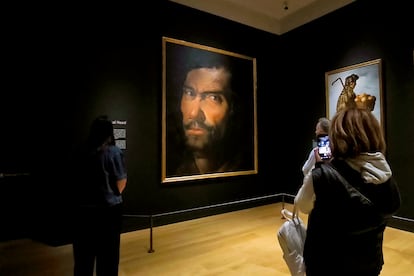
Some of the works from his time in Madrid appear in the anthology, to work alongside Velázquez in the service of Philip IV. It stands out, due to the mystery surrounding its authorship, the Colossal Headan immense face that adorned the stairs of the Buen Retiro palace in Madrid, about which hardly anything is known, neither regarding the character nor the possible theme of the work, which experts consider to be by Zurbarán.
In a landmark exhibition that marks the National Gallery’s main event in 2026, two works stand out from the rest. Agnus Deior Lamb of God, the piece chosen for the exhibition poster, is the best of the seven paintings by Zurbarán that are known for this reason. A Merino sheep, legs tied and ready for sacrifice, looks up with longing eyes. The texture of its wool is of such technical precision that it invites the viewer to reach out to caress it.
and the Crucified Christ with a painterwhich shows the deceased Christ on the cross and, at his feet, an artist with his palette ready, his lips parted in amazement and ecstasy, and his gaze devoted to the spectacle of the Passion. Hardly anything is known about Zurbarán’s personal life, and many want to see his only self-portrait in this work. But even if it is not, it is a more intimate and symbolic representation of Zurbarán, and his vital purpose of transmitting the transcendent through the beauty of art.