
A smiling sun that says: “Nuclear? No, thanks”; the white handkerchiefs of the mothers and grandmothers of the Plaza de Mayo, and the green ones, a symbol of the fight for the right to abortion in Argentina; a flag with six stripes: red, orange, yellow, green, blue and purple; a white coat with a graffiti: “Public health”; a banner that exclaims: “Manolo, you make dinner yourself!”… All, recognizable symbols of social movements, some with many decades of experience. These claims are part of history, the one that citizens build, not the one that is written in the centers of power, from the officials. A memory that deserves to be saved, cared for, disseminated and recognized. With these objectives, the Historical Archive of Social Movements (AHMS) emerged in 2021 in Spain, although it was not until 2025 when it got underway with the appointment of its director.
In February of last year, Marta Hernangómez Vázquez joined her position and with five other professionals from the State Archives they have been shaping the ninth and youngest of the archives managed by the Ministry of Culture for just over 12 months. The only one constituted by the documentary heritage generated and preserved by entities and associations of a political, union or religious nature, that is, by civil society. The one who ensures the good conservation and durability of the materials that generate social transformations, from a CNT badge to photos of the construction of the Madrid neighborhood of Orcasitas; a letter of condolence to Ethel Kennedy, the widow of Robert F. Kennedy, from the Friends of Unesco Club, or the recordings of Clandestinea documentary of 10 interviews with key women in the feminist struggle, one of the latest additions to the AHMS funds, which has announced the creation of the Women’s Archive to safeguard the documentation of those who were fundamental to history.
The most significant thing about this organization is that it is a citizen archive; They even have a form posted on their website so that anyone who believes they can provide relevant documentation can communicate it. Unlike other archives, such as the General Administration (AGA), whose funds end up there because they are obliged to remain there. AHMS funds arrive voluntarily, that is, no group has the duty to deposit what they keep here. For this reason, in addition to the objectives stipulated in the heritage law (recover, organize, preserve and disseminate the memory of social movements), others are also owed: generating trust, seducing and making themselves known among the owners of documentation that may be part of this archive. Work carried out by the director.
Hernangómez, based on a census of organizations they created, visits associations to show the benefits of having their heritage become part of the funds of the state archives. Above all, it ensures durability, security, dissemination and recognition, in addition to putting them in relation to those of other groups. The archives of relevant figures in the transformation of society are also the object of the AHMS, such as that of the photographer Carlos Melchor Pujolat, who until his death in 2024 documented mobilizations in favor of Palestine, against sexist violence, against the impunity of Franco’s regime, for decent housing… Or that of Salce Elvira, a leading trade unionist who was active in CC OO, whose personal archive was donated by his sister. The unions are a potential source of the AHMS, not in vain the first thing that came in was the May 1st Foundation fund.
The team spreads its passion for work, for building a repository of memory, a public service whose purpose is to rescue citizen history. They go from speaking with acronyms and technicalities to mentioning words like “seduction” and “passion” or using colloquial language to describe their work: “Opening boxes.” Boxes full of surprises. In them you can find any unexpected document and object. So when a new collection comes in, they open it, describe it and reinstall it, that is, they adapt it to archival regulations – no staples or clips, for example -, respecting the original organization, because, as they explain, it always responds to something that must be taken into account.
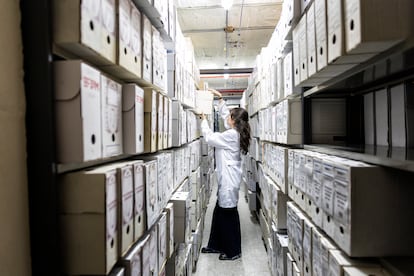
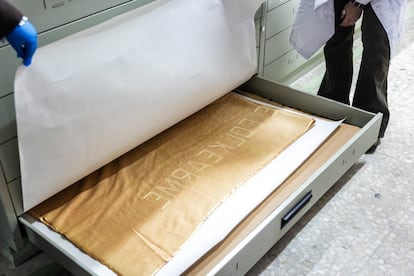
They show their space: some rooms and warehouses inside the building of the General Administration Archive (AGA) in Alcalá de Henares (Madrid). Being located in this place provides them with the security and conservation conditions that documentary heritage requires. In the warehouse area, the areas are divided into watertight compartments, so that if one suffers an accident, it is isolated and does not affect the others. “Water and fire are the most dangerous,” says Hernangómez. On the shelves there are mainly cardboard boxes, also tubes with plans and posters. Keeping them rolled up “is not the best way, but it is not the worst either, the ideal would be for them to be stretched out on flat planes,” explains Natàlia Gregori Vayá, in charge of preventive conservation work. She adds that it is important not to separate them from their context until all the elements described are there.
Specifically, it refers to those that contain the plans of Orcasitas, which arrived at the AHMS last November with the entire archive of the historic neighborhood association of the neighborhood, founded in 1970. This, like others of the same nature, was an example of the claims and achievements of the neighbors who in the fifties and sixties left rural life to settle on the outskirts of the big cities. History written in the periphery. These funds were incorporated as a long-term loan (five years), which is technically called bailment, which can be for five, 10 and 15 renewable years. This and donation are the most frequent forms of income. In this year of life, only one archive has been purchased, the history of the Communist Movement.
And what do those boxes full of surprises contain? Lighters, pens, accreditations, badges (an infinite number of them), stickers (with the difficulty of conservation that they entail due to the glue and the types of paper), glass photographic plates from 1937 (the oldest things they preserve are funds dating from the time of the Civil War), slides, audiovisual material. All types of documents, many clandestine: correspondence, minutes, propaganda, photographs, periodical publications, for example those of the Conscientious Objection Movement. Papers of different qualities, but with one characteristic in common: they were not made to last, but to reach the maximum possible population; Therefore, the important thing was cheap multiplication, so the papers were not good. That they were part of history is something that emerged later. Textile objects are also common: t-shirts, pennants, a bracelet from a Belgian brigade member – a piece from the archive of the Association of Friends of the International Brigades, which also contains a script for a photo novel about German anti-fascists, among other things -; even a silk flag from the previous fund and a cloth banner from the Feminist Research and Training Center. More than 734 meters of boxes and it has just been born. Yes, archive funds are counted in linear kilometers (the size of the boxes placed one after the other). The General Archive of the Indies is about eight kilometers, the AGA, about 300; and the Historical National, 40, although Roberto Sabater Serrano, one of the archivists, clarifies the comparison: “Perhaps it is not very appropriate since, for example, the Indies was created almost 250 years ago and stopped producing because it was created to preserve the funds of the main institutions of the New World.”
In the future, AHMS will open the researchers’ room. This is another reason for state archives, that everyone has access to them; therefore, one of Hernangómez’s priorities, although he cannot yet set a date. Once these queries are possible, users will also be able to access the oral file they are creating. Taking advantage of the links that are forged with the owners of the archives before they are incorporated into the Social Movements, they conduct interviews that give context to the archive and answer questions that the documents could never answer. The voice and history of the archives, which adds a more human factor to this repository that is citizen memory and historical heritage.