
The players of the Spanish soccer team lifting the World Cup in South Africa, on July 11, 2010; Berliners pounding the Berlin Wall, November 9, 1989; a plane with passengers about to crash into one of the Twin Towers in New York, on September 11, 2001… There are three historical moments, and for many people, seeing the photographs that portrayed them brings back memories and feelings. Where was I that day? What did I feel when I saw that photo? Others, younger ones, perhaps were not born when those events happened or do not remember them, but now they will be able to get an idea of what happened.
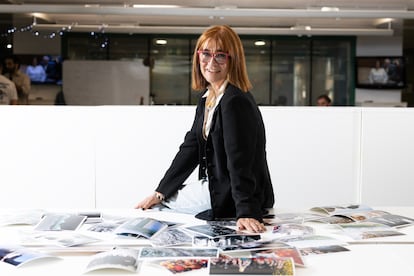
All those sensations will surely be in the minds of those who visit the EL PAÍS Festival during the first three days of next May, a great event in Matadero Madrid with which this newspaper will celebrate its first 50 years of commitment to journalism and its readers. One of the attractions of its programming is the exhibition moments, which has been curated by the photographer and former graphic editor of this newspaper, Marisa Flórez (León, 1948). It has been up to her to choose 50 transcendental images since EL PAÍS was born, on May 4, 1976.
The photographs selected by Flórez can be seen on both sides of some monoliths that will be outdoors, in the Plaza de Matadero, at a size that exceeds two meters wide by one meter high in the horizontal images. Below each one, on a pedestal, the title of the photo and its author will be indicated, and it will also be possible to download a QR code to obtain more information.
“It has not been easy to choose, imagine everything that has happened in the last 50 years in Spain and in the world,” says Flórez at the Madrid headquarters of EL PAÍS while finalizing the preparations for the exhibition, to which he has dedicated the last five months. “I have emphasized that the topics that have been the main topic of news throughout that time and on which the newspaper has invested so much in Spanish and international politics, social life, the economy, sports, science, culture… A testimonial journey of five decades were collected.”
However, for the exhibition, titled MomentsFlórez has not sought a standard summary or prints of the official photograph. “It wasn’t so much about looking for the protagonists. We were more interested in the moments in which something happened that made history.” What is the value of these images? “Their narrative power, each one freezes a moment, an experience.”
“It is not an exhibition about photographers either,” he adds, “it is about showing EL PAÍS’ point of view of what has happened this half century and, in some way, it also tells the life of this newspaper.”
This tour of recent history can be done freely until capacity is reached at the EL PAÍS Festival venue in Matadero Madrid, during the hours in which it will remain open, from 9:00 a.m. to 8:00 p.m. In addition, each of the three days there will be a guided tour with Flórez. This visit, in which Flórez will tell how these images were taken and their importance, will begin from the Matadero information point, on Paseo de la Chopera, 14. On Friday, May 1, it will begin at 12:30 and on Saturday, the 2nd, and on Sunday, the 3rd, at 11:30. After Matadero Madrid, the exhibition Moments New stops are planned in Barcelona, Bilbao, Seville, Vigo, Gijón, Zaragoza and Málaga.
In this visual tour you can see, for example, the spectacular image of CERN, the largest particle physics laboratory in the world, which is near Geneva; a barge seen from the sky in which people are crowded who are risking their lives in the waters of the Mediterranean in search of a better future; or the tennis players Rafa Nadal and Carlos Alcaraz together and in profile, as a couple in a doubles match showing the same gesture of courage.
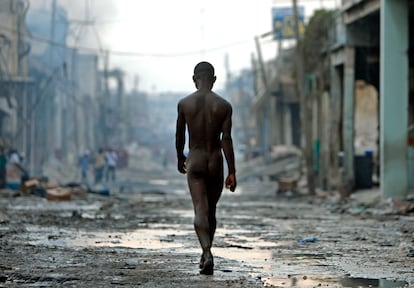
“In each image that I have chosen, different things are told,” says Flórez, of whom you can see, for example, that of the actress Susana Estrada showing her breast at an awards ceremony with the socialist politician Enrique Tierno Galván, in 1978. A snapshot that symbolized openness and the change in social customs in Spain. Another scene reflects one of the great moments of the Transition, when the poet Rafael Alberti and the historic communist leader Dolores Ibarruri, Passionflower, They descended the steps inside the Congress of Deputies, on the first day of the democratic courts, in July 1977, among the surprised looks of the other deputies.
Of the fifty photographs, Flórez estimates that a little less than half are authored by EL PAÍS photographers: thus, along with hers you can see those of Ricardo Martín, Joan Sánchez, Ricardo Gutiérrez, Cristóbal Manuel, Alejandro Ruesga, Luis Magán, Manuel Escalera, Carlos Rosillo, César Lucas, Álvaro García, Alfredo García Francés, Gorka Lejarcegi and Samuel Sánchez. From other agency photographers or freelance James Natchwey, Emilio Morenatti and Goran Tomasevic stand out.
After a last look at the photographs he has selected for the exhibition, which is sponsored by Telefónica, on paper copies, Flórez is clear about what he would like the people who stand in front of these images and stop for a few seconds to contemplate them to feel: “I would love for this exhibition to faithfully reflect the newspaper that has accompanied those readers in their moments of joy and sadness. That has accompanied them in their lives.”
All the information about the EL PAÍS festival in www.festivalelpais.es