
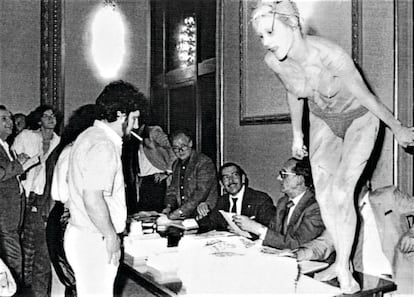
At the beginning of the eighties, after the Spanish Transition and in the final stretch of the Cold War, in the center of Madrid the opening to the public of the Círculo de Bellas Artes was planned, a cultural space that had closed its doors with the Civil War and, during the Franco dictatorship, had practically become a gambling casino. To take on the task of the new cycle, a group of artists from different disciplines were called to form the board of directors: the sculptor Martín Chirino as president, accompanied by some such as Lucio Muñoz, Rafael Canogar, Juan Genovés, Basilio Martín Patino, Tomás Marco and Pedro García Ramos. In addition, for the first time women joined, including Marisa González, Josefina Molina, Amalia Avia and Carmen Hermosilla. The new board took office on May 7, 1983, governed by Chirino’s directives to convert the Circle into a “center for the protection of the Fine Arts and a public utility entity, promoting the arts in general and giving it the character of modernity necessary for change to take place.”
100 years after the inauguration of the Alcalá 42 building, the Picasso Room presents Hatchingthe exhibition that covers the decades after the opening of the Circle with archival material, videos, paintings, photographs and audios that total 480 pieces. Olivia María Rubio, the curator, dedicated about a year to reviewing more than 9,000 elements that tell the story in an exhibition open to the public until May 10.
For Rubio, this exhibition is not about art, but about history. It has been a job to recover that of the Círculo and those who have made the project possible. For example, about women: “I have taken into account that there is representation of women in everything, because there was, I am not making this up.” Also the enhancement of the coordinating team, which often acts from the shadows. “I believe that this institution was the first school for cultural managers in Spain.”
The resurrection of the Circle was not easy. In addition to decades of censorship and dictatorship, and a stalled development of national culture, there were debts to settle and a building to recondition. “This was ruined,” says Rubio at the beginning of the tour. But there was plenty of intention. The doors opened with the Resurgence Festival on May 31, 1983, where around 4,000 people attended according to the press of the time. “It became a symbol of the cultural transformation that occurred in our country with the coming of democracy,” explains the commissioner.
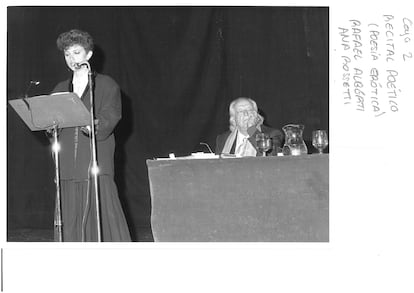
A short walk away, the walls of the Picasso are filled with black and white photographs—almost all taken by Enrique Castellano, the Círculo’s photographer at the time—, showing all the cultural personalities of the time. In one of them, Rafael Alberti appears in the Erotic Poetry Recital accompanied by Ana Rossetti, in an image accompanied by the sound of the poem through headphones. Others include Javier Vallhonrat, Julio Le Parc, Pilar Miró, Gabriel García Márquez, Pilar González España… Rubio sums it up like this: “Over the two decades they really managed to get all the great intellectuals, artists, essayists, theater directors, film directors to pass through here… It was impressive.” Everyone wanted to be there, because they surely understood the political and social importance of doing so after a long night in Spain.
In 1984, the first video festival in Spain was held and, in 1985, the first Foco photography festival was held. A red and black poster with an eighties aesthetic announced the first Current Art Workshop, “a great success from the beginning,” says Rubio, where teachers from different areas took courses in close relationship with their students. In that version, for example, the names were Alfonso Fraile, Juan Hernández Pijuán, Antonio Saura, Dario Villalba, Josep Guinovart, Eduardo Arroyo and Pablo Palazuelo. They were years of madness, openness, irreverence, and the Circle managed to incorporate it by becoming a center of modernity and avant-garde where all the names of architecture, cinema, dance, reading and literature, theater, design, music… All disciplines were found in Minerva’s house. “It was that moment when everyone was enthusiastic, willing to do anything, to break molds, to break those structures that had kept them absolutely armored,” Rubio remembers.
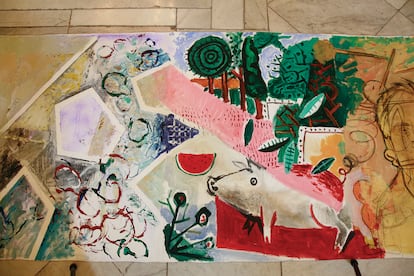
Regarding these structures, 22 artists painted a exquisite corpse 20 meters long and one meter high, on the days Culture and dissidence, the fight for freedoms during the dictatorshipheld from the 17th to the 23rd of 1997. It now appears along an entire wall, where it invites us to identify the painters. “There are some that you distinguish, others it is difficult,” says Rubio while looking at the piece. In the background, a handful of not so legible signatures give them away. Some of them are Alfredo Alcaín, Marta Cárdenas, Óscar Estruga, Abraham Lacalle, Patricia Gadea, Miguel Condé and Mercedes Gómez-Pablos.
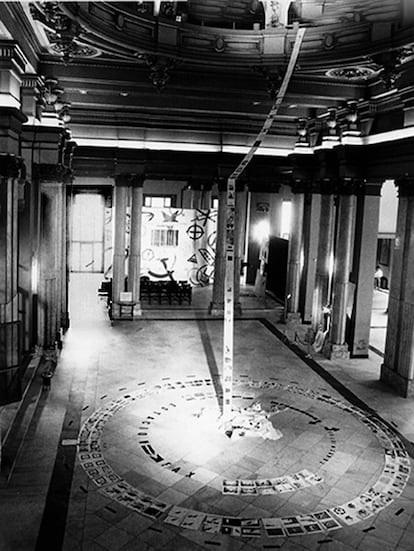
In 1993, while they were going through a great economic crisis and the Circle was once again in financial trouble, they decided to make an open call to which more than 400 projects arrived. Alcalá 42 was taken over for six weeks by artists from all branches in the exhibition Culture Crisis Culture. This is not a crisis. “Every corner was full of performances, photography exhibitions, art, conferences, music, everything.” It was there that Marisa González exhibited for the first time Fax Station – Fax Station. A video projected on a television even shows a young Almodóvar at a conversation table at the event.
One of the tasks that the Círculo set itself in its reinvention was to recover what was truncated by the Civil War and the Franco dictatorship, such as the work of Federico García Lorca or the carnival mask balls. The poster for the 1936 ball was already designed but, in the midst of the political tension, it could not be held. In 1984 they recovered it, identical, in what can be read as an act of reparation with the past.
A space for thought
A projector shows the video of the cycle The body. Scenarios for freedomorganized by Antonio Bernabeu in the midst of the HIV/AIDS crisis. Jean Baudrillard, Julian Barnes, Alain Finkielkraut, Guillermo Cabrera Infante, Susan Sontag, Gianni Vattimo and Pedro Laín Entralgo participated in it. “All of them talking about the body from different perspectives,” says the commissioner. “For me it is one of the great milestones, because by summoning all these characters in Spain, in 1987 and in the Círculo, to talk about such an important topic at that time, it shows that the openness was not only in matters of art, but also in thought.”
The closing of the tour is in a dark room with a few chairs and a video about the program that Arte channel made in the Círculo de Bellas Artes in 1993, days before the elections where the Socialist Party won with Felipe González after facing José María Aznar. The images show some young French people talking about politics on the roof of the building: “You hear them talking and it’s as if we were talking right now. The problem of housing, the problem of corruption, that we don’t want politicians,” reflects the curator, who discovered this record at the last minute and could not leave it out of the exhibition. “It reflects that moment very well. On the one hand, the importance of the circle abroad as a place of reference in Spain and, on the other, the political situation that was experienced.”
Rubio emphasizes the importance of looking back and valuing what has been done: “It is good to remember where we came from, where we have arrived and where we can return… It is important to remember that there is always an attempt, on the part of many people, to resist setback and continue moving forward.”