
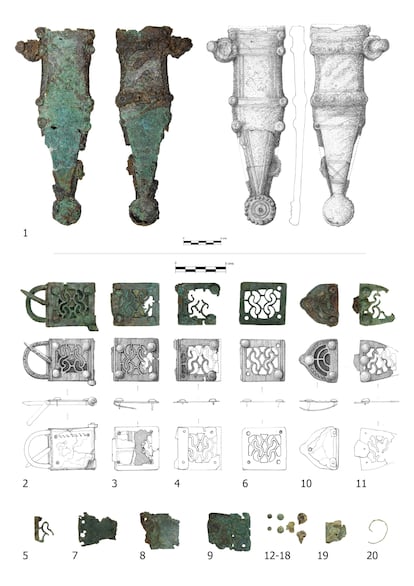
Emperor Augustus was fed up with those tribes in the northern peninsula who resisted the boot of Rome. So he sent his soldiers to crush them. It is the episode known as the Asturian-Cantabrian Wars, which lasted between 29 BC. C. and 19 BC. C. Although he finally achieved victory, not everything was a military parade, with defeats against the indigenous peoples. This caused one of his soldiers to be captured by the Cantabrians and sacrificed inside the La Cerrosa-Lagaña cave (Suarias, Peñamellera Baja, Asturias). His body was left abandoned inside the cavity along with his panoply. (This text is an extract from EL PAÍS’ weekly archeology bulletin, ‘Cuatro piedra’. To receive the newsletter, you can sign up here).
Of all the objects he carried, two stood out: the sheath of a dagger and an articulated bronze belt made up of sheets. The curious thing is that this belt had not come from a Roman workshop, but from a Vaccean one, a pre-Roman town in the interior of the peninsula. In other words, the belt that the soldier wore was designed by indigenous artisans, and with later modifications, it ended up becoming the belt that the soldiers of the empire would wear, from then on, the cingulum. That is to say, archaeologists had found in an Asturian cave the father of all the belts of the legionaries and auxiliary troops of Rome.
The La Cerrosa-Lagaña cave is located next to the Deva River on the wall of a small shelter. It has an mouth about four meters deep that gives access to a descending gallery of 60 meters and a 29-meter drop. In 2020, a series of archaeological interventions began there that still continue. “During this time the cave has provided materials ranging from the Neolithic to Late Antiquity. Two periods of use during the Iron Age stand out: the first between the 8th and 3rd centuries BC and the second, between the 2nd centuries BC and 1st AD The panoply located belongs to this last stage.
For Susana De Luis, Roberto De Pablo, Mariano Luis Serna, Ignacio Montero and María Martín, authors of Study of a ritual deposit from the Asturcantabrian wars: the set of the curved-edged dagger from the La Cerrosa-Lagaña cave, as a link between the indigenous dagger belts and the Roman cingulumwhich published in the magazine Spal, the military elements and the remains of animals and humans found in the grotto are “evidence of ritual practices within a liminal space.” That is, the Cantabrians caught a Roman and executed him in a ceremonial act that included placing next to his body the belt, the dagger sheath, a fibula and other objects such as a spear and a razor. However, the interpretation of the soldier’s sacrifice is only a hypothesis, since the dated bone could also belong to an earlier time. However, this panoply would represent for them the enemy, thrown into the depths to achieve the favor of the gods in their war against Rome.
“The belt,” they write, “stands as one of those prototypes of cingulum manufactured by indigenous artisans who were later replicated by other artisans or gunsmiths in the limits of the Empire, most likely, already in the workshops (production centers) associated with the Roman military apparatus. It would be a material sample of a first evolutionary stage towards the cingulum“It is, by the way, the same process that the Hispanic curved-edged daggers underwent – the one that was inside the sheath found -, which gave rise to the famous punch (dagger) Romans.
Experts maintain that the belt found in the cave “would have been manufactured on the Plateau, most likely by indigenous artisans. They would have adapted their curved-edged dagger suspension belt to be more ergonomic and flexible, making shorter articulated plates and replacing the clasp with a buckle, all of this adapted to the way of fighting of the Roman army.” Furthermore, both the metallic composition of the bronze pieces and the decorative motif of the plaques (an animal schematized in a top-down position, as the Vacceans did) point in the same direction: they were made by the indigenous people.
On the other hand, the pod found is in very good condition. Its interior lining is made of strawberry wood. Due to its typology, shape and metallic composition, it was manufactured between the second half of the 2nd century BC and the end of the 1st century BC “It is one of the most modern types of daggers with curved edges. The typological analysis of the belt plates refers to an even later moment related to the wars of conquest of Rome in the Plateau and north of the Iberian Peninsula which, in the case of La Cerrosa-Lagaña, would be part of the wars Asturian-Cantabrian”, say the specialists.
The archaeologists conclude about what was found: “It is proposed that it is the delivery of the enemy’s weapons to the gods, which could have involved the sacrifice of its bearer, with the aim of achieving their favor with the Roman army. The deposit of similar pieces in other caves in the central Cantabrian reinforces their ritual interpretation as acts carried out by an indigenous population that reactivated the use of these underground spaces, thus enhancing the link with the ancestors and perpetuating the perception of the caves as spaces of memory.”
in the bulletin ‘Four stones’Vicente G. Olaya collects stories like these every Monday, in addition to reviewing the latest news from centuries ago. If you also want to be part of the ‘cuatropedreros’ community, sign up here.