
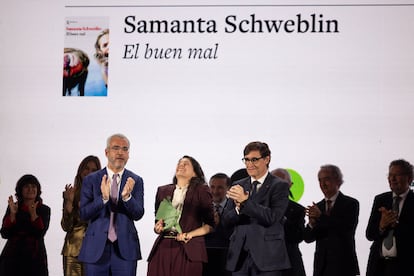
After two months of expectation and much controversy, this Wednesday night it was revealed who has won the first Aena Prize for Hispanic American Fiction. The Argentine writer Samanta Schweblin has been announced as deserving of the million euros by Rosa Montero, president of the jury, at a gala with dinner at the Barcelona Maritime Museum, shortly before the city celebrates the great literary festival of Sant Jordi, on April 23. The name was made public after the dinner, in which some tension reigned and in which the green envelope from Aena, which the jury members deposited when all the attendees were already seated, waited to be opened on a lectern on the stage.
The award recognizes the best title published in the Spanish-speaking world or in co-official languages and translated into Spanish in 2025. Samanta Schweblin has been honored for her novel The good evil (Seix Barral) and has beaten four other finalists, announced on March 18: Now and in the hour (Alfaguara), by Héctor Abad Faciolince; Marciano (Random House Literature), by Nona Fernández; The illusionists (Anagram), by Marcos Giralt Torrente, and Camera obscura canon (Seix Barral), by Enrique Vila-Matas.
The good evil, by Samantha Schweblin (Buenos Aires, 48), is a set of five stories that begins with that of a mother who ties an anvil to her body, jumps into the lake and, after failing to commit suicide, returns home to prepare dinner. Relationships between fathers or mothers and children abound in this “catalog of loneliness,” as Nadal Suau wrote in his review in EL PAÍS, “with the painful addition that the presences that should cure said loneliness are so close.” According to the author, the stories focus on a particular question: “We all know that we are commanded by forces, the ideas of the world, family mandates… Given all these forces, is there one of them capable of putting the others in check? Can we pay attention to what we want and what we are? The protagonists of my stories have managed to touch that moment of change.”
The winner thanked the recognition stating that, for the Aena award, choosing her is “a declaration of principles.” According to the writer, international awards usually reward novels and, “very occasionally, a name like Alice Munro” appears, that of a short story author. “Those of us who write stories run half lame,” said Schweblin, who considered that the prize has taken “a first step in rewarding the exception.” In a nervous tone, he declared that he was “in shock” and acknowledged that “it would have been hard to be in the jury’s shoes.” The author had words of gratitude for her family, for the “very abandoned” public university of Buenos Aires, for infecting her with the reading passion, and for the readers.
In recent weeks, the Aena award has been the protagonist of conversations in the literary sector, both due to the fact that it is promoted by an airport management company, 51% owned by the State, and due to its high financial endowment. The winner and the finalists, who will receive 30,000 euros each, attended the gala after 24 hours of activity in Barcelona, with a meeting with the media and a visit to Salvador Illa, president of the Generalitat of Catalonia. In the relaxed atmosphere of the previous day, all of them affirmed their enthusiasm and stressed that it is a “serious and literary” award, as Schweblin stated on the eve of the award. However, the candidates’ attitude had turned into visible nerves at the beginning of the presentation ceremony.
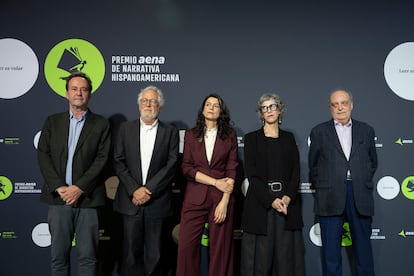
Maurici Lucena, president of Aena, welcomed the attendees, responding very directly to the controversy and confessed a certain astonishment at the lack of understanding of the award: “Since it was presented publicly, a lot has been written and not always with good guidance. Sometimes things are simpler,” he stated. In his speech, the president contradicted Nobel Prize winner Milton Friedman, who considered that the only objective of a company is to make a profit, and spoke about corporate social responsibility: “Societies are imperfect and patronage makes sense to contribute modestly to the support of the general interest.” Lucena insisted that “it is normal for patronage to be carried out by private companies that do not necessarily have anything to do with the cultural activities that they generously finance.”
Although he did not name names so as not to put them “in any garden,” Lucena spoke of the participation of many professionals from the literary sector in the construction of the award. He also thanked the participation of the preselectors and the final jury, composed of Pilar Adón, Leila Guerriero, Luis Alberto de Cuenca, Jorge Fernández Díaz, José Carlos Llop, Elmer Mendoza, Sergio Vila-Sanjuan and Jesús García Calero, as well as the support of the Minister of Transportation, Óscar Puente. Lucena insisted that “the award should not have ideological or editorial interference of any kind.”
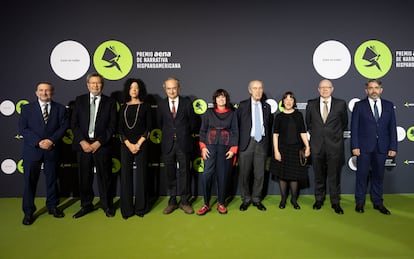
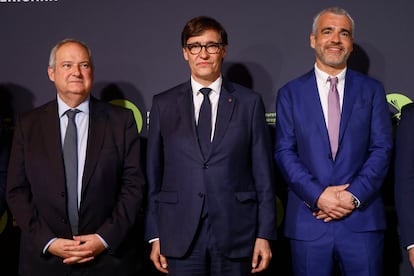
The dinner featured personalities from the world of politics and culture. Among the authorities, the Catalan president, Salvador Illa; Jaume Collboni, mayor of Barcelona, and Jordi Hereu, minister of Industry and Tourism. Also among the audience were Javier Argüello, Paula Bonet, Rosa María Calaf, Najat El Hachmi, Bob Pop, Pilar Eyre, Paulina Flores, Arturo Pérez-Reverte, Carme Riera, Santiago Roncagliolo and Jordi Soler. There were also visible absences, such as that of the management of Grupo Planeta, which had two of its authors among the finalists (Schweblin and Vila-Matas).
The first gala of the Aena Narrative Award was presented by Martina Klein and Josep Cuní, under the direction and production of La Tropa Produce, in charge of organizing events such as the Feroz film awards. One of their most striking proposals was to recreate the five finalist books in the set design, signed by the art director Vanesa de la Haza. The playwright Alda Lozano wrote a monologue in which she revived Josefina, the grandmother of Marcos Giralt Torrente, one of the protagonists of The illusionists, through the voice of actress Nieves Soria. Samanta Schweblin’s book inspired a musical composition that its author, Álex Gassent, performed on the piano. Ryo, the daughter of the protagonist of the Vila-Matas work, was incarnated during the gala as Lola Blasco, actress, playwright and winner of the National Prize for Dramatic Literature. The work of Nona Fernández was present through the live drawing of the “painter” Patricio Hidalgo, and the voice of the Chilean actor and director Benjamin Leiter. AND Now and in the hour, by Héctor Abad Faciolince, set in the war in Ukraine, gave rise to the choreography of the Ukrainian Alina Sokulska.
With the award already inaugurated, there are still many doubts about its continuity or possible changes, since it is subject to any political change. Lucena assured that the annual call will be maintained around Sant Jordi and also the amount of the prize, and also expressed the wish that the location remains in Barcelona. According to Álvaro Colomer, technical director of the award along with María José Solano, it is the intention that the jury changes every year, but it is not clear that this will be the case. On the other hand, it is not yet known how the “thousands of copies” of the five finalists will be purchased, for which Aena will invest more than one million euros and will allocate it to its airports and also to educational and cultural centers in the places where it has a presence.