
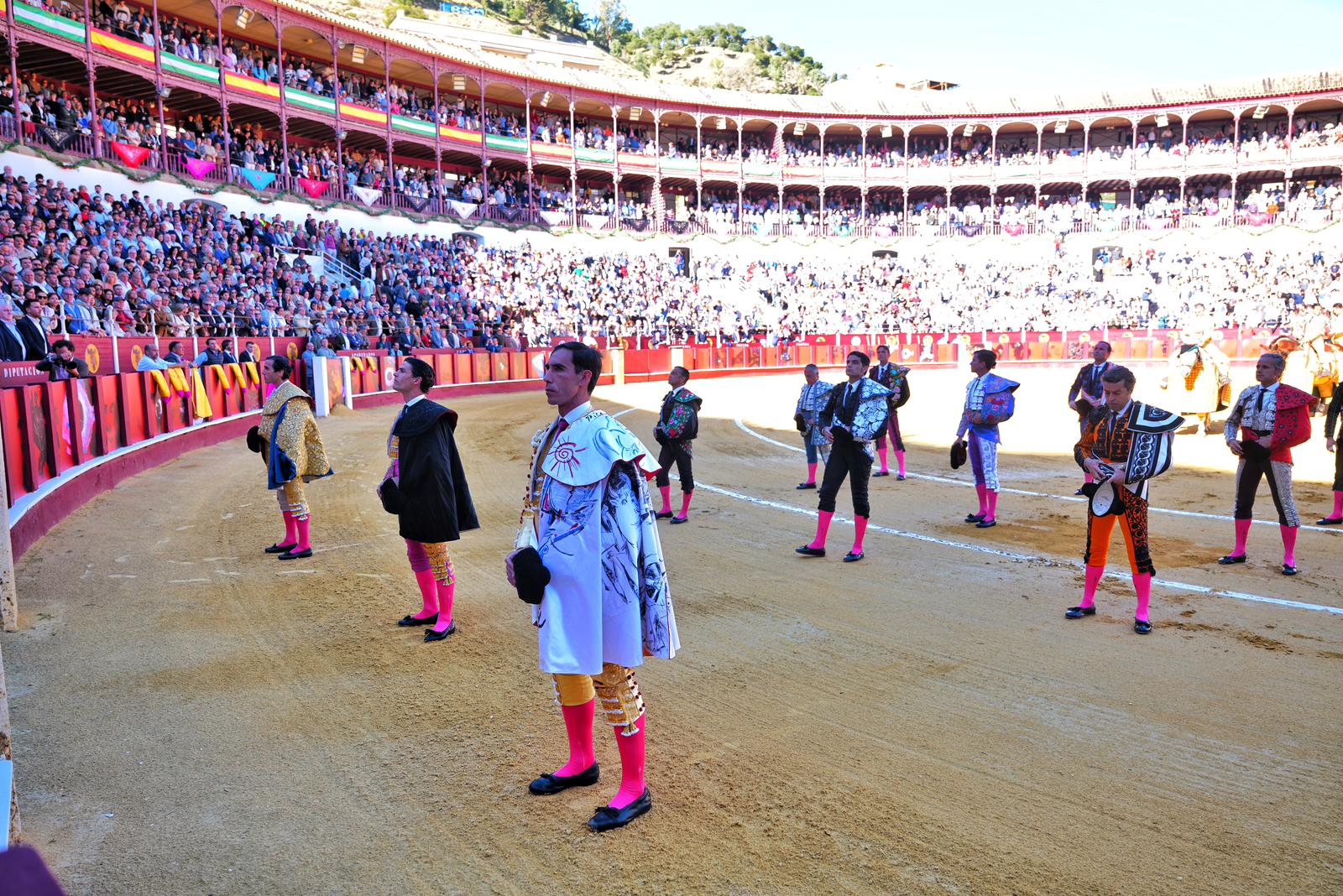
It was obvious that the square was in mourning, sad faces on the streets, and a strange silence while the music band played notes of processional marches to make the wait more bearable. The Paseíllo, without music; a trumpet solo, then, as a funeral prayer, flags at half-mast, black crepes in the arms of the workers in the square…
It was inevitable that the memory of Ricardo Ortiz, the bullfighter who died the previous afternoon while carrying out his duties as corralero with the announced bulls, would be present. A bouquet of white roses was deposited at the bullpen door, where Fortes left his montera before starting to muleta his first bull.
But that melancholy, that sadness over the death of a bullfighter, did not dissipate throughout the afternoon despite the fact that the magnificent Miraflores-Gibraljaire band decided to liven up the muleta tasks of the last three bulls with works by Manuel de Falla, Turina and an Easter march.
It is not that such chords gave rise to joy, but they did not manage to enliven the absence of breed of the bulls that came out into the Malaga ring, lacking in life, dull, lacking in strength and without a hint of class in their guts.
That was the main reason why the emotional memory of Ricardo Ortiz did not bring out an excited smile of good bullfighting.
The bullfight was of no use, and the bullfighters, especially Ortega and Aguado, preferred to remain installed in their comfort zone rather than start a war that was presumed useless.
Better, more spirited at least, Fortes, the bullfighter of the land, very firm against a first opponent without mobility, dull and without rhythm. His was a hard work, of little brilliance, but of plenty of dedication. With the same intention he faced the fight in the room, with little desire to live, very timid, but with more class than his brothers. Thus, while the sounds of Amor Brujo were heard, Fortes drew some natural ones of a certain depth and some graceful ones helped with a knee on the ground.
Ortega slipped when he was trying to catch his lead and got a good scare without any further consequences. The animal was rough and lacking quality, the bullfighter was able to leave details of its category that, again, they knew little about. He gave the public the fifth because he developed mobility and believed that the tables would turn; but it wasn’t like that. The bull adopted a violent attitude and the bullfighter’s work lacked bonding and command. What remains in the memory is a removal of four aprons, a stocking and a revolera.
Aguado, for his part, insisted on bullfighting Veronica, and some emerged temperate, like the ones he drew when receiving the third, a bull without clarity in his charge that did not make it easy for him; The sixth was very dull and the processional march was not the best company for a task that turned out to be insubstantial.
P. de San Lorenzo, El Pilar/Fortes, Ortega, Aguado
Four bulls Port of San Lorenzoand two, first and sixth, of The Pillarfair in presentation and comfortable in appearance; very unequal in the horses, with high faces and without strength, dull, outcast and without class.
Fortes: lying and back lunge (ovation); puncture, half thrust _warning_ (return to the ring).
Juan Ortega: lunge (ovation); puncture and almost whole (silence).
Pablo Aguado: puncture, half a lying lunge and fall _warning_ and two crazy things (silence); two punctures (palms).
Malaga bullring. April 4. Full of ‘no tickets’.
Picassian bullfight with which the events celebrating the 150th anniversary of La Malagueta begin. The boards of the barrier were pictorially decorated by Jacob Vilató, Picasso’s great-nephew,
The Paseíllo went on without music and at the end of it a prayer song was played; The flags were at half-mast and all the workers in the plaza wore black crepe. All this in memory of the bullfighter Ricardo Ortiz, corralero of the plaza, who died yesterday due to being gored while carrying out his work with the bulls announced this afternoon. Fortes offered the death of his first bull to his missing companion.