

“It is a film that clearly reflects me. There is a lot of fiction, but no invention. I am absolutely present and totally fictional. In reality, if I made a film talking about me, it would be very boring. Fiction is always necessary.” This is how Pedro Almodóvar responded to a question from Álex Vicente in The Weekly Country on account of the premiere, today in commercial theaters, of Bitter Christmas, the film in which the filmmaker reveals more of his intimacy and, therefore, is closer to autofiction, a genre that, born in literature, has achieved great success in films and series.
On screen, the story of the filmmaker, Raúl Rossetti (played by Leonardo Sbaraglia), finds frontal opposition from a person close to him using real dramatic events to construct a script. And in this way, Almodóvar himself opens the debate: should autofiction be subject to moral limits? Or can he hide behind his fictional side to legitimize the use of everything around the artist as a source of inspiration? A group of filmmakers and experts reflects on it.
If there is a filmmaker who until now has most successfully explored her past to create an enormous film trilogy, it is Carla Simón. “In my case, more than facts, I have been inspired by emotions,” says the winner of the Berlin Golden Bear for Alcarras “I write without restraint because, if you condition yourself, you are not free. Although I have premises: in Alcarras I wanted to preserve the privacy of my family and decided that it would not be based on any of their stories, and that the film family structure would not be like mine. With Pilgrimage I maintained this starting point, so that no one felt that this character was exactly him or her.” And he thinks the same as Almodóvar: “Reality often doesn’t work. “You have to dramatize it and you have to look for cinematographic images for the story.”
All in all, the woman from Barcelona lets out a laugh: “Summer 1993 It is the most faithful film to what I experienced, and my mother always says that reality is stranger than fiction.” At least, they don’t tell her what Borja Cobeaga confessed to this newspaper at the Malaga festival: “My life as a screenwriter is divided into two stages. The first, in which my mother told me that I was watching everything on the screen; and now, it is my wife who tells me that I watch everything on the screen.”
Before asking other filmmakers, such as Zaida Carmona or Liliana Torres, who are closer to autofiction, it is worth clarifying their definition. “It appears with postmodernism in the 20th century. Although it was the Frenchman Serge Doubrovsky who was the first to use this term to describe his book Children in 1977,” explains Angélica Tornero, professor at the Faculty of Humanities of the Autonomous University of the State of Morelos (Mexico), and editor of the collective book I-graphies: autofiction in Hispanic literature and cinema (2017). “It is a term that argues with two main concepts of the literary theory of genres, already convoluted in themselves, which are the novel and the autobiography. And that makes it difficult for us to conceptually delimit it, because it is born as a hybrid. This reflection is equally applicable to cinema.”
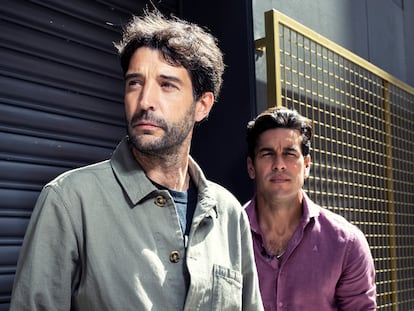
Because in that artistic play the best results are born. Gerard Oms, who was a candidate this year for the Goya for new director, explains that the first part of his Very far It is pure fiction, until its alter ego, played by Mario Casas (also nominated for the Goya for this film), stays in Utrecht. “I wanted to be honest with what I was saying, but I also decided to take care of the people I love and protect them. It made me suffer a lot to think about the reflection of my surroundings. Because my friends and families knew that I was talking about an episode in my life, they were witnesses of that moment.”
That is why Oms believes that there is an ethical issue “obligatory in fiction that reveals real facts.” “And it has to do with honesty and the reasons from which you approach the creative exercise. If it is for exotic or Manichean reflections, I am not interested at all. Not everything is valid for you to take your film home.”
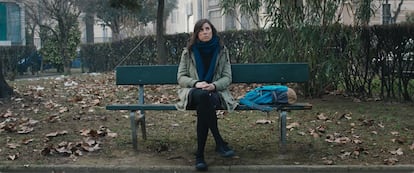
Something that filmmaker Liliana Torres agrees with: “In my cinema there is a line that is more fictional, although with many real elements, like the film Mammal. There I feel free because I have the feeling that no one is going to fully identify with the characters. I don’t ask permission. And then there are the more documentary autofictions (Family Tour o What did we do wrong? in which he examined four ex-partners in his life), in which, with the scripts finished, I read the scripts with the people who were going to be represented and who were going to appear. I didn’t find red lines, although I did find someone who didn’t want to leave, or phrases that they asked me to remove. And I did it.”
For this reason, he insists, “a negotiation comes into play,” so as not to end up asking for forgiveness from, for example, an ex-partner, as happened to the French writer Emmanuel Carrère, king of this genre, after publishing Yoga. Carla Simón provides another case: “Who knows what Arnaud Desplechin’s family would say to the filmmaker after watching A Christmas story…” Or Almodóvar after Women on the verge of a nervous breakdown, released in 1988, since the story of Candela (María Barranco) started from an episode starring a close friend. On screen she says that she has unknowingly fallen in love with a man linked to a Shiite terrorist cell (in real life, an ETA commando), she has helped him hide and she fears that the police will consider her an accomplice. When her friend saw the movie, she said, “How dare you put that on?” Almodóvar defended himself by saying that fiction had transformed everything. His response was: “He will recognize himself”… a phrase that appears in Bitter Christmas. Today he explains: “When I write, I feel totally free. But I also believe that there is a moral sensitivity that lets you know how far you can go. It’s about not hurting anyone. You can’t write your script no matter who falls.”

Zaida Carmona directed, wrote and starred in 2022 My friend’s friend. “My advantage is that it was a comedy, and there the border expands. If you set limits, it stops being honest, right? And for me autofiction is more interesting the more it goes to the bottom. It shows our mediocrity, our baseness… All that we are ashamed of. If you stop, you lose freshness, power and identification.” Although she shared things, “the most problematic,” from the script with the group of friends portrayed, she “sneaked little things behind their backs, because they were very funny.”
Almodóvar has created this identification of filmmaker-person-spectator for decades. Beyond the filmmaker Salvador Mallo (Antonio Banderas) in Pain and glory, Was it Pepa, in Women on the verge of a nervous breakdown? “Yes, totally,” he said in The Weekly Country. Do I read, in The flower of my secret? “Of the most.” And Manuela, in Everything about my mother? “Also, although with nuances. In the great homosexual authors, like Lorca or Tennessee Williams, there is a constant identification with a female voice. The difference is that my characters start from me, but then they become real women. They are never men in disguise.”
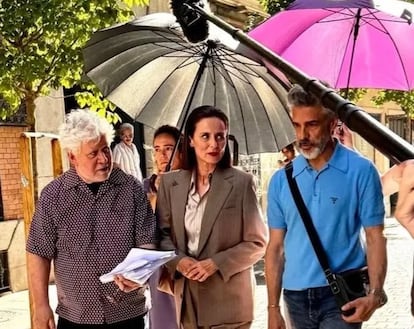
For Professor Tornero Salinas, in this genre, more than in other literary and cinematographic genres, “the receivers” are fundamental. Because “they are the ones who are going to have their different approaches; and some will have more information than others.” And, he adds, “it may even happen that a receiver does not even know that what he sees is autofiction, because the genre moves in ambiguity.”
According to Tornero, autofiction has also served so that groups that did not have a voice or previous references in the novel and cinema could convey their experiences to the general public. “Think about the Anglo-Saxon writers of the 19th century or about groups like the LGTBI or, in Chile and Argentina, about the filmmakers who talk about those who disappeared during dictatorships.”
Carla Simón agrees with this: “We are facing a thematic repair of things that had never been told from our point of view, and I am referring to the directors. It is a step to change the dynamics of the stories, although there is still a long way to go.” That in general, that in particular, Oms and Simón almost use the same words to clarify: “Autofiction also raises questions for those who have experienced real conflicts, and almost always in retrospect They manage to heal the wounds. Movies are not made for that reason, but if they bring this gift, even better.”