

Carmen Linares arrives at the appointment with significant hoarseness. He apologizes. We tell him that for less than that Morrissey would cancel the interview and half the tour. Series. “No, I couldn’t miss this,” he says with a harsh voice that in a few days, once recovered, will shine with depth. The occasion deserves the effort of the singer: for the first time, the Andalusian poses and grants an interview with her entire artistic family. The proposal came from this newspaper and they accepted without much thought. This 2026 we celebrate 30 years of a proverbial album in the history of flamenco, Anthology. The woman in singing, where the singer puts light where there was only darkness: she recreates the songs performed by courageous women placed in the background in a patriarchal context. The singer begins a tour to commemorate the three decades of the album: on Saturday, March 21, she performs at the Price circus in Madrid.
And now it’s time for presentations. Miguel Espín (Ávila, 79 years old), Carmen’s husband, journalist and deep connoisseur of flamenco, author of several series on the genre on RTVE and documentary maker for the Anthology. And the couple’s three children, born in Madrid: Miguel (47 years old), manager from his mother; Edu (41), flamenco guitarist who has played with Los Planetas, Lagartija Nick or Elbicho; and Lucía (38), actress and singer, with her first recent album, A reason to return. Communicating vessels flow between the family: Edu plays the guitar at his mother’s concerts; Carmen sings on her daughter’s album (a sensational The times); Miguel Sr. advises on palos and songs, and Miguel Jr. organizes tours and recitals for the family.
None has inherited the imposing clear eyes of the matriarch, who sits presiding over a table at the Madrid tablao Corral de la Morería, where the meeting takes place. “My grandmother, my father’s mother, had sparkling green eyes. I inherited them from her,” explains the singer, who during the talk will be moved to hear her husband and children compliment her on what she represents as a mother and as an artist. He deserves them. Carmen Linares (Linares, Jaén, 75 years old), vocalist, trained in the tablaos next to Paco de Lucía, Fosforito, Paco Cepero, La Perla de Cádiz or Camarón. Princess of Asturias Award, Latin Grammy for Musical Excellence, Honorary Doctorate from the University of Seville. “But, above all, a singer with great qualities and a great fan and student of flamenco. She has dignified the genre,” says Fermín Lobatón, flamenco critic for El PAÍS.
The seed of the Espín Pacheco family (the singer’s real surname) was sown in Ávila. “My father was a railroad worker and they assigned him there. We arrived when I was 13 years old,” explains Linares. The connection occurred between his father, a great fan and guitarist, and Miguel Espín, another flamenco nut. “I’m from Ávila. All the fans there knew each other. We found out that a family from Linares had arrived with a girl (Carmen) who sang and that her father played the guitar. One day I showed up at their house with my vinyls, to exchange them with Antonio, Carmen’s father. That’s where it all started,” says Espín.

When Carmen turned 17, her father was moved to Madrid and the family moved to the capital, where they have lived since then (Edu, the middle son, now resides in Granada). Miguel lost contact with Carmen until he, already a journalist, began working at the Madrid headquarters of RTVE in 1971. They met again, and until now. Carmen talks about the difficulty of raising three children and at the same time attending to the artist’s hectic schedule, with international tours and weekends of performances: “I remember that one day Lucía told me: ‘Mom, why don’t you be a hairdresser and we’ll set up a hairdresser at home.’ I took my mother’s curlers and she saw it and thought: ‘Better a hairdresser at home than a singer outside,’ she laughs. Lucía speaks up: “I realized that my mother was not in the normal range of my friends’ mothers. We have always been very close, but it is true that sometimes I have felt that my mother took a long time to come. But when I was older I thought about it and said: ‘Wow, my mother has been a heroine. A woman who has supported her family, has dedicated herself to her work and has stood out in music at a time when it was very difficult for female singers.’
Miguel, the oldest of the brothers, served as musical guru for the two little ones. “At home there was always a lot of freedom. My father played his flamenco records, but I also listened to other things: Queen, Michael Jackson, Guns N’ Roses, Nirvana, Pearl Jam, Radio Futura, Antonio Vega, Otis Redding…”, he says. Very popular was Carmen’s blank soup, a great help for her children’s hangovers when they started dating. The singer launches into revealing the recipe: “Fish, rice, onion… Everything well cooked. It gives you a new stomach.”
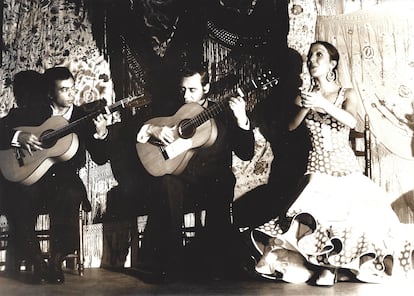
In 1996, when Carmen was 45 years old, the kids only heard one word in the house. “Anthology here, anthology there,” says Edu. And he adds: “I was 13 years old and I didn’t know what this thing was about Anthology. Then I heard I was born in Algiers, the last song on the album, with Tomatito accompanying my mother. I put it on loop. That bulería got me hooked on flamenco and from there I started pulling the thread.”
Anthology. The woman in singing It was in a record company drawer for eight years. The brave and ambitious project scared record executives. Until someone gave it the green light. The fundamental research work was carried out by Miguel Sr., who rescued up to 27 women’s songs: Tía Marina Habichuela, Niña de los Peines, La Repompa, La Trini, La Perla de Cádiz… Themes reinterpreted by the young voice of Carmen Linares with accompaniment by guitarists that takes the hiccups: Tomatito, Vicente Amigo, Juan and Pepe Habichuela, Paco Cepero, Enrique de Melchor… It was recorded for a year. “The guitarists arrived with great enthusiasm, because they knew that something big was brewing. ‘Show me what so-and-so has recorded,’ they told me. And I: ‘I can’t until it’s published, it’s a secret,’ says the singer.
They remember a trip to Paris, the whole family, to present the album in 1997 at the Teatro del Châtelet: “Ten days performing before about 2,000 spectators. With the tickets sold out. In the first part El Güito and Sara Baras performed at the dance, in the second my mother with Moraíto. We did not miss a single performance. And we were very young. That’s when we realized that this album was an event,” the children say.
Anthology It sold 70,000 units, a high amount considering that it is a double album. Among her many achievements, she functioned as a school for young people, paving the way so that subsequent generations of cantaoras would not feel fumbled. There was a light to follow. Rocío Márquez, Ángeles Toledano, María Terremoto and even Rosalía can talk about it. When Edu is asked what his mother represents, he says: “One day they asked Enrique Morente what he thought of flamenco being a World Heritage Site, and he said that it was better the other way around, that humanity should be a heritage of flamenco. My mother goes that way: flamenco always has to be above artists. An artist should never consider himself above flamenco.” Miguel Sr. adds: “Carmen is very brave, very artistic and very beautiful.” An “olé” escapes from the aforementioned woman’s soul.