
They were a film festival, yes, but this Sunday’s were not the Oscars of politics or commitment either. Neither the 14 chaotic months of Donald Trump’s mandate, nor the recent war with Iran, nor the entrenched conflicts in Ukraine or Palestine, nor even the future merger of Paramount and Warner, so much of the industry, were stronger than the glamor of Hollywood and the cinema itself at the 98th awards gala. There were jokes and veiled references, but few explicit messages. The name of the president of the country was not even pronounced at a party where One battle after another emerged as the absolute winner with six awards, including the biggest: best film and direction, as well as adapted screenplay, supporting actor (Sean Penn), editing and the new casting.
stepped on his heels The sinnerswhich with four (out of 16 nominations) was close and took up a good part of the conversation of the evening. It won for original screenplay, best actor (Michael B. Jordan, the most applauded of the evening), photography (for Autumn Durald Arkapaw, the first woman to achieve this) and original soundtrack. Frankenstein It was done with three (makeup and hair, costumes and production design). The Spanish Sirât, by Oliver Laxe, He did not achieve either of the two he was opting for. The K-pop warriors they achieved two (animated film and song, for Golden) and one was for F1 (sound, the one I was looking for Sirât), another for Valor sentimental (international film, also wanted by Sirât), another for Hamnet (best actress, Jessie Buckley) and another for Weapons (best supporting actress, Amy Madigan).
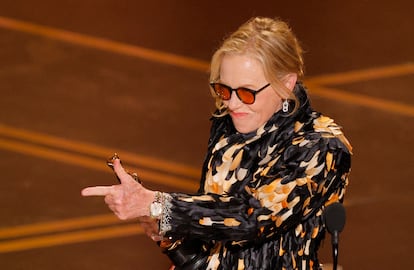
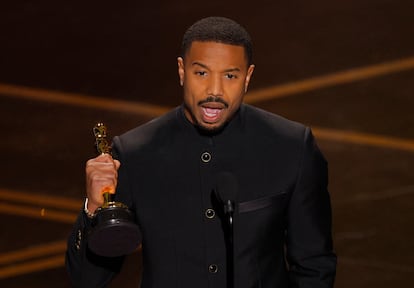
Precisely for Madigan it was the first prize of the night. The oldest in the category, for her already iconic role of Aunt Gladys in Weapons, I couldn’t stop laughing. “My legs are shaking!” he said, happy to take “the little golden man” home 40 years after his first nomination. After Sean Penn’s, in between and which he did not pick up (“he couldn’t or he didn’t want to”, as Kieran Culkin said when delivering it), those of leading performers were left for last. First, best actor, the big question of the night. It was for Michael B. Jordan, who brought the audience (and the press room in his wake) to their feet after beating Timothée Chalamet. “God is good,” he began. To continue: “Hello, mom.” He thanked the director of The sinnersRyan Coogler, whom he thanked “for being able to call a friend and collaborator.” “I’m standing here for the people who came before me, Sydney Poitier, Denzel Washington, Halle Berry,” he listed, naming some other black actors who won before him, as well as his ancestors.
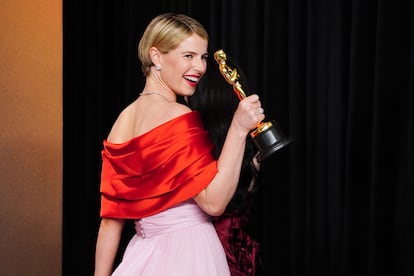
Then came the Irishwoman Jessie Buckley. His name could have been engraved on the Oscar for months: for his precise performance and because he has won everything. She told her husband: “I want to have 20,000 children with you.” He thanked Chloé Zhao and the author of HamnetMaggie O’Farrell, and remembered her eight-month-old daughter: “I would like to dedicate this to the beautiful chaos of a mother’s heart. We all come from a lineage of women who continued to create against all odds. Thank you for recognizing me in this role. It is a great honor.”
Buckley was the first Irishwoman to win in her category. There were a few first times. Many of them female. That of Madigan, who took his first statuette after 40 years of his previous nomination. That of Arkapaw, the first woman winner in the best photography category, who asked everyone present in the room to stand up, because, she stated, without them she would never have gotten here. They did it. That of Anna Wintour, former director of Vogue and grand dame of global fashion, presenting two Oscars (costume and makeup and hair, both for Frankenstein), and joking with Anne Hathaway. Or the prize for the best castinga new Oscar for the first time in 25 years (next year there will be another, for best stuntman). “We celebrate your magnificent invisible architecture,” Gywneth Paltrow told the nominees; It was won, with some surprise, by Cassandra Kulukundis, for One battle after another. That of the president of the Academy, Lynette Howell Taylor, in her first year in office, who stated: “We all need the joy of movies, to connect us with our experiences and to change our perspectives.”
There were also situations, if not unique, little seen. For the seventh time in the 98-year history of the Oscars, there was a tie. It was in the category of best fiction short film. The last time it happened in 2012 (in sound); the first, in 1931-1932 (as an actor). Furthermore, Sean Penn did not appear to collect his third Oscar, although he had gone for the previous two (for My name is Harvey Milk y Mystic River). And there were a handful of reunions: those of actors from Marvel and of The Mandalorianof the Pullmans (Bill and Lewis, father and son), those of the protagonists of My best friend’s weddingwhich celebrated 15 years of comedy; and those of Moulin Rouge, Ewan McGregor and Nicole Kidman, celebrating, even breaking into song, the 25th anniversary of the film.
The audience had a moment of great emotion and communion. This year, the in memory It was very special. The murder of director Rob Reiner and his wife, Michele, in mid-December (their youngest son is the only one charged), deeply touched the heart of Hollywood. Hence his close friend Billy Crystal came on stage to talk about him, his art and, above all, their friendship for decades. “They fought together for the injustices of this country,” he said of the Reiners. “They were the driving force behind equal marriage rights in the United States,” he said. “Their loss is immeasurable,” he added. “For those of us who had the privilege of working with him and knowing him, all we can say is: ‘Dude, what a great time we had storming the fort.’” To top it all off, some of the actors who worked with him came out on stage, from Meg Ryan to Cary Elwes, Demi Moore and John Cusack, up to 17 stars and friends, shaking hands.
In a year of great losses came the in memoryin full, remembering Val Kilmer, Robert Duvall, Claudia Cardinale, Diane Ladd, Catherine O’Hara and Diane Keaton, who received immense applause from the public. Even Rachel MacAdams, introducing her colleague Keaton, was moved. And to top it off, Barbra Streisand presented the tribute to her beloved Robert Redford, Bob, as she called him, praising the creation of the Sundance festival, amidst applause. “It was a cowboy intellectual,” she said, with a smile. “Now I miss him more than ever,” she stated, remembering how he always made her laugh, and how they talked “on the phone about politics, art.” “In the last note I wrote him I told him how much I loved him,” she stated. And she started singing a fragment of The Way We Wereof just as we were.
After two and a half hours came the first disappointment for Sirât upon losing the award for best sound, for which he had more possibilities than for best international film. The latter was presented by Priyanka Chopra and Javier Bardem, who took the opportunity to send a message: “No to war. Free Palestine,” he said before giving Norway its first Oscar for Valor sentimental. “All adults are responsible for all children,” said its director, Joachim Trier, quoting the writer James Baldwin, “let’s not vote for politicians who don’t take it very seriously.”
They were two of the few political proclamations of the night. Mr. Nobody against Putin won the Oscar for best documentary film. In the press room, those in charge talked about how filming could have cost them up to 20 years in prison, and they were also asked if they saw parallels between the situation in Russia and the United States. “In the United States it moves faster,” they even said. “Trump moves much faster than Putin.”
In his second year as host, Conan O’Brien threw in some political nods, but not too many. She ripped off like Aunt Gladys from Weaponsrunning chased by the children from the horror movie, but passing through all the movies, from the scene of Hamnet to Benicio del Toro’s car in One battle after another, and even becoming an animated character alongside the K-Pop warriors.
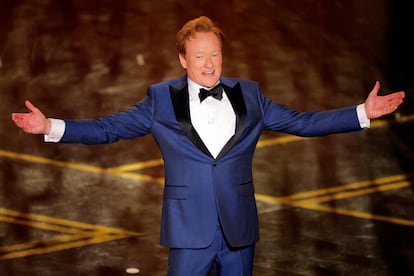
Between humor and criticism, he presented himself as “the last human host. Next year it will be a driverless car.” He spoke of security being “extremely strong this year,” without mentioning the war, and spoke of “the ballet community,” with a close-up of Timothée Chalamet, in reference to the controversial interview in which the actor stated that this discipline no longer interests anyone. “The gala can get political,” he warned. “If you don’t like it, there is an alternative event with Kid Rock,” he said, referring to the Super Bowl, when the Republicans organized an alternative party at Bad Bunny’s halftime. He even ended up imagining himself winning an Oscar, with a cape and crown, in a musical.
O’Brien continued with jokes at the gala, some full of intention. For example, he stated: “For the first time since 2011, there is no British actor nominated.” And he added: “But at least they stop the pedophiles there,” in reference to former Prince Andrew of England and Jeffrey Epstein. He also did not hesitate to criticize Netflix CEO Ted Sarandos, commenting that it was “his first time in a movie theater.”
But the one who got into the most trouble was his predecessor, Jimmy Kimmel, when presenting the award for best documentary short. At the center of the conversation this year after his show was suspended by the Trump administration in September for a week, he said: “At events like this there is a lot of talk about courage, but telling stories that can get you killed is what really has value. As you know, there are some countries whose leaders don’t support free speech…say North Korea and CBS.” He also commented that President Trump (without saying his name) would be “angry because his wife was not nominated,” in reference to the documentary Melaniareleased in January.
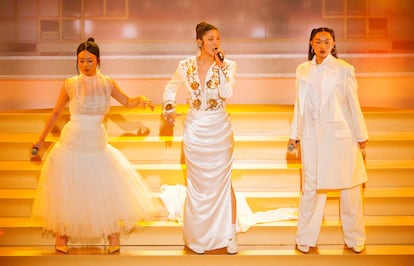
But in the end, it was a gala by and for cinema. Not even as musical as other years: there were only two performances, the one on the soundtrack of The sinners, I Lied to Youwhich brought its evil vampires down to the stalls and made everyone stand up, and that of the K-Pop warriors with their very viral Golden. It was a night for Paul Thomas Anderson, who appeared on stage three times, as best director, screenwriter and for his film, One battle after another. “They will be the generation that will bring us common sense and decency,” said Paul Thomas Anderson about his children, after collecting the award for best adapted screenplay. In the best director category, where he started as a favorite, he thanked the Academy and his nomination colleagues. “I’m here because people have given me their faith and their time, and that’s the best thing about making movies, being with each other.”
And in the last one, for best film, with actress Teyana Taylor coming out on stage first, screaming and hugging everyone, it was correct, fun, emotional. He thanked the actors, especially Chase Infiniti. And he said to everyone: “Let’s take a martinithis is incredible.” And, without wars or presidents, they went for it.