
Los Angeles is far from everything; sometimes even from their own country. For California, much more progressive than the rest of the United States, the war against Iran seems very foreign to it. On the streets of Hollywood, closed for days, the closest comment refers to the price of gasoline, which has doubled in a week (“Eight dollars a gallon?” is heard). Little more. For this reason, on the eve of the Oscar ceremony, which is being held this Sunday under the spotlight around the world, a big question is in the air: will Hollywood dare to raise its voice in the face of the complex political situation that the country is going through, even if it is amidst jokes and sequins, or will it let the show does it develop smoothly?
Everything is to be written. The result can be black or white, but also have a wide gray scale. It is striking in a year in which the two favorite films (The sinnerswith 16 nominations, a record, and One battle after anotherwith 13) are especially critical and address some of the big issues that divide American society today; the first, between music and vampires, highlighting black identity, its ability to tell stories and to be the epicenter of culture and narrative; the second, where a leftist guerrilla tries to deactivate persecutions against migrants – little more in vogue today in the country -, a satire in which humor, race, idealism and pain are also present. It would be strange if no winner, neither of the one of the other (or of many others: there is still much to be decided in these Oscars, perhaps more uncertain than ever), spoke about the political issue, be it the war in Iran, the expulsions of migrants by ICE or the, always complicated to deal with in Hollywood, Israel’s war in Palestine.
Hollywood, in reality, is worried about its own thing: the possible merger between Warner and Paramount, which could leave thousands of workers on the street; the renegotiation of the collective agreements of the writers’ and actors’ unions, two years after the strike that paralyzed the world of cinema, and which does not look easy this time either; or the lack of filming in its famous hills, with production fleeing to cheaper places like Vancouver or Hungary. But the public would not forgive that it was a white gala, without references to current events.
In 2025, with Anora As a winner, Trump had already governed, for just six weeks. The date now seems very far from these last 14 chaotic months. If the gala wants to remain relevant, it will have to keep current affairs in mind not only with jokes about Timothée Chalamet for reviling ballet and opera, but also with references to the political situation. “Last year it was almost seen as a threat, a danger that was looming, something that was more to come than already here. Trump was president, but he had only been in office for a couple of months, but now it is completely real. It is happening,” argues media professor at PennState University Matthew Macallister in a telephone conversation with EL PAÍS. “I think they have to be forced to accept it, they can’t help it. They can’t stop talking about it.”
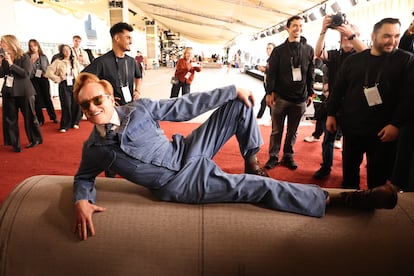
Part of what is said, the laughter of the audience and the venom load of the darts, will come from the presenter. For the second consecutive year, comedian Conan O’Brien (Massachusetts, 62 years old) will carry the weight of the gala, which he has been preparing for almost a year. On Wednesday, during the red carpet rollout, he was asked if he was going to talk about the Iran conflict. In response, he invited the spectators to follow the ceremony. “Let them connect and see it,” he commented. Then, in his usual half-joking, half-serious tone, he added: “I’m using what people see on the news to keep the Oscars going.” That is, he himself is aware of the interest.
The doctor in communications from the Bellisario center believes that there will be “a kind of hierarchy of political statements.” “I think O’Brien will allude to what’s happening as a wink to the audience; he won’t completely ignore it, but he won’t put it in the foreground either,” he reflects. “And the gala will become more politically explicit as it moves from the presenter to the award giver to the winner, all the way to the last category,” that is, best film.
Maximum security at the Dolby theater
This is not the first time that a conflict with the Middle East is present at the Oscars. It happened in 2003, the year of Chicagowhen the Spanish Pedro Almodóvar won the award for best original screenplay for talk to her. Five days before, the Iraq war had begun. There were no references to her at the ceremony. However, the world was different, without social networks, without immediacy, without live criticism. And without a president who posts messages on his own network live and furious.
Although Hollywood lives in a certain bubble, the war cannot go unnoticed, especially after information was leaked this week from the FBI warning of possible drone attacks on California in retaliation for the conflict. Maybe that’s what has raised awareness. In a meeting with the media to talk about the gala and its structure, the executive producers of the broadcast spoke about the matter, explaining that security came first and they had help from the FBI and the Los Angeles Police Department. “The collaboration is very close,” said Katy Mullan and Raj Kapoor, the managers. “This event has to run like clockwork. But we want everyone who comes, everyone who sees it live, even the fans outside the fences, to feel safe, secure and welcome, so it’s our job as a production team to make sure that’s a reality.”
As the newspaper has told Los Angeles Timessecurity has been reinforced with more invisible measures, FBI agents and even air control, including possible radiation. In other years there was a biological decontamination unit on site. But, they say, there are no real threats, it is only for prevention. The department of sheriff of Los Angeles County – the most populated in the entire United States, with about 10 million inhabitants – explained in a statement to EL PAIS that it maintains “a high level of preparation and is increasing surveillance.” “We are working closely with our federal and local law enforcement partners to share intelligence, closely monitor the ongoing conflict in the Middle East, and assess any potential impact on our communities,” they say, explaining that citizen safety is their “top priority.” For this reason, they have “continued to increase patrols around places of worship, cultural institutions and other prominent places throughout the county,” and have more resources available if needed. And they ask, as usual, for citizen collaboration.
Raising your voice is not easy from the most watched podium in the world. Oliver Laxe, nominated for best international film and best sound for his praised Sirât, I reflected this Saturday. “It’s difficult,” he commented, slowly, asking that “the complexity” of his words be reflected. “I understand that we are citizens and it is okay to express ourselves. What happens is that it is difficult, because you say something and it is wrong; you say nothing, and it is wrong. And if you say it, it will not be picked up with the complexity, it will be cut wrong…”, he thought out loud. “It has to be understood from society that there is a lot of exposure. Making a film and sharing it puts you in a state of very strong vulnerability, we are not aware of the degree of pressure,” explained the filmmaker. “We are in a moment of great fear, I think there will be few political proclamations tomorrow, but it’s okay when there are, it seems good to be brave. We are not that strong. Or not me, at least.”