
Books, exhibitions, conferences, audiovisuals, podcast programs and even an opera. The city of León – capital of the old Kingdom – is experiencing a new fervor for Urraca (1080-1126), the first European woman to reign in her own right (she was neither consort nor regent), in view of the imminent anniversary of her death, which this Sunday marks 900 years. To top it all off, on the same date that International Women’s Day is celebrated, March 8. Simple anecdote or something more?
“Urraca was, of course, a very hardworking woman; in fact, where the interest of her historical figure lies was not only in the fact of becoming queen, but in the enormous effort of maintaining her reign until death,” reflects Gerardo Boto, main curator of the exhibition. She reigns. Magpie I of Leónwhich opens its doors this Friday at the León Museum, in the central event of this year of commemorations. An ambitious cultural proposal that talks about Urraca and also the Kingdom of León as a focus of international artistic creation in the first quarter of the 12th century. And it does so through fifty pieces that come from national temples, institutions and museums, such as the Archaeological Museum or the Prado, and international ones, such as the Louvre in Paris, the Metropolitan in New York or the Art Institute of Chicago.
Redefining and rehabilitating the memory of Urraca I of León in the face of the “historical fictions” that have persecuted it since ancient times is one of the great objectives of the exhibition organized by the León City Council, with the coordination of Acción Cultural Española. But what fictions are those responsible referring to? The main one, his presumed libertine character, his disordered extramarital life. Like Urraca, “her father, her son and her grandchildren had lovers and many adulterous children because even in that she behaved like a king, although it seems that the sin only resides in her,” compares the art historian Gerardo Boto (University of Girona), who has shared three years of preparations with his colleague José Alberto Moráis (University of León), at the head of the organization of she queens. Another of these misunderstandings is the supposed inconsequentiality of his reign, as if it had only been a mere period of transition, an interregnum between his father, Alfonso VI, and his son, Alfonso VII. However, the abundant sources of the time – the commissioners defend – point out exactly the opposite: “He was concerned with seeking the most favorable circumstances to maintain his government.”
In any case, what has really motivated the exhibition is the cultural profile of the first European sovereign. And another legend has also crept in here. “For a time, an image of Urraca was formulated as a plunderer, as a true destroyer of the heritage that existed in her kingdom,” says Professor Boto. On the other hand, when it is the documents, the buildings or the artistic pieces themselves that speak, the protagonist of the story abandons the role of villain. The Leonese queen is credited, for example, with the expansion of the church of San Isidoro – linked to the royal family through its exalted Pantheon of the Kings – or the promotion of the temple of the Holy Sepulchre, also in the city of León, at the crossroads of the Camino de Santiago. “She is a woman who promotes the arts directly, but who also stimulates relevant works and culturally dynamic characters in her environment,” describes Boto. It is worth remembering that during the 11th and 12th centuries—the historical time of Urraca and the explosion of Romanesque art—in the Kingdom of León “there was a concentration of creative talent of local and international origin that turned this territory into a great artistic center,” he details.
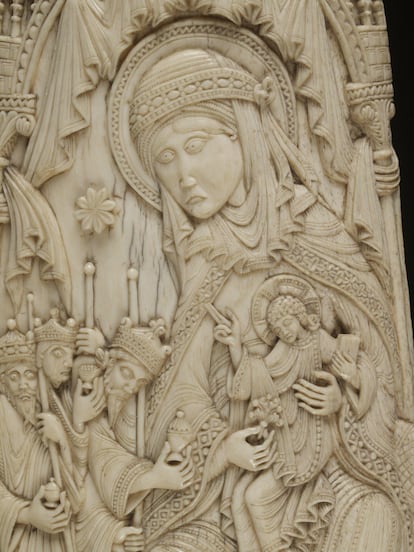
Now, how to draw the artistic landscape of the Lion from the first quarter of the 12th century? Those responsible for she queens They have selected fifty or so paintings, sculptures, ivories, manuscripts, textiles or coins for their aesthetic or historical importance, but also for their “eloquence”, that is, for the ability to describe the protagonist. The 900th anniversary of Urraca I of León has also given them the opportunity to bring back a few Leonese testimonies scattered around the planet, which in their day packed their bags for European or American museums. like the extraordinary epiphany reliefa piece delicately carved in whale bone that comes from the Victoria & Albert Museum in London, which will soon be joined by an ivory plaque with biblical scenes made in the workshops sponsored by the Leonese queen, a specimen that currently belongs to the Metropolitan Museum in New York. Or the sculpture Romanesque lion traveling from the Parisian Louvre. All these works symbolize the game of concepts that the curators were looking for, “concentration of origin and dispersion of destination.”
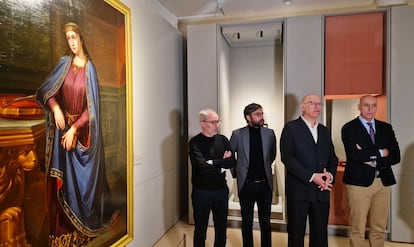
In the Museum of León, geographically closer pieces are also listed until June 7. like him Diurnal of Fernando I and Sanchaan illustrated codex reflecting the sponsorship of manuscript works in the Kingdom of León, which is absent these months from the library of the University of Santiago de Compostela. Or the different pictorial portraits that are gathered in “an unprecedented room of Spanish queens,” Gerardo Boto advances, as an unusual circumstance. That is, a room in which the visitor will put a face to all the Spanish sovereigns with testimonies such as the “beautiful painting” – the organizers highlight – of Queen Juana I of Castile, which the Valladolid Sculpture Museum has lent for the occasion. Or the oil painting by the painter Carlos Múgica y Pérez that features the Urraca herself, from the Prado Museum. “This is a historical sequence that, for the first time, is shown here complete, since even in the gallery of the Sala de los Reyes of the Alcázar of Segovia there were notable absences,” underlines art history professor Gerardo Boto. “We know that there are some female rulers of extraordinary importance, such as Isabel I of Castile or Isabel II, but they were not the only ones,” he says.
Nor the first ones. This historical milestone only corresponds in Spain and Europe to that Magpie that reigns again these months in León without the prejudices or impositions that it had to live through in its time. “We have built a very different profile of the character,” point out the curators, who have tried not to fall into idealization. “He is a complex figure, not exempt from contradictions; we tried to highlight the value of his heritage for our present, in which it had been too eclipsed,” says Gerardo Boto. The expression “wanting was his power,” the curator confesses, has inspired and guided, in some way, the assembly of she queens. And leitmotif perhaps also suggestive at the gates of this March 8, International Women’s Day, which marks 900 years since the death of the first European sovereign.