
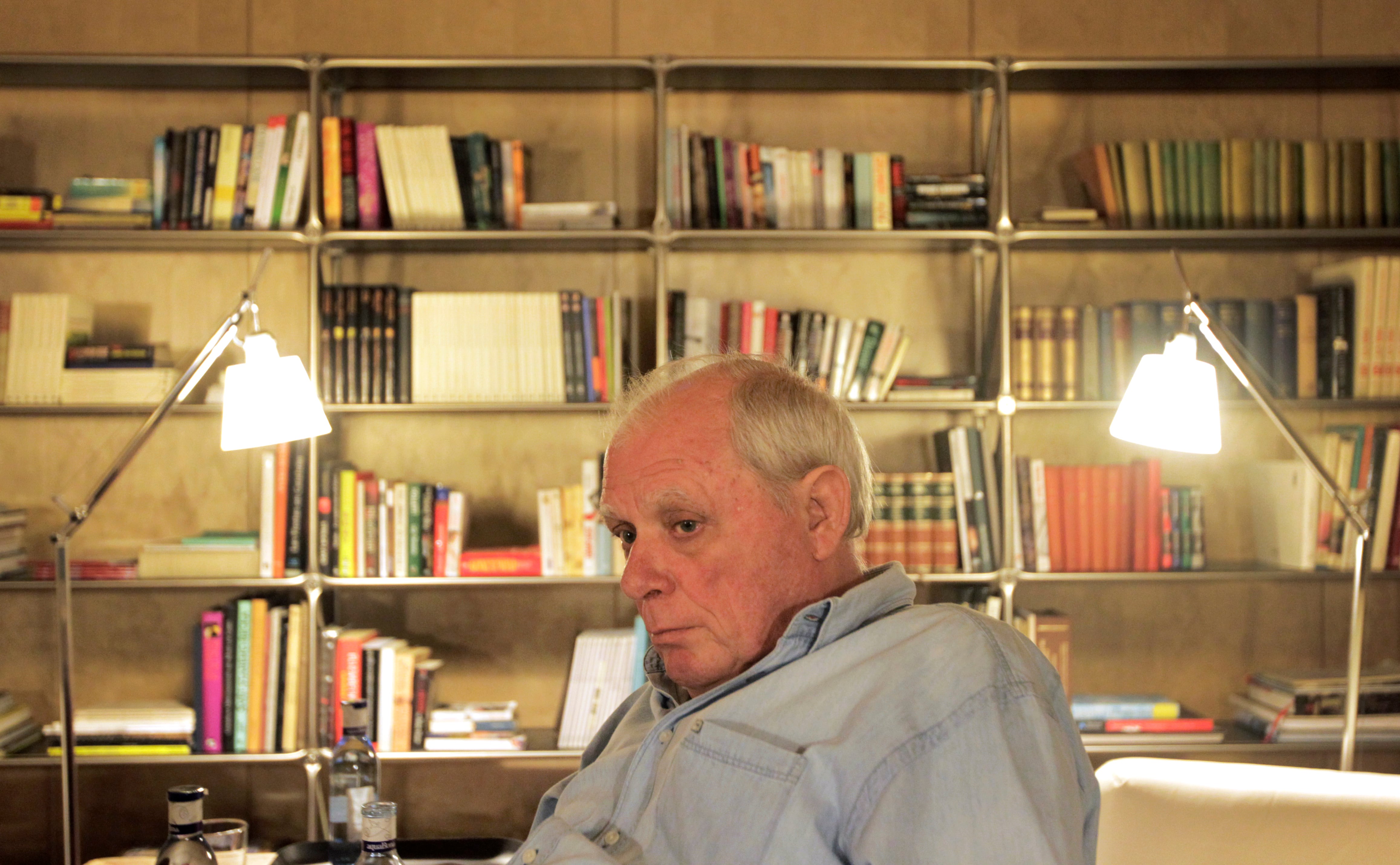
Everything in the biography of António Lobo Antunes was capital, cyclopean, colossal. So is his death. The gap left by the greatest Portuguese writer of contemporary literature is one of those black holes of space that had already begun to be drawn when his illness gradually removed him from writing and memory. His death, which occurred this Thursday in Lisbon, was confirmed by the Dom Quixote publishing house, where he published more than thirty novels, chronicles and essays that followed one another almost compulsively while their author was the owner of the words. Lobo Antunes was 83 years old and had been retired at home for several years after the onset of one of those ailments that take away memories.
His last novel published in Portuguese was The Size of the World. In Spain, translated by António Sáez Delgado, Random House Literature published last year The last door before the nighta kind of deceptive thriller, started from a real crime and turned into another of those pieces of psychological and literary craftsmanship. Lobo Antunes, a psychiatrist by profession, had a perfect combination to delve into human torments: the experience of the clinic and the gift of words. And he died without receiving the Nobel Prize for Literature in whose pools he appeared again and again, as if the distinction that José Saramago received in 1998 was exclusive. The forgetting of Lobo Antunes is another of those capital sins of the Swedish Academy, which in a history of more than a century has ignored the richness and heterogeneity of literature in Portuguese. From now on, the author of Alexandrian Fado is in the pantheon of those unjustly forgotten like the Brazilians Jorge Amado and Clarice Lispector or the Portuguese Agustina Bessa-Luís, among others.
The rivalry between both authors, the most brilliant and successful of literature after the Carnation Revolution, became in the Lisbon circles a kind of duel similar to that experienced by Benfica and Sporting fans, as if admiration for one of them prevented that of the other. One of those forced polarizations before the era of universal polarization.
Since publishing his first book, elephant memoryin 1979, António Lobo Antunes wrote each work as if it were his last. Perhaps because he found in literature the saving board to take refuge from the two chaos he faced: the internal and the external. His biography is typical of a survivor: he resisted two years in Angola where soldiers were killed and forced to say goodbye to adolescence and he overcame three cancers, including two lung cancers that did not make him stop smoking. As a psychiatrist, he traveled through the traumas of others and, when he was almost eighty years old, he made it clear to whoever would listen what was worth it: “Love and friendship are the only good things in life. The rest is shit.”
António Lobo Antunes was born in Lisbon in 1942 in a bourgeois house marked by the figure of his father, a doctor with a tyrannical character and social conscience. The relationship between the writer and that figure who “was born with reason,” according to one of his children, was tempestuous. One of the many stormy relationships that the author would have throughout his life. But the biographical fact that perhaps would most determine his personality and his literature was his time in the colonial war as a second lieutenant in the Portuguese army in Angola between 1971 and 1973, the final years of the long dictatorship that the country suffered. “There I learned that I was not the center of the world and that others existed,” he would confess to the Spanish journalist María Luisa Blanco. Ensign Lobo Antunes was one of the thousands of Portuguese forced to fight in Africa against the winds of history and the determination of the Portuguese dictatorship to block the independence of its former African colonies.
Those days of pain and camaraderie can be traced both in the novel Os Judas Asspublished shortly after the triumph of the revolution, as in war lettersan anthology with the letters he sent from Angola to his first wife and which were compiled and published by his daughters in 2005. He had been writing since he was a child, but he only began publishing after the fall of the dictatorship, after the April captains’ coup. One of the leaders of the rebel movement, Ernesto Melo Antunes, had been a subordinate and reading friend of Lobo Antunes in Angola.
In his four dozen books of novels and chronicles, he drew contemporary Portugal like no one else with all the contradictions and traumas that the dictatorship and the colonial war had left in his generation. There is no better treatise to understand the wounds caused by 13 years of armed conflicts in Mozambique, Guinea-Bissau and Angola than the novel Alexandrian Fadopublished in Portugal in 1983 and a decade later in Spain. The book was a response to his father’s challenge, who had told him that he would only be a writer when he published a Balzac-style book. The result was a 700-page work written with stark prose and starring four former combatants from the war in Mozambique, who meet again in a brothel 10 years after returning to Portugal. In its pages are the misogyny, fraternity and classism of postcolonial society itself.
Since he was a child he lived with a drive that generated a literary geography distinguished with awards, translations and honors such as being included in the Pleiade Library or being praised by colleagues such as George Steiner or JM Coetzee. The only thing missing was the call from Stockholm, but Lobo Antunes stopped caring a long time ago. The rivalry with José Saramago, the only Nobel Prize winner in the Portuguese language in more than a century of history of the award, was sometimes fueled as a commercial lure, although the truth is that Lobo Antunes disdained both the literature of the author of convent memorial as his political career which, in his opinion, was developed without taking extreme risks.
(Last minute information, there will be an extension soon)