
For Marc Minkowski (Paris, 63 years old), the origin of his style as a conductor dates back to a night in 1985, when he attended the oratorio at the Salle Pleyel Theodora by Handel conducted by Nikolaus Harnoncourt at the head of the Concentus Musicus Wien. That aesthetic impact—the awareness that the orchestra could generate discourse and theatricality on its own—was fixed as a revelation.
In his recent memoirs, Conductor or centaur. Confessionsevokes that experience as a conjunction of strength and delicacy that marked him indelibly: “How could the thought of an instrumentalist, who was also a director, produce such expression, such theatricality, only with an orchestra? The singers obviously added a higher level of expression, but not everything depended on them; it was the orchestra that produced the speech.”
At that time Minkowski was a young bassoonist who had just founded Les Musiciens du Louvre—later Les Musiciens du Louvre-Grenoble. Its first great milestone came with the modern recovery of The triumph of Time and Disillusionmentby Handel, which he recorded in 1988. From Harnoncourt he inherited a conception of sound based on incisive articulation, muscular energy and a constant theatrical tension. That ideology retains its effectiveness intact and was the driving force behind the success of Julius Caesar in Egypt last Saturday, February 28, at the Palau de les Arts. Vincent Boussard’s production premiered in May 2023 at the Cologne Opera, with refined visual splendor, was served by a cast where quality took precedence over flash.
The Valencian theater has once again surpassed the Teatro Real this season, even with the same Handelian title on the bill. While the Madrid coliseum opted a week ago for a concert version with Il Pomo d’Oro and names with strong international projection – the countertenor Jakub Józef Orliński and the soprano Sabine Devieilhe -, the Palau de les Arts Reina Sofía has reinforced its own orchestra and opted for the Spanish debut of the countertenor Aryeh Nussbaum Cohen and the first Handel of the Valencian soprano Marina Monzó.
The approach was reminiscent of last season at the Gran Teatre del Liceu, with William Christie in the pit and the production kitsch by Calixto Bieito, although then the result was inferior. In Valencia, on the other hand, the cheers – with a good part of the auditorium on their feet after almost four hours of performance, with a single 25-minute break – confirmed the success of a performance that flowed naturally and with a sustained pulse.
Minkowski seems to have thoroughly measured the physical limitations of the theater designed by Calatrava, where he debuted four years ago with Hoffmann’s tales, from Offenbach. On this occasion he raised the pit and successfully managed the enormous distance that separates him from the stage. It is true that, at the beginning, the volume of the 45 musicians did not make things easier for the voices, but the Parisian conductor ended up balancing the ensemble without losing an iota of intensity.
His direction propelled the singers in each aria with authentic sound meatiness; In his memoirs he defines that task with a precise maritime metaphor: “breathing wind into their sails.” He provided an imaginative continuous accompaniment, in which the excellent harpsichordist Yoann Moulin shone, maintaining the same theatrical liveliness in well-cut recitatives. He followed the 1724 version quite faithfully: he preserved all the from scratch —with the sole exception of Giulio Cesare’s less inspired aria, Isn’t it so vague and beautiful—; from the first act he deleted Cleopatra’s third aria, as he already did in his recording for DG/Archiv (You are my star), and the most substantial cut was Sesto’s last aria in the third act (Justice already has on the bow).
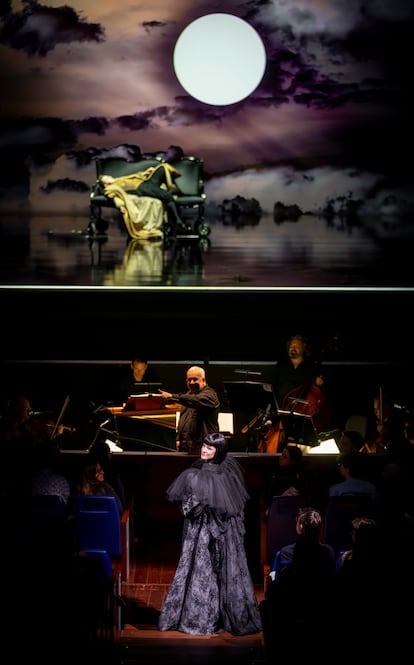
The production relapsed into the same problem as at the Liceu by scheduling a single break after almost two hours and in the middle of the second act. In Valencia, however, an effective solution was adopted at the beginning of that act: the orchestra located on the stage moved to the center of the room and both Cleopatra and Giulio Cesare sang their arias from the stalls. The resource was especially attractive in the bird aria If in a pleasant flowery meadowwhich led to a spectacular musical duel between the solo violin of Stéphane Rougie, on stage, and the voice of Aryeh Nussbaum Cohen, in the audience.
The American countertenor, 31, was one of the winners of the evening. His qualities as a Roman leader had already been evident in his debut, two years ago, at the Glyndebourne Festival. In Valencia it was confirmed as a current reference in the character of Handel created for the gelding Senesino from his bravura aria, Wicked, I will say, you arewhere he displayed dizzying vocalizations, brilliance in the high register and refined variations in the from scratch. His interpretation did not stop growing, with successive flashes of musicality, until culminating in the third act with an impetuous and spectacular That stream, which falls from the mountain.
The other great winner of the cast was Marina Monzó. In her first incarnation of a Handelian character, the Valencian soprano, of the same age as the American countertenor, emerges as a Cleopatra to be taken into account. Added to this are notable acting and musical skills to go from brilliant coquetry to fury and emotional depth. He demonstrated this especially in the third act with I will mourn my fateone of the highlights of the night, from the intoxicating timbre of the initial sadness to the virtuosic violence of the middle section.
It did not detract from the rest of the cast. The Persian-Canadian countertenor Cameron Shahbazi was a more accomplished Tolomeo than in Barcelona last season, as an effective counterpoint to Giulio Cesare. In Valencia he not only created a more complex villain, but, despite a lower volume than his American colleague, his voice was projected from beginning to end with the necessary incisiveness, as evidenced in his last aria, I will tame your pride.
The experience of the cast was provided by mezzo-soprano Venetian Sara Mingardo, who has been playing the role of Cornelia for at least two decades. He corroborated it with several flashes of musicality, as in the duet They are cream to tears with his son Sesto at the end of the first act. The transvestite character that Handel wrote for the famous Margherita Durastanti was assumed in Valencia by the Italian soprano Arianna Vendittelli, who sang unwell—as announced—although she knew how to balance vengeful youthful fire and contemplative lyricism.
For his part, Canadian bass-baritone Jean-Philippe McClish captured Achilla’s evolution with a deep voice. In recitatives and choruses, both the baritone Bryan Sala and the mezzo Lora Grigoriev were, respectively, Curio and Nireno solvents.
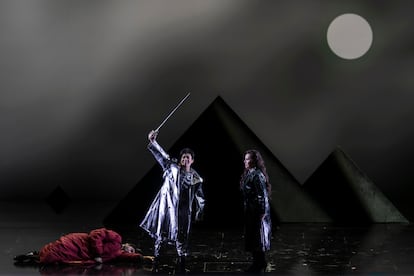
Vincent Boussard’s production stood out, as already noted, for its visual splendor and aesthetic cohesion. But also due to an effective direction of actors, attentive to the dramatic evolution and supported by some attractive ideas. This is the case of the doubling of Cleopatra by an actress with the same black bob wig, a resource that allows the seductive side and politics of the character to be shown in the same aria. Also the conception of Ptolemy, initially evil, but evolving towards the grotesque and ironic, in contrast to his advisor Achilla, whose costume traces a journey from jester to defeated man.
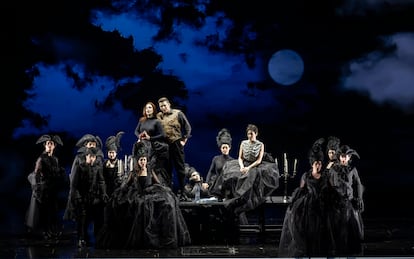
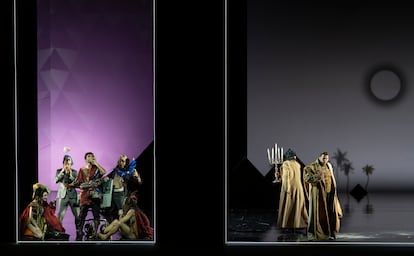
There is no doubt that Christian Lacroix’s costumes are one of the pillars of the production. He imaginatively distinguishes Romans and Egyptians, contrasting Western conventions with colorful and fanciful exoticism. He plays intelligently with nods to different eras—crinolines, tricorns, armor—and precisely outlines the protagonists: Caesar’s sumptuous cloak and Cleopatra’s darkly shiny tunic.
The greatest success is, however, the set design by Frank Philipp Schlößmann, decisive for the fluidity of the show. A rigorously planned device of moving walls, mirrors and environmental projections that dialogues with the music in both the most intimate and the most spectacular passages. In short, a production in which action, music and scene come together until you lose track of time.
‘Julius Caesar in Egypt’
Music by George Frideric Handel. Libretto by Nicola Francesco Haym (based on the libretto of the same name by Giacomo Francesco Bussani).
Aryeh Nussbaum Cohen, countertenor (Julius Caesar); Marina Monzo, soprano (Cleopatra); Cameron Shahbazi, countertenor (Ptolemy); Sara Mingardo, mezzo-soprano (Cornelia); Arianna Vendittelli, soprano (Sextus Pompey); Jean-Philippe McClish, bass-baritone (Achilla); Bryan Sala, baritone (Curio); Lora Grigoriev, mezzo-soprano (Nireno).
Orchestra of the Valencian Community.
musical direction: Marc Minkowski.
stage direction: Vincent Boussard.
Palau de les Arts, February 28. Until March 13.