
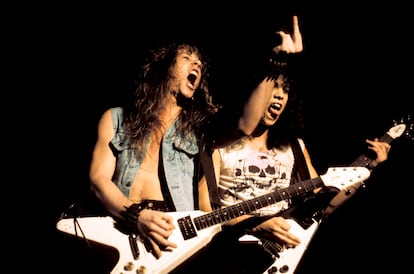
In 1984, Metallica released Fade To Black, an acoustic ballad integrated into his album Ride The Lightning. That a band of thrash metal incorporating a slow and melodic song was enough to trigger an immediate reaction among part of their audience: they wanted to sound more accessible, more commercial. They were, in short, “sellouts.” The accusation was not new then nor would it be new later: every time a rock group moved away from the original rawness, a part of the audience interpreted the gesture as a betrayal of an imaginary. In Spain, one of the paradigmatic cases is that of Evaristo Premos, singer of La Polla Records. The band represented anti-establishment punk since the 80s. When they began to fill venues and Evaristo was able to make a living from music, the economic success was read as a break with the original spirit of the genre. In the nineties it was a recurring debate: if you were indie You couldn’t sign for a multinational. Decades later, in a different register, C. Tangana would receive the same adjective when he abandoned his initial rap stage. underground to embrace, like El Madrileño, melodic and folkloric sounds under the multinational Sony Music. In all these cases, the accusation responds less to concrete facts than to a cultural expectation: an artist authentic should behave in a certain way.
That debate has been reactivated again with several bands. One of them is the Madrid band La Paloma, who have just released the album a stroke of luck. Formed by Lucas Sierra (29 years old, Gran Canaria), Juan Rojo (31, Madrid) and Nico Yubero (30, Madrid), the band receives EL PAÍS in a cafeteria in Tetuán (Madrid) to talk about the reactions that the album has generated. His first album with the multinational Universal presents a cleaner and less distorted sound than his debut, a turn that some sectors of the scene (accustomed to saturation and aesthetics) amateur) have interpreted as a marketing signal. “It seems that by sounding better you are already suspicious, as if there was a hidden intention behind it,” says Yubero. The cursed word has returned: sold. From his surroundings, Joan Guàrdia (45, Castellar del Vallès), artistic director of La Paloma within La Castanya, explains that the transition towards a larger structure was natural: “We have made strategic and logistical decisions to continue moving forward together without losing the essence that encouraged us to form a team.” Regarding the agreement with Universal, he adds: “The fact that they contemplated a business alliance between two record companies was decisive.” For him, the idea that a multinational detracts from authenticity is outdated: “Today most people don’t even pay attention to which record company is behind it.”
Although the term reappears cyclically, the discussion about authenticity in rock is as old as the genre itself. Since the emergence of rock and roll in the fifties, its values (rebellion, spontaneity, counterculture) were consolidated as immutable realities. The philosopher Theodore Gracyk explains it clearly: the recording industry not only exploited rock’s image of rebellion, but participated in its construction from the beginning. In your article Rhythm and Noiseexplains how rock’s aesthetic (defiant attitude, anti-establishment aura, controlled unkemptness) was deliberately molded into a recognizable product. What was understood as spontaneity was, to a large extent, an aesthetic code agreed upon between artists, labels and media.
For Fernán del Val (43, Madrid), a sociologist specialized in popular music, authenticity functions as a moral category rather than a musical one. “Authenticity is not a rock whim, but a deep cultural value that we use to evaluate not only music, but also people and behaviors,” he points out by video call. It is not an objective quality, but a shared construction that acts as an ethical thermometer. “Since Walter Benjamin and the Frankfurt School, there has been the idea that industrial production causes cultural objects to lose their aura. That aura can be understood as authenticity, and that discussion is still alive.” Although today’s industry works differently (streaming, algorithms, accelerated professionalization), the tension between the artistic and the commercial continues to mark public reception. “The scenario has changed, but the conflict remains intact,” says Del Val. “The audience does not reject professionalization, but rather the perception of artifice.”
That framework helps understand the reactions to La Paloma. The band emerged at the height of post-pandemic guitar rock, when distortion and urgency became a canon of authenticity for a generation. His first album, Not yethe fit that mold. Therefore, the contrast with a second album that is more restful and supported by clean guitars has generated friction. From within, they insist that there was no calculation: “No one was thinking in such a scripted direction. We had songs, we worked on them sincerely, and each one asked for something,” explains Nico, “the album already existed before Universal.”
Thus, one of the keys to the story is the automatic association between sound neatness and commercialization. “It seems that if you sound better, you have automatically sold yourself. As if sounding good couldn’t have an artistic intention behind it,” says Sierra. This prejudice reveals the extent to which certain sectors of rock have linked the “authentic” to the precarious. For Rojo, the conflict is born from a mold that is too narrow: “People care a lot about whether a group is authentic. But no one really knows what that is. They only know that, if you don’t fit into a very specific mold, then you are no longer one.”
The stylistic inbreeding of the scene also influences: “The references of many groups are other groups from the same scene. And that’s great because it generates community, but in terms of sound everything becomes smaller. If your influences are My Chemical Romance or A Perfect Circle, you’re already suspicious,” adds Yubero. Del Val agrees: authenticity is a symbolic agreement. “Fans can see authenticity where critics see artifice, and vice versa,” he explains. What matters most is not the sound, but the coherence: that what the artist does fits with what the public believes he should do.

A final element further strains the debate: personal exposure. At a time when naturalness online has become cultural capital, many artists feel pressure to share intimacy to be accessible. It is not new: Del Val studied how Dani Martín, in his years of greatest media pressure, resorted to closeness to counteract the perception of inauthenticity of his band, El Canto del Loco. “That naturalness was not coincidental,” he explains, “but a way of contesting a space that critics denied them.” Today, that mechanism is amplified in networks. Even projects born under rigid commercial structures (like Katseye, formed under K-pop standards) build their image authentic through intimate and spontaneous gestures that function as proof of truth to their audience: they introduce their partners or speak openly about their sexual orientation. La Paloma rejects that logic. “I don’t think you have to show your life for people to understand your music. Music is one thing, your personal life is another,” says Rojo. “If society demands that you know the life of an artist to validate their music, what is broken is society, not the artist,” he adds.
The case of La Paloma is just the most recent example of a debate that has been going on in popular music for more than half a century. What is being discussed (again) is not just sound or strategy, but cultural identity: what we expect an artist to be, who decides the rules, and how the idea of “being authentic” changes in a musical ecosystem that no longer resembles that of stadium rock or punk fanzines. As Del Val and the musicians themselves point out, authenticity is a negotiated, mutable and collective value. More than a verdict, it is part of the permanent conversation between creators, industry and public: a space where, for better or worse, rock has been discussing itself since it has existed.