
I imagine that the production companies are racking their brains looking for formulas that will allow them to continue making the most of a business that has been lavish for so long, but with symptoms of illness since the ancestral clientele decided to gradually abandon the theaters to watch movies at home or through the screen of their cell phones. The second must be the ideal means to taste the essences of cinema. And among the temptations to get spectators to go through the box office and sit in a seat surrounded by darkness, I perceive the penchant for telling scenes set in remote pasts and starring invented or real circumstances of great characters in history. It has lately been the turn of Cervantes and Shakespeare in two immediately forgettable trifles, including their claims to transcendence, entitled The captive y Hamnet. I suspect that it will also happen with literary works from a long time ago that delighted the general public and also the very enlightened.
I read as a teenager Wuthering Heights and that one crazy love of impossible happy ending in the middle of the moors of northern England upset me. Cinema has adapted or been inspired by that legendary novel on several occasions. Even the Mexican Buñuel, his most impressive period, made a surreal and fun version of it in Abysses of passion.
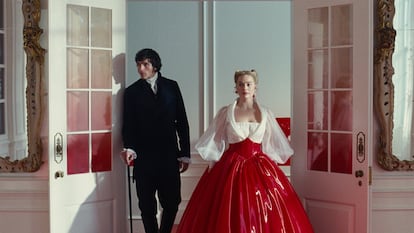
The volcanic and self-destructive love of two people united fraternally (due to the adoption of the child) since they were children, which Emily Brontë imagined and who will since then be immersed in the tormented neither with you nor without you, gives director Emerald Fennell the opportunity to recreate once again those abysses of the body and soul that provoke an irrevocable and eternal passion. And they show it all the time, even though she has married an individual as rich as he is balanced and her eternal love returns to resume what was never broken. And the big fuss is made in a time and society as hypocritical and cruel as those before and after.
Although that love tries to be so abrasive, I don’t feel infected or burned by what I see and hear. It slips slightly on me. Margot Robbie, considered a queen of current stardom, and the handsome Jacob Elordi (who did move me playing the monster in the beautiful Frankenstein) can’t make me believe that there is a powerful chemistry between them. They can squeeze each other all the time and express all the time with their eyes or with words that they cannot live without each other, even though she has an intense sexual life with her civilized husband and he maintains a sadomasochistic relationship with another woman, but I can’t believe those volcanic sensations that apparently overcome the tragic protagonists.
And the production is very careful, but it has the same effect on me as when I look at luxury advertising, it doesn’t make it tacky. And I don’t believe what they’re trying to sell me. It is artifice at the service of nothing. Director Emerald Fennell also constantly abuses the use of music, an easy and stomach-churning resource with which you try to distract or excite the viewer when what they see and hear do not have that magnetic effect. I finish up to the genitals of pianos and violins. And new adaptations of enduring novels will arrive. I hope that some are worthy of the literary material from which they are inspired. It is a notable risk. John Huston adapted extraordinary novels such as The maltese falcon, Moby Dick o under the volcano. Hammett would have recognized himself in his. But I very much doubt that the same thing would have happened to Melville and Lowry.
Wuthering Heights
Address: Emerald Fennell.
Interpreters: Margot Robbie, Jacob Elordi, Hong Chau, Alison Oliver, Martin Clunes.
Gender: sentimental drama United Kingdom, 2026.
Duration: 136 minutes.
Premiere: February 13.