
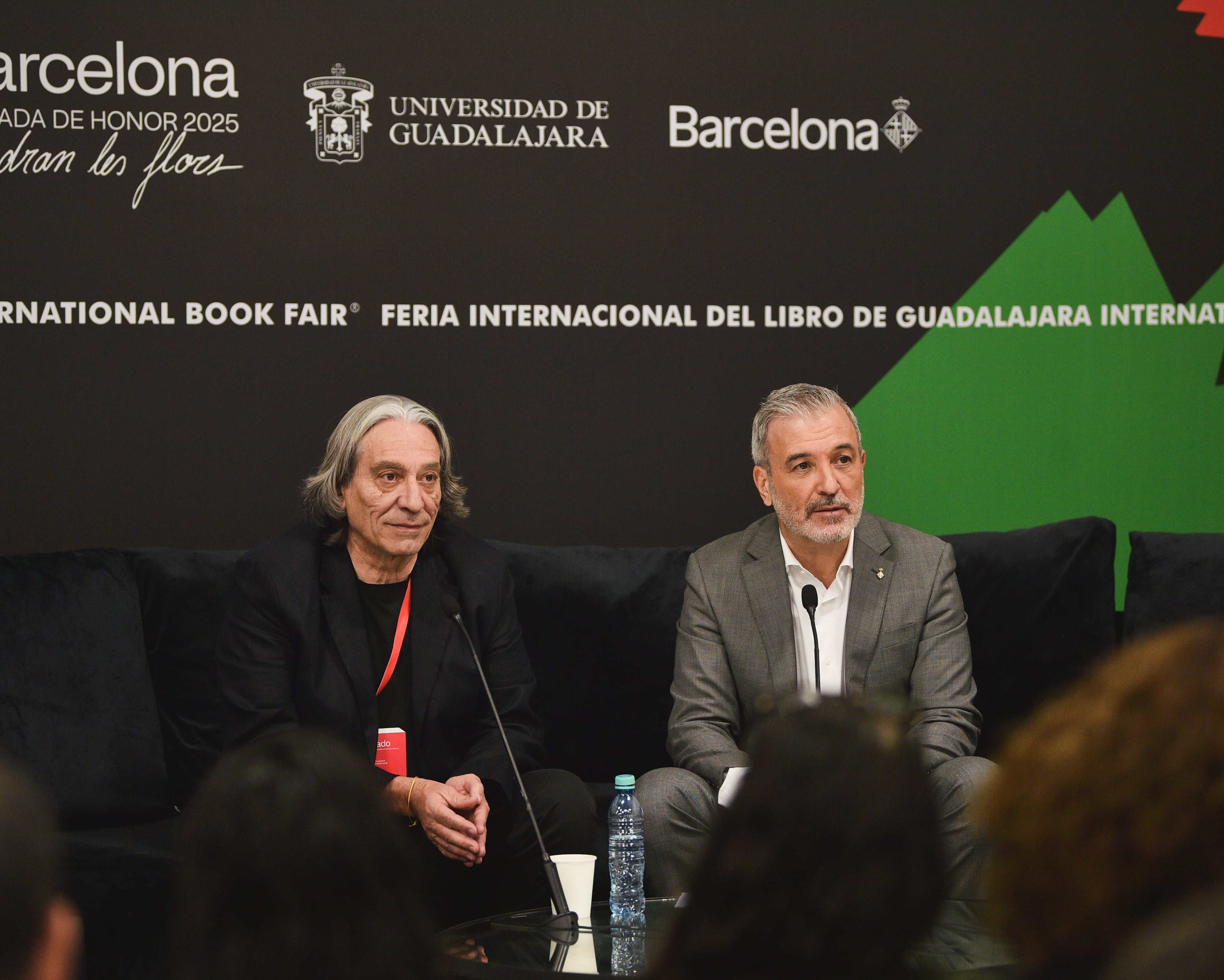
The international residency for Latin American writers announced by Barcelona City Council within the framework of the Guadalajara FIL has raised alarm in the Catalan literary sector. Endowed with 80,000 euros and promoted by the City Council with the collaboration of the Barcelona Library Consortium and Casa Amèrica Catalunya, it is a writing residency for Latin American authors to narrate the city. The scholarship was criticized online for dedicating a large amount to the promotion of literature in the Spanish language in a context of the emergence of Catalan. One day after the announcement, the Associació d’Writers in Catalan Language has published a statement asking Mayor Collboni to withdraw it and dedicate “the entire planned endowment to the creation of Catalan, a language that has no other institutions than Catalan ones to guarantee its promotion, dissemination and continuity.”
In a text published on the institution’s website, the scholarship is considered a “unilateral measure not consensual and not even previously shared with the authoring entities.” The concern arises because, although it is not specified, it is deduced that the scholarship will be allocated to writers in Spanish: “any call that disparages the indigenous languages of South America and Mesoamerica, and obviously Catalan, will do nothing other than insist on the minorityization processes suffered by these languages.”
Frustration has also been expressed on networks over the amount of the scholarship, which is higher than all the subsidies and prizes intended for the publication of a book in Catalan. Some politicians have also come out to criticize the initiative: according to Jordi Martí Galbis, councilor for Junts per Catalunya, “in the face of the current linguistic emergency, the City Council’s aid has to prioritize writers in the Catalan language and Catalan. Joining the Pact for the Language is of no use if Catalan is then discriminated against.” Elisenda Alamany, general secretary of ERC, has also tweeted: “In the same way that a tourist who comes for a few days cannot be able to understand it, no writer can represent the identity and soul of Barcelona by doing a three-month Erasmus paid for by the City Council.”
Asked about the controversy, Xavier Marcé, Councilor for Culture and Creative Industries of Barcelona City Council, stated at a press conference this Monday that the residency must be interpreted in a context that already has the Montserrat Roig scholarships, “with a cumulative investment of one and a half million euros,” as well as writer exchange programs and subsidies for translations: “This scholarship would be controversial if it were the only cultural policy action of the city council,” stated the councilor, who also highlighted that 74% of the invited authors to the FIL they originally write in Catalan.
Announced annually, the Montserrat Roig scholarships, intended mainly (but not exclusively) for literary creation in Catalan, are endowed with 6,000 euros and a total of 27 grants are planned for the next call.
Marcé also pointed out that the budget of the new scholarship is not entirely for the author, more than half is allocated to editorial production. For each residency granted, the author receives 20,000 euros in fees. Another 43,000 euros are for production, translation into Catalan, distribution and communication, and 16,000 euros for travel, accommodation and subsistence expenses.
Recently arrived in Guadalajara to inaugurate the stand of Catalonia in the FIL, Salvador Illa, president of the Generalitat, stated in response to the media that he respects the initiative of the Barcelona City Council and that he considers that “opening up is always good,” reports Camilo S. Baquero.
The concern about this scholarship coincides with the figures recently published by the Department of Linguistic Policy of the Generalitat of Catalonia and Idescat, which demonstrate the continued decline of Catalan: in Barcelona less than 25% of the population speaks it regularly.