
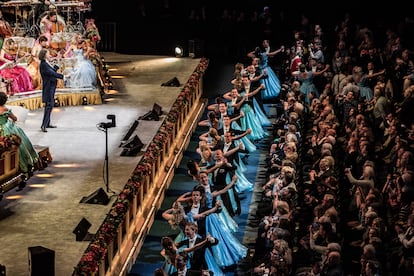
four decades ago André Rieu He founded the Johann Strauss Orchestra with a single goal: to make people happy. Since then, the Dutch violinist and conductor has dedicated himself to filling stadiums around the world and offering the public everything that in conventional concert halls would be considered tacky or in bad taste. The formula, based on the aesthetics of excess, limitless sweetening and a repertoire as eclectic as it is easy to digest, appears collected in the essay The new era of kitsch (Anagrama, 2025), where the sociologist Gilles Lipovetsky and the film critic Jean Serroy analyze this and other cultural phenomena of modernity.
“Rieu applies the logic of excess to his shows neokitsch“, confirm the authors. “In contrast to the traditional concert liturgy, we find a desacralized hodgepodge of musical genres.” A tear-jerking aria by Händel there, a bit of Nesum dorma over there and, between waltzes and polkas of the Strauss familyhe My heart will go on of Titanic sung by a soprano dressed as a Disney princess. “The result is commercial and a little weak, but not at all unworthy,” they warn. “It neokitsch “It does not mean the death of classical culture, but rather its transformation into an ephemeral fashion product.”
According to Lipovetsky and Serroy, these proposals are not so much about democratizing access to classical music as about adapting the offer to the dynamics of consumer life. “This idyllic encounter between purists and neophytes never occurs, since for the former it is kitsch represents an intolerable transgression, while the latter are satisfied with what they already know.” Not even the class codes that seek social recognition operate in these formats. “This new sensitivity does not need to be justified,” they add. “Its purpose is entertainment in its most uninhibited, fantastical and hedonistic state.”
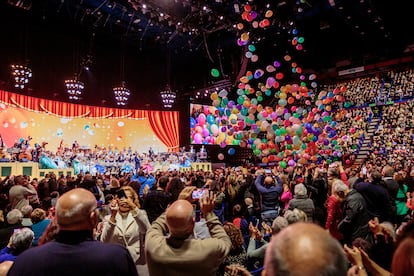
At Rieu’s concerts you can talk, drink, eat, record with your cell phone and, of course, dance. “There is a type of audience, not experts in classical music, who may be reluctant to go to an auditorium or an opera house for fear of not knowing how to behave,” he explains. Paz Apariciodirector of the Movistar Arena in Madrid, where Rieu’s tour will stop on January 29, who will also perform in Malaga (26 and 27) and Valencia (30) and will take in the crowds at the Palau Sant Jordi in Barcelona on the 31st. “Here everything is different: people give themselves without complexes to the fun, they let themselves be surprised and applaud when they feel like it.”
Rieu is not the only one of his kind: the singer Andrea Bocelli, the violinists David Garrett and Lindsey Stirling and the vocal quartet have all performed on these stages. The Divine. On his last visit to Madrid, the cellist Stjepan Hauser began with the Suite nº 1 of Bach and ended up throwing a sweat-soaked towel into the audience. In front of him: 12,500 viewers who had paid between 55 and 230 euros for a program that included Coldplay covers and an arrangement of the kiss me a lot. “The economic barrier disappears when expectations are met,” says Aparicio. “And Hauser fans are very clear about what they are going to find.”
The idea according to which crossover and its drifts kitsch prepare the ear for more demanding listening rarely corresponds to reality. “I don’t know anyone who, thanks to an album crooners lyrical, has ended up subscribing to the season of an opera house,” he says. Costa Pilavachiformer director of the Philips Classics and Decca record labels. “What I can confirm is that the commercial success of these projects once allowed them to sustain the careers of the maestro Valery Gergiev, the pianist Alfred Brendel or the Alban Berg Quartet. Without that volume of sales, the historical labels would have been reduced to simple catalogues.”
It was Pilavachi who discovered Bocelli in the mid-nineties, when he was working as a talent scout for Universal. “They sent me a model of The calm sea of the evening and it was clear to me that that voice could work in two registers at the same time.” From the album Sacred ariasan operatic candy with a pop wrapper, sold four million copies. According to Pilavachi, the signing of Bocelli (who just sang privately for Donald Trump) never eroded the label’s prestige. “The obsession with purity is foreign to the industry and is concentrated in a minority of critics and guardians of essences,” he asserts.
Artist agencies have also borrowed some of the strategies of the crossover. “Classical music must be taken out of the niche and its protagonists recognized as powerful and fully mainstream“says Moema Parrott, CEO of the Harrison Parrott Group and founder of Polyarts, one of the main promoters of the new classical. “The aging of audiences has changed the financing model and consumption habits, which forces us to be more ambitious when it comes to connecting genres and platforms that attract a more diverse audience,” he points out.
65,000 spectators will attend the sensational and sentimental appeal of the Johann Strauss Orchestra in five days, the equivalent of thirty performances at the Liceu in Barcelona or ninety concerts in the Chamber Hall of the National Auditorium. “Whatever vices or criticisms we may make of these types of experiences, we must not lose sight of the entertainment and relief they provide,” reflect Lipovetsky and Serroy. “The rise of the show neokitsch “It does not pose a real threat to classical music, but in the era of colossal concerts we must accept its enormous potential as a stimulator of emotions.”