
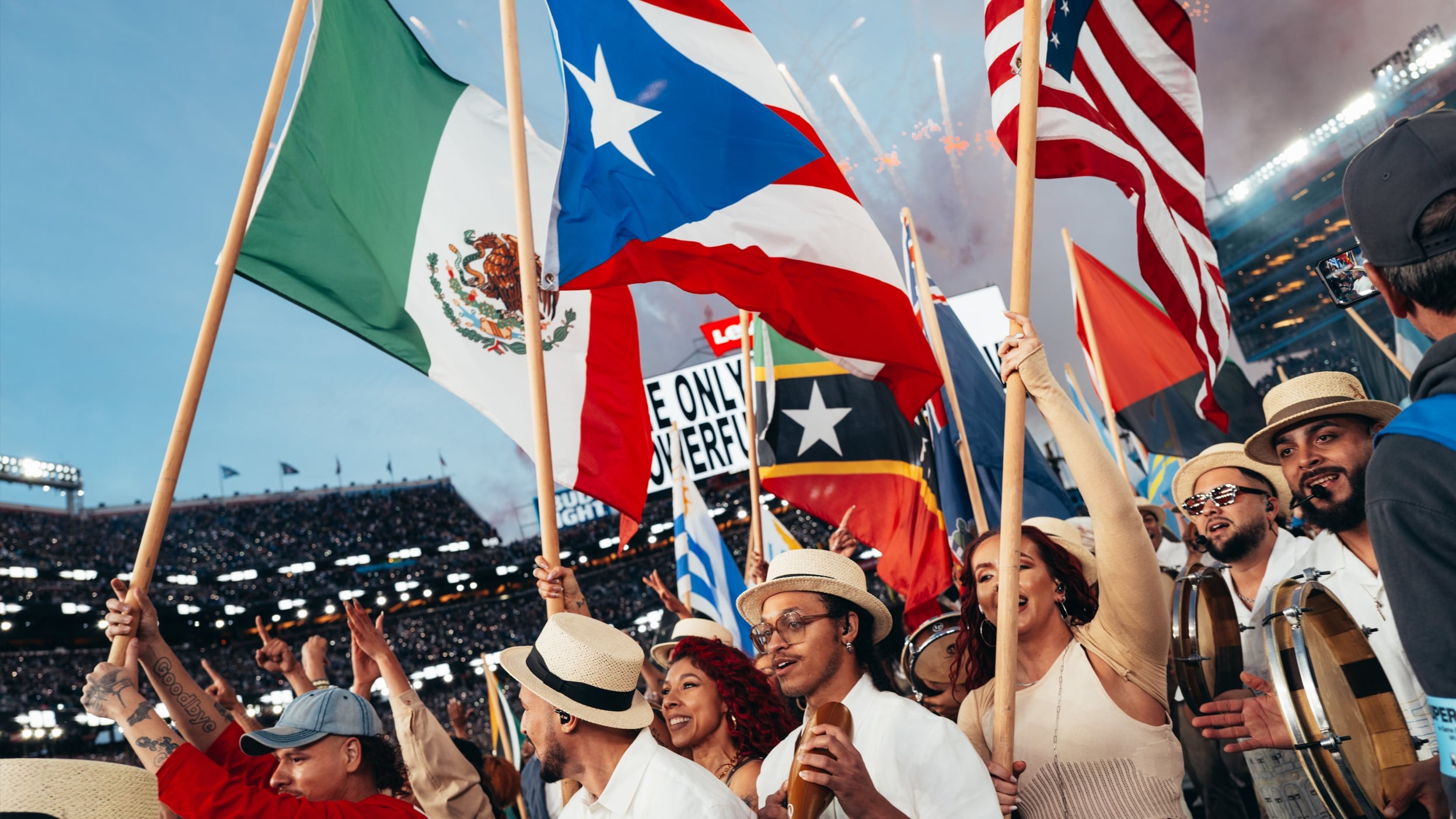
“Good afternoon, California. My name is Benito Antonio Martínez Ocasio…”. He show by the Puerto Rican singer Bad Bunny, last Sunday at the Super Bowl halftime, a display of Hispanic pride, a vindication of America beyond borders and the Monroe doctrine, has caused enormous irritation in President Donald Trump and the entire Maga movement for its use of Spanish and Boricua, the dialect of Puerto Rico. The ultra-conservative Fox network spoke of “cultural shock” and “linguistic barriers” for not singing in English. Until Trump’s second presidency, the United States had not had English as an official language. In real life, beyond xenophobia, as happens in almost all countries in the world, the existence of different languages enriches countries, not weakens them.
The idea that a strong State can only have one language began to prevail after the French Revolution and has become an obsession of the right-wing people in half the world, including Spain. Starting in the 18th century and with more intensity since the 19th century, with the consolidation of some European States, national languages gradually became imposed, in some cases, such as in France, in an overwhelming manner. The historian Graham Robb dedicates a chapter of The discovery of France, an essay on the society and history of France, to the languages that disappeared in this country due to the efforts of Abbot Grégoire after the Revolution. He considered that “without national language, there could not be a nation” and made it his almost divine mission to “exterminate the patois”, regional dialects.
In total, Robb puts the number of languages, dialects and subdialects that were once spoken in France at 55. Many have fallen by the wayside. In 1977, Shuadit or Judeo-Provençal, a dialect of Occitan, became extinct, surviving centuries of persecution, but not globalization. In Italy, where it is said that Dante’s language did not prevail until the arrival of public television, the small island of Burano tries to keep alive Buranello, a dialect of Venetian, which is in turn a dialect of Italian. On the English Channel island of Jersey, they want to preserve Jerseyese, a variant of Anglo-Norman, once spoken throughout England and being swallowed up by English.
Abbé Grégoire—and Donald Trump—could not be more wrong: a language does not form a nation. Linguistic diversity is one of the great riches of a country because each language builds a way of looking at and describing the world, each word contains its own history. The historian Eduardo Manzano Moreno explains it very well in diverse Spain: “A single language has never been spoken in the Iberian Peninsula throughout history.” “Compared to neighboring countries such as France, Germany or Italy, Spain has preserved a unique linguistic wealth, which coexists with the global projection that has allowed Spanish to rub shoulders with other universal languages,” he continues.
Spanish has been part of the history of the United States since even before its birth as a nation, 250 years ago. “The United States cannot be understood without Spanish. This is an incontestable fact. Historically, it reached what is today North American territory before English,” wrote Eduardo Lago in this newspaper in 2025 when Trump imposed English as the official language.
Additionally, there are the 150 languages spoken by different Native American nations. During World War II, the Navajo language (Diné) was used as a code in the Pacific War because the Japanese were unable to decipher it. In the world of westerns, that American ultranationalists glorify, languages from all over the world were spoken: Mandarin, Yiddish, Norwegian, Swedish, Spanish… that continue to be part of the history of the United States. The Amish speak a dialect of German known as Pennsylvania Dutch: members of this community express themselves in this language at home, in learned German in church, and in English at school. The culture and daily life of the United States continue to flow, without any problem, in that rich and diverse linguistic universe.
An exhibition at the MUVI, an eclectic and fun museum in the Extremaduran town of Villafranca de los Barros, showed last summer the collection of tintinologist Juan Manuel Manzano Sanfélix, which includes albums of the character of Hergé in all the languages into which it has been translated. Naturally, Tintin is exhibited in Castúo, the Extremaduran variant of Spanish, where The Castafiore jewels becomes His estate is Cataphyore and Target: the Moon transforms into Jabemoha and.
There was the edition of The black island in sephardic, La izla preta, or in Romany, Kali Ada; a volume also translated into cadaquesence, a dialect of Catalan spoken in this town, isolated for a long time: The black illa. It seems like linguistic gibberish, but looking at the covers there is no communication problem. This fabulous collection of comics shows one of the great riches of any society: its linguistic diversity.
Communication, as the 136 translations of Tintin demonstrate, goes far beyond the language in which it is read, written, thought, loved or spoken. Hating that different languages and dialects are used in a State means not having understood anything about the history of your own country and, what is even worse, its future. You don’t need to speak Spanish or English to understand Bad Bunny: “Welcome to the calorón”.