
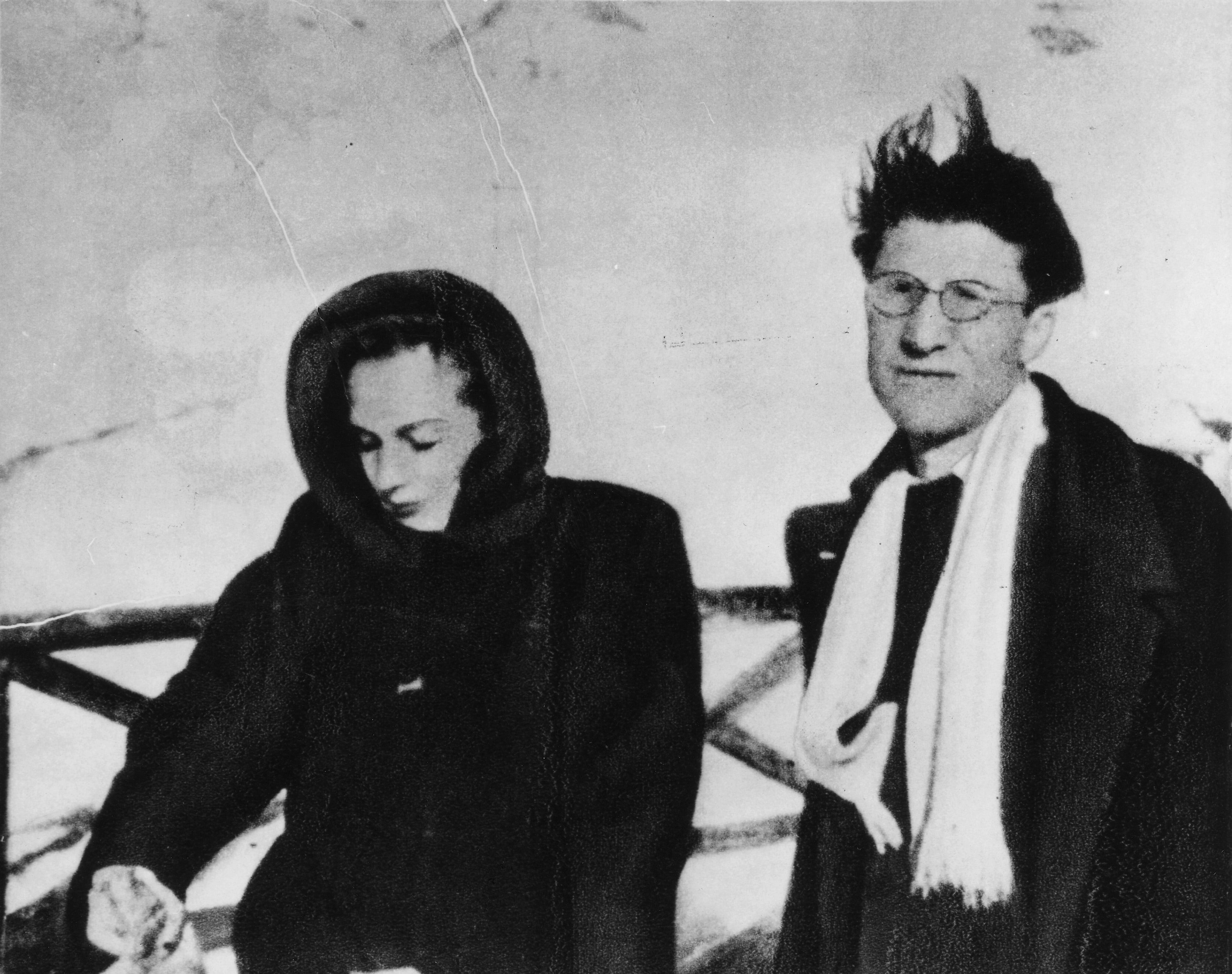
Faced with the regret of not feeling loved, the poet Cesare Pavese had written in his diary: “All this is disgusting. Enough words. A gesture. I will not write more.” A few days before committing suicide, he confessed to his friend Pierina that he had never woken up with a woman at his side, that he had never experienced the look that a woman in love directs at her lover. He had not even gotten from his mother the maternal love that every child deserves. Nor did his introverted, sour, pessimistic character and ashen face help him win over a woman. Pavese’s last frustrated love affair was with the American actress Constance Dowling, famous for her hazel eyes, during the filming of a film in Rome. The poet in love offered her marriage, but she married someone else. To this helplessness we owe one of his most desperate verses: “Death will come and have your eyes.”
I imagine Cesare Pavese that Saturday, August 26, 1950 in Turin with a briefcase in his hand in which he carried his book Dialogues with Leucó and no clothes, crossing Carlo Felice Square, in front of the Porta Nova railway station, a central place in the city, towards the Roma hostel, located under the arcades. There he asked for a room. He lay down on the bed dressed in his dark suit and white shirt; he loosened the knot of his tie; the bare, livid feet, light as two wings ready to fly. He had just gotten one last love snub, he had made three phone calls with no answer.
It was a hazy summer afternoon, the deserted city at that hour was permeated by the drowsiness that rose from the Po River. The sound of a motorcycle crossing the square sometimes reached that room on the second floor with the open balcony and the curtains floating. Maybe there was a happy girl in the carrier, in love, who was returning with her boyfriend from a day in the countryside. Perhaps the poet imagined what he had written. After a roll in the grass, “the girl, sitting, grooms her hair / and does not look at her companion, who is lying down, with his eyes open.”
There are things that one cannot forgive oneself. I will not forgive myself for not having visited that room at the Roma hostel when I passed through Turin on one of my trips. I knew what she was like from the way the writer Natalia Ginzburg described her when she visited her seven years after Cesare Pavese had committed suicide. They had been very friends, they worked at the Einaudi publishing house, both were retaliated and exiled by fascism. Upon entering the hostel, Natalia found the daughter of the family behind the counter. Everything was the same in the hall. The two radiators, the red carpet, the two threadbare armchairs, the blurred mirror. The receptionist told him: “I know what you’re looking for. It’s room 346 on the second floor.” They went up and she opened it with the key she had in her apron pocket.
In the room, time had stopped with the air stagnant just as death had left it. The same narrow bed with an iron headboard, the coat rack, the chair, the wooden table, the plastic lamp on the nightstand where the poet, before taking the seven tubes of barbiturates, left writing in the space of a page of his book Dialogues with Leucó: “I forgive everyone and I ask everyone’s forgiveness. Don’t gossip too much.” Nobody had touched those belongings. In front of the bed, Natalia thought that her friend never had a wife, children, or home of his own. She knew about all her love failures, first with herself, then with Battistina Pizzardo, an activist of the Communist Party, then with Bianca Garufi, another writer. I remembered him as stubborn and lonely, an impossible lover, always in love, writing in smoky cafes. The writer began to cry.
I open your book of Pavese poems this day when the sun of a radiant spring invites you to do everything, except suicide. Leo: “Oh, how long has it been since I played Malay pirates!” Other days, other games, other outbursts of blood against more elusive rivals: thoughts and dreams.”
That Saturday evening in 1950, while the body of Cesare Pavese remained in the room at the Rome hotel, a festival with lanterns had been established not far from the square under the August moon; The orchestra of saxophones, trumpets and accordions sounded with the voice of a vocalist who sang sweet boleros of love, and girls with flowered skirts and boys with a lot of glitter in their hair danced with their bodies very close together, oblivious to the fact that Italy’s greatest poet remained dead for all the impossible loves behind the curtains of that open balcony. The music stopped almost at dawn. On Sunday morning, the hotel waiter, having received no answers to his calls, entered the room and discovered the body. At that moment perhaps the bells of the cathedral of Saint John the Baptist were ringing happily calling for high mass.