
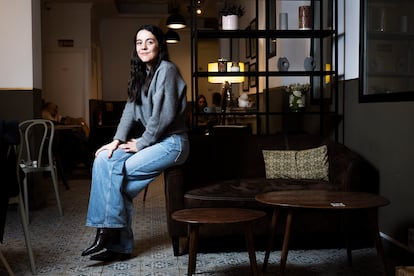
Valeria Castro is having a cheerful afternoon. He has just activated Spotify’s annual statistics, those that half of humanity shares these days on Instagram, and the platform has attributed an emotional-music-loving age to him of 80 years. And she, a Taurus of 99, accustomed to having the sambenito of old man, It is not willing to be offended by the designs of machines or algorithms. “This is what happens to me for continuing to listen to Silvana Estrada and Sílvia Pérez Cruz so much,” she reasons, resigned. And it breaks.
Indeed, the news is that the author of warrior, take care of yourself, loneliness o it has to be easier (yes, she is so modest that she writes all her titles in lower case) she has recovered her humor, her humor and even her capacity for self-parody. In the course of the conversation, a long hour of confessions and some sweets in a friendly cafeteria in Chamberí, the smiles more than subdue the tears, which sometimes feign but do not even find enough reasons to flow. And this surrender of sadness had not happened since that fateful October 13 when the singer-songwriter from La Palma starred in an unattractive performance in Operation Triumphwith an agonized voice that did not seem like his own, and dozens of anonymous vigilantes proceeded to a cruel stoning process on social networks. Three days later, the artist announced in a statement “a small pause on this path to recover physically and mentally.”
“I faced a family mourning in the summer (the death of her grandmother) and a period of a lot of mental noise. No one teaches you how to handle yourself in such a strange and exposed world of work, so capitalist and prone to vertigo,” she reflects now after these seven weeks of retirement (she prefers to talk about “sick leave,” as the medical reports clearly certify). “We live in a world in which external noise is so aggressive that therapy becomes as necessary as your regular doctor. And my psychologist explained to me that my wounds were no longer healing just with the small band-aids that I had been putting on until then…”.
Castro has recovered his lucid and affable tone, his loquacity and his proverbial bonhomie, although he does not feel like remembering in all the details that television Black Monday, preceded by a performance at the Gran Teatro Falla in Cádiz in which an attendee wrote, ruefully, to this journalist: “She doesn’t look like her. Do you have any idea if something is wrong with her?” “On TV day I already knew the reality that lived in my head,” summarizes the artist. “And from then on I faced not so much crying as emptiness. We wrote the statement at my representatives’ house and I understood how lucky I was to have a human team that not only works with me, but has taken care of me like a glass.”
That same morning, Valeria deleted all the social networks from her cell phone (“now I have reinstalled them, but I am entering little by little”), canceled trips, postponed a handful of concerts and began a healing process that today reaches its culmination: the Mar de Vigo auditorium will attend her happy reintegration into the maelstrom this Monday. “On the day of the announcement I reluctantly agreed to stop,” this three-time Latin Grammy candidate, author of the central song of The 47 and recent Ondas Award. “Since that same Thursday I have not stopped mentally visualizing my return all the time. Along the way I have understood that I have gone on many stages out of extreme self-demand, and that cannot be. I had many accumulated psychological vices. Not the others, because I am very healthy, but I ended up incurring in an almost entrepreneurial dynamic, in that artistic ambition of wanting to be everywhere. After having limited the time of my life, now I come out more human from all of this.”
He thought that with the rest, the pause and the disconnection he would start writing songs and more songs, but what the hell. At first I had enough to bear the discomfort. Then came the most complicated part: rediscovering her very personal and unmistakable vocal performance, so fragile, beautiful and focused on the tremolo. “It has taken me a long time to listen to myself and think that my music has value. And I have sung a lot, a lot at home. I guess the neighbors are fed up!” More laughter.
She hasn’t been alone. The messages of affection between professional colleagues were so overwhelming that she suspected that the mockery and jokes, the merciless mockery, would continue on the networks. It didn’t surprise him either: she is sweet, but not candid. “I am a child of immigration and I have known hatred, but I refuse to accept that the world is doomed to it.” She has been cared for, pampered, and even invited home by her friend María Rozalén, a companion in singing-songwriter fatigues and a trained psychologist. And she has become a regular student of the Argentine Patricia Ferro, a singing teacher and music therapist, a petite and temperamental woman who has also had among her pupils illustrious figures of Spanish pop-rock such as Pucho (Vetusta Morla) or Antonio García, the leader of Arde Bogotá.
Patricia has been “the decisive piece in healing the shortcomings”, the first to make him understand that an artist writes about sadness because he has already experienced it. AND in the body after all (March 2025), his beautiful and heartfelt second LP, already contained a lot of concentrated pain, although in spring almost no one realized it.
– Not even in your closest environment?
– Not even. The other day my mother, who is also a family doctor, told me this. “Daughter, I stopped to listen to the album more carefully. I hadn’t even realized that you were so bad!”
The good thing about the falls, in short, is the renewed momentum of reactivation. The pandemic catastrophe did not make us come out better, Valeria assumes, but she does feel more established and secure now, more willing to “contribute a little light, even if she is not the savior of the world or anything.” Embarrassed to have deserved so much attention and affection, committed that her case “can serve as a mirror for other people to undertake a therapeutic process.” And even determined that the public powers sink their teeth into the dilemma of mental health once and for all. “We have to look at it very seriously. Therapy cannot be a privilege. It must be included in public health systems and prejudices must be overcome. It is a problem that affects us all.”
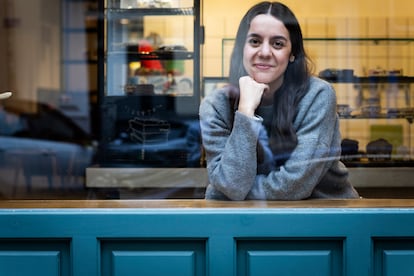
– And you really haven’t written any new songs in the last two months?
– Well, for a week yes, although almost as a therapeutic exercise. Many have started to appear, but I haven’t reviewed them yet and I don’t know if any of them will work or if they will all stay in the drawer. Of course: I have confirmed that communicating through songs is my authentic mother tongue. Now, while you and I talk, it’s as if I were expressing myself in a second language, as if we were speaking in English…
On the same day of this coffee, that office that takes care of Valeria Castro “like a crystal” announced that the Canarian would undertake the most massive concerts of her career in 2026, in separate pavilions in Madrid (January 9), Tenerife (March 21), Gran Canaria (July 26) and the Palau Sant Jordi in Barcelona, on October 30. They will be four splendid occasions to listen to Valeria at the top of her lungs, in her mother tongue.