
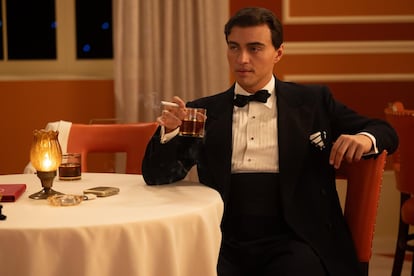
Tonatiuh’s smile gives him away. No matter how big and sincere she is, she shows the tiredness on her face. The 30-year-old Los Angeles actor is at the peak of his career, but getting to the top is difficult and leaves him without oxygen. In a talk from the living room of his Los Angeles home, he acknowledges Its (as his friends call him, shorter than the artistic Tonatiuh and much longer than the authentic Tonatiuh Elizarraraz) who sometimes feels “out of touch”, shocked by all the work he has done and continues to do and then returns every night to his normal life. As he summarizes, as a good representative of his generation, “a bit like Hannah Montana”, with a double life.
It is normal for Tonatiuh to be exhausted. In just a few months, he has become one of the most powerful names on the film scene. With a career that spans a decade in short films and series, now co-starring alongside none other than Diego Luna and Jennifer Lopez (who is also a producer) the film kiss of the spider womandirected by Bill Condon. The desired project has made Tonatiuh get into the shoes of the prisoner Luis Molina, who, imprisoned, lives in a dream of fantasy and films from the forties. That has made the actor sing, dance and lose 20 kilos.
The Angeleno is a first generation American, born to Mexican parents: “I, as the son of immigrants, have always been the little lawyer or the doctorcitoor the translator,” he says, helping his parents with the language, like so many descendants of migrants. “And I have always felt a great disgust for injustice.” When he was younger he even had a scholarship to study law, but he admits that right now he does not see himself in that role. “It would be unbearable,” he laughs. But he does not stop being a lawyer for the causes that touch him closely, and now that his voice is more public, it is even more so. In the conversation he does not hesitate to speak—in more than correct Spanish— of the harshness with which his country treats the migrants who have worked so hard for it, expelling them, of the importance of maintaining pride, of raising one’s voice for the community.
And that says that he was the last to enter the casting of the movie. He sent his audition at the end of December, for which he learned to dance tango, and they only told him that they were still looking. He spent that night with his mother, they lit a candle, he asked God to help him let go of control, to flow (“I have a very obsessive mind,” he admits)… and the next day they announced to him that the role was his. The role of Luis Molina, a homosexual locked up for public scandal in the Argentine dictatorship, portrayed in Manuel Puig’s novel, was now in his hands.
However, there is a lot of Molina in him, a man who does not purposely seek to break molds, but for whom breaking out of the mold is part of his life. “Since I was a child I never understood the obsession of people telling other people what they should like, or what they should do. I was always very stubborn about that. I mean, if I wanted to play with dolls or if I wanted to dance, sing… I hated it when people told me that it was wrong for a child to do that. That point of telling people ‘Who are you to say that?’, I have always had it. And in my youth I have always loved to transform and modify, to play with different cultures, different groups of people. friends, learn different music. I have an unbearable hunger for life,” he admits, laughing.
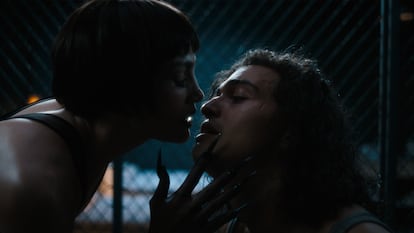
He had that taste for creating, playing and transforming since he saw his first musical, Wickedat the central Pantages theater in Los Angeles, with some friends from school, when she was about 12 years old. “I remember very clearly seeing the magician and saying: ‘What a beautiful life he has! I want to live those lives!’. Since then, I have had this obsession with musicals, and the ability to be transported to a world with a single song has always enchanted me,” he admits. Hence, the fact that this is his first big project, with Condon, Lopez and Luna, is even more special for him. That’s why he has put his all into it, taking classes, learning and losing 20 kilos in 50 days.
It would be so ugly to forget where I come from, it seems so ridiculous to me…
Tonatiuh, actor
Despite having participated in two dozen projects in the last decade, such as the series Life, Hidden Canyons o a crazy houseit has been this film that has given Tonatiuh more visibility and, also, a speaker. For him, the Latin community he knows is made up of “the most hard-working people,” who “live with joy.” “What I love, more than anything, is that our film can remind people of this dignity, and it is also a way to remind Hollywood that Latinos have always been (part of it). There is no latin Hollywood”, he explains.
As the son of Mexican immigrants, he is aware and concerned about what is happening in the United States, with frequent and indiscriminate raids against Latinos. He, an American by birth, explains that this year he obtained his Mexican passport. “I carry it with me all the time. Not because I feel like I need it, but to have it when I go into places with people with privileges who are not thinking about it, to remind them when they are interested in getting to know me. I don’t want them to erase what is happening to my people with how extraordinary what is happening to me is, because right now everyone wants to hold my hand and kiss me and compliment me, but at the same time I take out my passports and tell them: ‘I’m one of these too.’
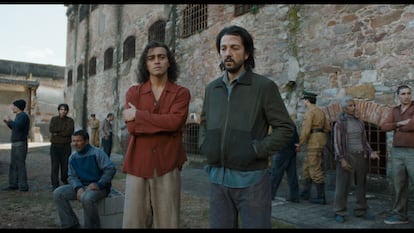
That of Molina and kiss of the spider woman It is also a story of the community queer, of which Tonatiuh feels part. But is it still important for him to tell stories about her, even late into the 21st century? “Yes, completely. What I love about both communities is that they come from a history deeply full of resilience,” he reflects, about Latinos and the LGTBQ community. “They both need that resilience, that tenacity. They need that fang to maintain dignity, to maintain freedom, to fight, to remind people who we are. Because they want to humiliate us, they want to make us small.” Tonatiuh has been aware of that sensation since he was very young, as he recalls. “I remember, as a child, having a certain confusion, being ashamed of something, as if I had a secret. But I said: ‘Why? If that’s my superpower (superpower)!’ My identity is part of who I am. “I am not a politician, I am an artist, and as an artist it gives me so much joy to be able to share and create spaces of joy for those communities.”
These spaces are not just figurative, nor are they pretty words. He excitedly tells how every year, every summer, he returns to the high school where he himself studied, and teaches acting to those teenagers. Just a few days ago, he just bought a screen for that institute and invited them to see the film, “to say thank you.” “And they cried in my arms because they could never imagine that something like this would be possible,” he says. “They know me, and I know them. And it would be so ugly to forget where I come from, it seems so ridiculous to me… Because I am very proud of that.”