
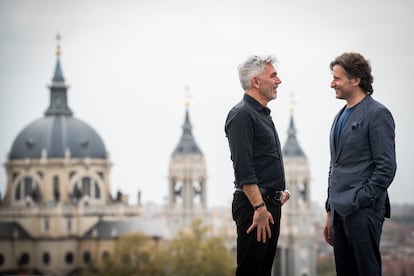
Maestro Gustavo Gimeno and stage director Laurent Pelly walk around the new roof of the Teatro Real, a large terrace covered with photovoltaic glass tiles that, on a sunny morning like this, can generate enough electricity to illuminate an entire performance of The bride sold, by Smetana, which premieres next Tuesday. “Maybe not so much,” jokes the orchestra director, and points to the dark cloud that covers the Guadarrama mountain range and threatens a storm. “Working here is another level,” Pelly says in French as he descends the stairs. “Maximum demand, but with everything necessary to live up to a challenge like this.”
It had been 102 years since the Madrid Coliseum had programmed the Czech national opera par excellence, a precursor of the great tradition that Dvořák and Janáček would later consolidate. “There were two performances at the Teatro de la Zarzuela, back in 1973, but then it was forgotten,” says Gimeno (Valencia, 49 years old). “And I don’t understand it, because it is very beautiful and very accessible music.” After the emotional intensity of The angel of fire, Eugene Onegin y Bluebeard’s CastleGimeno’s body asked for a comedy. “Smetana’s score is intimate, elegant, melancholic, but above all funny. During yesterday’s rehearsal I couldn’t stop laughing…”
It refers to the third act of this entanglement about a young man who pretends to sell his beloved to evade a marriage agreed upon by the family. “Then a small troupe of comedians appear and everything goes out of control,” explains Pelly (Paris, 63 years old) back in the dressing room. “It’s a Fellinian circus, with disastrous acts and a bear… Very funny, but also a little pathetic.” The action takes place in a rural area of Bohemia in the mid-19th century. “However, the entire work radiates modernity thanks to music that constantly changes color,” he adds. “We are not facing a recognizable reality, but rather a kind of story.”
He too has changed his register after his last visit to Madrid, two years ago, with a superb adaptation of The Mastersingers of Nuremberg. Unavailable to the comfort of his own style, the French stage director has once again reinvented himself. On this occasion he has moved away from the monumentality of that Wagner with a montage inspired by the Czech school cartoons of the fifties and sixties that were shown on French public television when he was little. “The silhouettes, the costumes, the makeup and the scene movements connect with that naïve and graphic approach, in the manner of a visual fable that functions, at the same time, as a dream and nightmare of the protagonist.”
As soon as the curtain rises, three tons of furniture float above the stage. “This heavy cloud evokes the ridiculous side of property, because the script constantly talks about money and marriage as a social transaction.” Not by chance, a good part of the scenery, the costumes vintage and the props in this co-production (with the Lyon and Cologne Operas and La Monnaie in Brussels) come from recycled materials. “My goal was to move away from realism and invent a chaotic world full of possibilities. I don’t like to underline in phosphorite, I prefer to offer powerful images so that everyone can interpret them in their own way.”
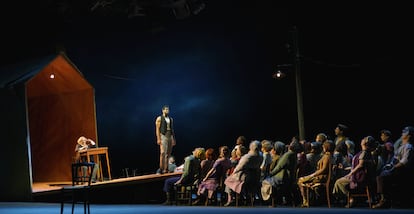
At his side, Gimeno proposes his own reading of the cloud. “The fantastic overture advances by accumulation of motifs that overlap, repeat, and ends up forming a compact whole.” It is the first time that he has conducted this score, but he has studied it so thoroughly that he has even located a motif that another great composer, born in the Bohemia of Smetana, borrowed for one of his symphonies. “Mahler loved The sold bride. He made the German version while passing through Hamburg and Vienna, and even officiated at its premiere in New York. It was one of those works that he always carried with him in his suitcase,” he recalls. “And after conducting it so much, he ended up quoting it in the final movement of the First.”
Gimeno has built a career deliberately open in terms of repertoire: from the visionary Messiaen of Turangalîla to the hallucinated Prokofiev of The angel of firefrom the heights of the Toronto Symphony podium or in the depths of the Royal Theater pit. “It is curiosity that marks the dates in my diary,” he boasts. “And here I have found a most stimulating intersection: The magic flutethe German Singspiel, the Italian opera buffa, some Offenbach… all fused into Czech folklore through their dances.” The very incarnation of the Czech national soul, but without literality, which earned Smetana many reproaches for his lack of patriotism.
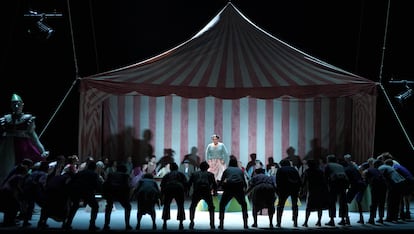
Pelly translates the references to polka, the raging and the jumpy in a lively setting: without dancers, but with very precise movements of the singers and a festive chorus that contrasts with the suffering of the woman over whom everyone is fighting. “What interests me about light works is finding darkness, and this story is a torment for the protagonist: having your loved one sell you is something quite violent and brutal,” reflects the stage director, who during rehearsals sings the first bars of the heartbreaking lament himself. The dream of love of the protagonist, to whom soprano Svetlana Aksenova will lend her voice until April 30.
The rest of the cast will be led by great specialists in this founding opera of the repertoire that, shortly before dying, its author himself defined in a disconsolate letter as “a simple toy”: the tenors Pavel Černoch and Mikeldi Atxalandabaso and the bass Günther Groissböck. “Smetana wrote The sold bride after losing his wife and three daughters, half deaf from syphilis and without the recognition he undoubtedly deserved, which did not prevent the score from exuding contagious joy,” says the musical director of the Teatro Real. “Composers do not always reflect what they are experiencing. “Sometimes music is the only escape.”