
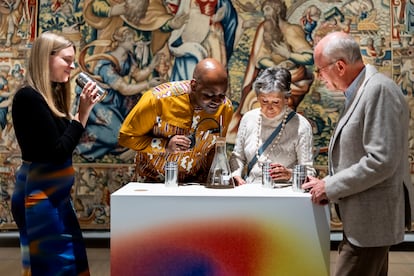
Not everything can be smelled at the Kunstpalast in Düsseldorf. Nazism, for example. When the curator of the exhibition reached this traumatic episode in history, he decided to ignore it, not diffuse any aroma in the room and limit himself to citing some cultural notes of the Third Reich to continue with its consequences, the smells of the years of the Cold War. Robert Müller-Grünow has designed an exhaustive historical tour, from ancient times to the present, around the aroma and its hidden power spread across 37 galleries. The challenge was to expose something that cannot be seen and that must be created – the smell – and faithfully accompany it with the works of art from the museum’s historical collection, one of the Rhineland’s treasure chambers.
The aroma of the cosmos, for example, is displayed in an elevator. It is a smell that greatly bothers astronauts and requires preparation. NASA captured some air samples (space particles, there is no atmosphere in outer space) so that Müller-Grünow could reproduce the aroma with the purpose of habituating the sense of smell of future cosmonauts. The compounds stuck to their suits after a spacewalk react when they return to the International Space Station. “The result of the gas chromatography analysis is a formula that accurately shows the chemical composition present in outer space and its smell. This is how we recreate the fragrance,” explains the curator.
He then installed it in the elevator, a work from the Kunstpalast catalog by Argentine conceptual artist Leandro Erlich, which plays with the idea of infinite space. Instead of the ground, the forklift projects a fall into the void with no recognizable limit. Once here, it is enough to approach a gap opened in the floodgates to smell outer space, the cosmos, the infinite universe, which gives off a ferocious sulfurous breath: it causes immediate nausea. It smells like a burned railway.
Aromas are a very powerful weapon that has the ability to create illusions. “They are purely emotional, the only sensory stimulus that is not filtered rationally,” says Müller-Grünow, originally from a city with a perfume tradition like Cologne, pioneer of aroma technologies and author of The secret power of scents (The secret power of aromas, Edel Books, 2018), a title it shares with the exhibition, which can be visited until March 8.
With synthetic laboratory molecules, the smells of leather, a vanilla dessert or rain can be artificially reproduced, that natural aroma that arises when it rains on dry land known as petrichor, which is achieved through the chemical synthesis of the geosmin molecule. The human genetic material has 400 olfactory receptors and their activation varies in each individual, so each person perceives odors differently.
The first room is dedicated to the role of aroma in religion. All confessions have used smell to stimulate their followers and make the sacred tangible. The museum corrects the Bible, a literary work of antiquity with a lot of fiction, and postulates that the gifts that the Three Wise Men brought to the baby Jesus were incense, myrrh and, instead of gold, a noble metal impossible to find, benzoin. It is a natural resin – displayed in an urn with a diffuser – that exudes a sweet, addictive and heavenly vanilla aroma.
Buddhism and Hinduism prefer woody notes such as sandalwood or agar. Natural agarwood is among the most expensive raw materials in the perfume industry along with ambergris, a secretion of the sperm whale, at tens of thousands of euros per kilo.
The tour continues through separate rooms with large curtains so that the olfactory notes do not escape. The penetrating smells of the autumn forests follow one another, of sensuality and status in the 16th century embodied in the rose and the civet, of the spices that were traded in the 17th century such as cloves, nutmeg and cinnamon, of the streets of Paris and Versailles in the 18th.
By pressing a button you can smell the fascinating and animal aroma of the galaxolide and hedione molecules, which are associated with the release of sex hormones. They are invisible seducers that increase our perception of attractiveness and subconsciously influence our choice of partner.
The smell linked to colors, memory, fear and trauma, and war is shown. “The room dedicated to the First World War,” says Müller-Grünow, “takes advantage of the work done earlier for the Museum of Military History in Dresden, which was much more drastic, as it also included the smells of corpses and death. Here we only use the aroma of gunpowder with a note of blood (like an iron smell).”
The smell of the Roaring Twenties is enveloped in the fragrance Tabac Blond (1919), by Caron, and in the large-format canvases of Otto Dix and Gert H. Wollheim. Immediately, the room dedicated to Nazism appears, where no odor is diffused but it is noted that the ideal of “simplicity, purity and national community” of the propaganda of the Third Reich was incompatible with perfumes, and canvases by persecuted artists such as Max Beckmann, or blessed ones such as Leo Poeten, with superb oil paintings like their Portrait of Miss Str.
Arte ‘underground’
After the odorless barbarism, comes the divided Germany of the Cold War. “Exposing the scents of East Germany was only possible thanks to the collaboration with a local perfumer who grew up in the GDR and knew exactly the key scents that defined his identity,” says Müller-Grünow. Among them, the smell of the Army barracks or the Trabant’s two-stroke engine.
In Düsseldorf, the city of Kraftwerk, Wim Wenders and the great collectors of avant-garde art, capital of North Rhine-Westphalia (historic heart of German industry), there was a bar that reached the stature of a myth. The Creamcheese on Neubrückstrasse 12, a stone’s throw from the Academy of Fine Arts, was a club by and for artists where Frank Zappa and Can performed, Joseph Beuys speculated with his performances, Heinz Mack designed the bar, Gerhard Richter painted his characteristic mural and where artists such as Imi Knoebel, Blinky Palermo and Katharina Sieverding served the drinks. The Kunstpalast, which acquired its interior in 1978, has reconstructed the gambling den inside the museum and now remembers its fumaroles of tobacco, sweat, whiskey, rum and beer.
There are fewer perfumers than astronauts in the world. It is estimated that there are close to 500 professional perfumers – some experts lower the figure to barely a hundred – a career without formal studies although related to university training in chemistry. “We smell every moment of our lives, every time we breathe. We are simply not aware of it. Very few people know the hidden power that smell has,” adds Müller-Grünow.