
Turkish drama Gelbe Briefe (Yellow Letters), by Ilker Çatak, has won the Golden Bear at the Berlinale 2026. Shot in Germany, and without hiding it on the screen – one poster reports “Berlin as if it were Istanbul” and another explains: “Hamburg as if it were Ankara” – the new film by Turkish-German Çatak, who was nominated for the Oscar for international film with his previous work, teachers room, uses classic film footage to illustrate the destruction of a family. The happy life of the protagonists explodes when the Government sends a dismissal letter to the father, a university professor and playwright (the title refers to those yellow letters) for being “unpatriotic”, which drags down his wife, a successful actress, and those around him, mainly his daughter. They lose their jobs, they lose their home. And therefore, they face the dilemma of defending their ideals or giving up and moving forward with their lives.
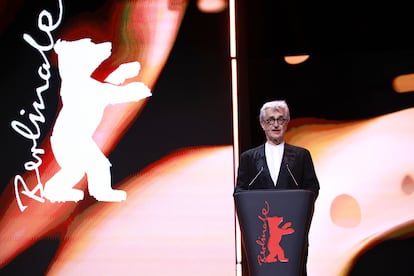
To the jury, chaired by Wim Wenders, Yellow letters It made them feel “chills.” “We saw his film as a terrifying premonition, a look into a near future that could also occur in our countries.”
And yes, for the first time the genocide in Gaza was spoken loud and clear, because several winners recalled everything suffered by the Palestinian people in the Strip, after throughout this edition various filmmakers and the Berlinale organization had decided not to comment on the Israeli invasion, despite honoring the Iranian and Ukrainian people.
Win Wenders assured that for him and his colleagues the first three awards were equal, that they considered the trio of awarded films at the same level. By the way, he deeply thanked Tricia Tuttle, director of the contest, for her support during these days, since at the first press conference she said the words that have echoed since that day: “We have to stay out of politics. We are the counterweight of politics, the opposite of politicians; we must do the work of the people, not that of politicians.” The beginning of a debate that this Saturday marked the awards ceremony. On the closing stage, Wenders defended himself, explaining: “We need to unite activists, filmmakers and journalists. This is how we will confront the terrifying, out-of-control world we live in.”
At the end of the ceremony, Tuttle herself defended the right of any filmmaker to speak “on any topic” or to remain silent, if they preferred to communicate through their work.
The Kurdish Emin Alper, when collecting the Silver Bear Special Jury Prize for the Turkish Liberation, He made an emotional speech in which he recalled the pain of the Palestinian people (“You are not alone”, words received with little applause and shouts of “Free Palestine”), the suffering of the Iranian population (“You are not alone”, and here there was a much bigger ovation) and, finally, that of his Kurdish compatriots, reciting the names of imprisoned friends.
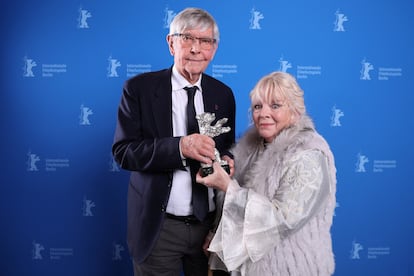
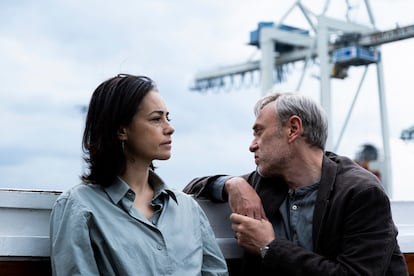
To Queen At Sea, by Lance Hammer, were the Bear Prize of the Jury and the one for the best supporting performance, shared by two classics of British acting, Tom Courtenay (it must be remembered that he debuted on the big screen in 1962 with The loneliness of the runner background) and Anna Calder-Marshall (now that there is a lot of talk about Wuthering Heights, she starred in a very interesting version in 1970 alongside Timothy Dalton). Hammer thanked the two actors, who play an elderly couple in which she suffers from the deterioration of dementia, and Juliette Binoche, the on-screen daughter of the sick woman and stepdaughter of her husband, for their work. Calder-Marshall, who barely says a dozen words during the footage, took the opportunity to talk about his work and the collaboration between the three.
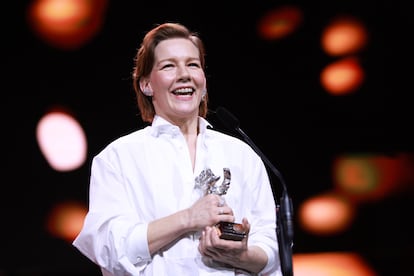
The Silver Bear for best lead performance (there is no gender distinction) was won by Sandra Hüller for Rose, where she plays a woman who in the 17th century poses as a former soldier with his face disfigured by a bullet to claim a farm that is not hers. Hüller, who achieved fame in Europe for Toni Erdmann (2013) and then the world championship in 2023, for Anatomy of a fall y The area of interest, I had already achieved this Bear in 2006 for Requiem, his first feature film.

The award for best direction went to Englishman Grant Gee, another creator who grew up making music videos, who has applied that experience in Everybody Digs Bill Evans, which illustrates the life of the legendary jazz pianist from June 1961 until his death (the date is important, due to the personal and artistic breakdown he suffered). On stage, Gee assured that his work, in black and white and with certain experimental airs, had been very easy to do for one big reason: “I chose the best possible team.”
The Silver Bear for best screenplay went to Canadian Geneviève Dulude-de Celles for her film—which she also directed— Nina Roza, starring an art curator who acquires works for a millionaire, and who returns to Bulgaria—where he left 28 years ago with his daughter, after his wife died—to see if it is true that there is a painting genius in the form of an eight-year-old prodigy. On that journey he will face the lost emotional territory, and will nourish the feeling that, despite everything, the double journey was not in vain: that of exile and that of returning home.
The award for best artistic contribution went to Anna Fitch and Banker White, for their work on Yo (Love Is a Rebellious Bird), a film very based on a dollhouse and how to overcome the pain of loss through puppets. In the list of winners, some recognition was missed for the American Josephine, by Beth de Araújo, and for the Mexican Flies, by Fernando Eimbcke. The jury led by Wenders awarded films that were more classic in their form. Besides, Josephine He had just won the two most important trophies at Sundance: at the Berlinale the organization regularly programs films from the American competition that are then usually disregarded by the juries.
In addition to the aforementioned Emin Alper, other winners spoke about the genocide in Gaza. Marie-Rose Osta, who won the award for best short film for Yawman Ma Walad, in which a Palestinian child has powers to shoot down Israeli planes in Lebanon, said: “The children of Gaza, all of Palestine and my Lebanon do not have superpowers to protect them from Israeli bombs. No child should need superpowers to survive a genocide powered by the right of veto and the collapse of international law.”
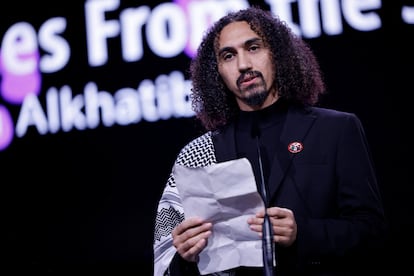
More tension was experienced when the Palestinian-Syrian filmmaker Abdallah Alkhatib, who won the award for best first film for Chronicles From the Siege, life in an anonymous city under siege, accused the German Government of being “complicit in genocide by Israel” in Gaza. “Some people told me that maybe I should be careful before saying what I am going to say now, because I am a refugee in Germany and there are many red lines. But I don’t care. I care about my people, I care about Palestine. So I address my last words to the German government: you are complicit in the genocide in Gaza by Israel (…). You are intelligent enough to recognize this truth, but you choose not to. Free Palestine, from now until the end of the world.”
Following her words, the gala’s presenter, actress Désirée Nosbusch, noted: “Cinema often reflects the conflicts of our world and, of course, also the deep pain that we fear and feel. These are the voices of artists and filmmakers. And that does not necessarily reflect the position of the Berlinale as an institution.”
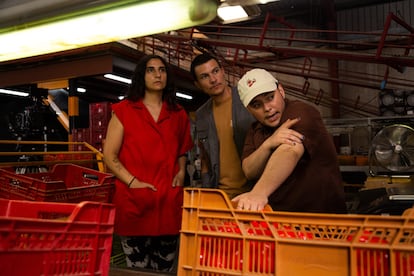
Among the rest of the awards, the one received by Ian de la Rosa stands out, the only Spanish filmmaker present at the Berlinale, whose feature debut, Ivan & Hadoum, screened in the Panorama section, it won the Teddy award, the most consolidated and prestigious trophy (in this edition it celebrated its 40th birthday) among the film awards intended for films about the LGTBI community. “We made the film trying to hug the viewer and we have felt this hug back with the people here, the public here. It has been very, very nice,” said De la Rosa from Granada on the red carpet prior to his recognition ceremony.