
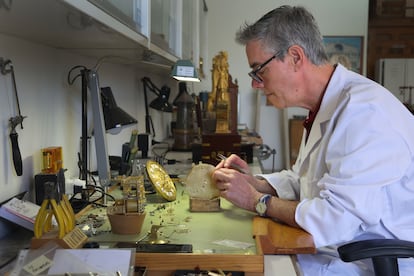
When twelve o’clock strikes, the place becomes a burst of bells. The weak sounds allow the voices to continue being heard, but José Antonio Gismera prefers to remain silent, leaving the spotlight to a solemn ritual that he already knows. High-pitched sounds, some less so, uncoordinated, melodic, playful. When they stop, he continues with his words: “They have been in operation for many years, and although they behave well, they have their wear and tear. Normal. You have to take good care of them because they are unique, go calmly, but without being overwhelmed by responsibility.”
He thus speaks of the 230 antique clocks of the Royal Palace of Madrid that, for more than 30 years, have only passed through his hands when the passage of time they spend marking takes its toll. In his workshop on the fourth floor of the 18th-century building, with views of the Plaza de Oriente and the Teatro Real, more than 10 varied pieces rest on the tables that the Palace watchmaker retouches a few days before sending them to the Gallery of the Royal Collections in Madrid. They will be displayed there at the exhibition The precision of time. 19th century clocks in the Royal Collectionsfrom March 26 to September 20.
Theirs are part of the nearly 740 that National Heritage protects in the different Royal Sites, one of the most important watch collections in the world, spanning from the end of the 16th century to the first years of the 20th century. “One of the most special things about this set is that almost all of them work and are in progress,” says Amelia Aranda, curator of the National Heritage Watch, Silverware and Luminaire collections and curator of the exhibition. They are found everywhere: rooms open to the public, others that are not, offices, hallways, workshops. Many of the places they have been in for hundreds of years and for which they were acquired. “Now that we are removing them,” Aranda says with a laugh, “some workers have told me: ‘Don’t take my watch!’. They don’t know how to work without its sound. And there are others who tell me: ‘Please take it, I can’t take it anymore.'”
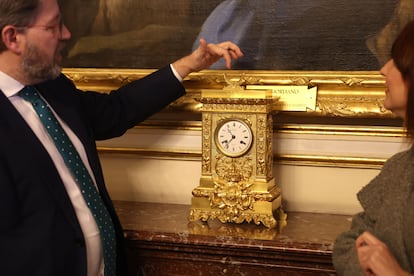
She, together with the Gallery’s director, Víctor Cageao, has selected a small sample of just 17 pieces, all from the 19th century, to exhibit to the public, almost all of them for the first time. “In 2011, an exhibition was held with clocks of Ferdinand VI, Charles III and Charles IV. That covered the 18th century. This new exhibition completes that story with the 19th, focused above all on the clocks of Ferdinand VII and Isabel II,” says the director from the palace stewardship, with a nice clock in the background. Nice in name, not because it is friendly or pleasant, but because it is made to place a pocket watch in a cradle above, which regulates it, synchronizes the time and winds it automatically: a unique piece – there are five or six in the world – by Abraham-Louis Breguet, perhaps the most famous watchmaker in history.
“They are works of art,” Cageao continues, “at the same time top-level technological advances, and testimony of the kings’ own tastes.” But the 19th century presents a special attraction. With industrialization, costs were reduced and made it possible for, for the first time in history, time to stop being the heritage of a few—or to be available only in the church tower or the town hall—to become a good available to everyone. “It is a very fast century of progress,” says the director, and although those in the exhibition are still luxurious items of kings, they do “allow us to see the rapid changes in typology” and how their decorative function was converted into utility.
Jaime Villanueva
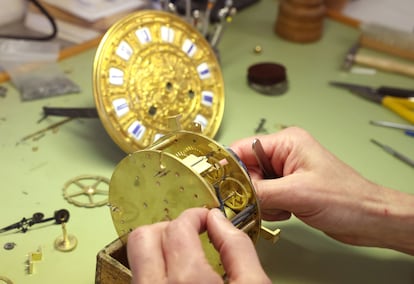
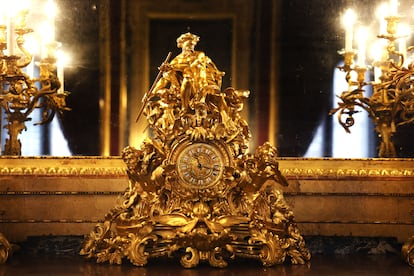
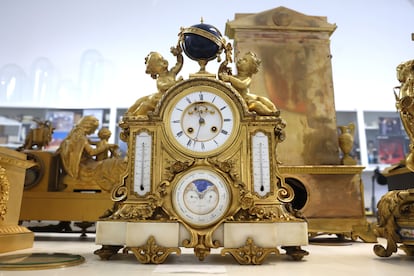
The baroque French clocks from the beginning of the century, a devotion of Ferdinand VII, very ornate, gold-plated, but with simple machinery, gave way to other English ones, from Isabel II, much more varied, without many ornaments, but more effective and complex. Some of them have a headboard, a tall case—with a large pendulum with a weight mechanism hidden inside a wooden box—, or skeletons that show the gears, “sometimes out of pure pride of the watchmakers, so that the wonder they had created could be seen,” Aranda clarifies. There are also more particular ones, such as a smoking automaton: a black wooden man who, at the rhythm of the seconds, brings a cigarette closer and further away from his mouth. The black manthey nickname him. “It has been difficult to make the poster for this one for the exhibition,” explains the curator, “because, of course, society is changing, but in the 19th century, these were called black watches, which I now understand is not entirely popular, although that is what they are, they represent black people because there is a whole literary movement that made these watches attractive and highly sought after.”
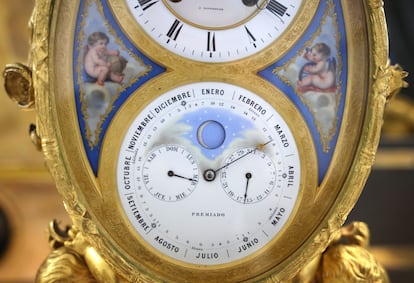
The best, he says, are the English. “If a Frenchman plays the halves and hours, the English also plays the quarters. They are more precise, they were the first to implement zodiac signs, calendar and equation of time (which shows the difference between true solar time, or sundial, and mean solar time, or conventional clock). We always say that if a Frenchman enters the workshop every 10 years, the Englishman does it every 50.”
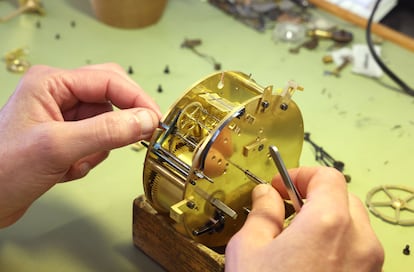
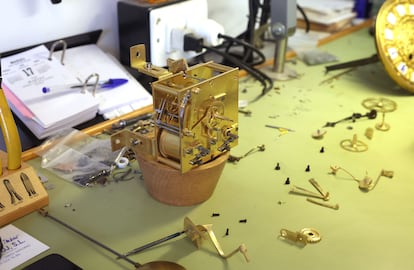
In practice, watchmaker Gismera, who agrees with the conservator’s assessment, says that the ideal is to give them thorough maintenance every six or seven years, although it depends on the needs of each one. Gismera goes through them every week in search of imperfections that he usually detects in the sound. “You can hear if a watch is round, lame or a little dodgy.” Check both the running and the sound of the ones they have. “Oil is usually the usual problem. We make sure there are no breaks, so we bring them in, dismantle them, clean them and change the oil, which usually thickens and slows down the mechanism until it stops permanently,” he says. However, time does not forgive them either and the wear of such delicate and small pieces ends up being inevitable. Gismera himself manufactures the parts that are needed in his workshop: “From a screw to the pivots, counters or pins. There are no spare parts and there are things that wear out due to use.” The important thing is to keep them alive.
Jaime Villanueva
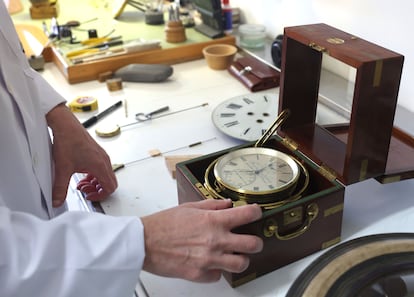
Of all the ones he cares for, there is one he likes in particular. “It’s cool,” he says as he delicately opens a small wooden box with a simple clock in the center. There are no frills or luxuries. It is a marine chronometer, a watch designed to operate on the high seas. “What it does is that it adapts to the movement of the boat so that it does not influence the movement,” he says while shaking it slightly to demonstrate how the machine balances and stays level. That not only gave sailors the time, already accustomed to measuring it with the sun, but it was a revolutionary navigation tool that boosted transatlantic routes by allowing ships not to deviate from the exact course. It marked on board the time of a terrestrial reference point (Greenwich) which, compared with local time, allowed the exact position of the ship to be determined, a solution to the eternal marine problem of longitude.
It also falls to him, and him alone, to perform the seemingly easy tasks of winding everyone up once a week and changing schedules twice a year. The time change this Sunday, which will catch some watches already at the exhibition, is, he assures, “the easy one.” The difficult thing is not to advance an hour, but to set it back: “It is more difficult because you cannot go backwards, or just turn around, because if it has a calendar, you have to give it 24 hours so that it does not change at 12 noon.” Since only he touches the gears of the Palace pieces, he divides the task into three days.
He joined as an assistant when he was barely 20 years old, before taking the opposition to keep the position in a department that, little by little, has reduced its number of personnel. The generational change does not seem easy. “What you do here you learn by doing, there is no other way. You have to go from less to more,” he says. He learned from “the best” and now, at 57 years old, he has no one to teach. “It is a job of patience, but one that is very good,” he says. His charm, I warn those interested, also brings some side effects: a perfectionism that makes any watch Gismera finds unfocused if it doesn’t work, and a slight obsession with his work. “You leave and say: ‘Damn, let’s see how I find him tomorrow, let’s see if he played well or if he didn’t play well,’” he says. And another: “I’m leaving here and continuing with the ticking.” A small sample of what he feels can be heard by those who visit the gallery these months. Almost twenty antique clocks in operation. And its quarters, halves and hours will reverberate relentlessly throughout the building. Let’s see if any disciples emerge from there.