
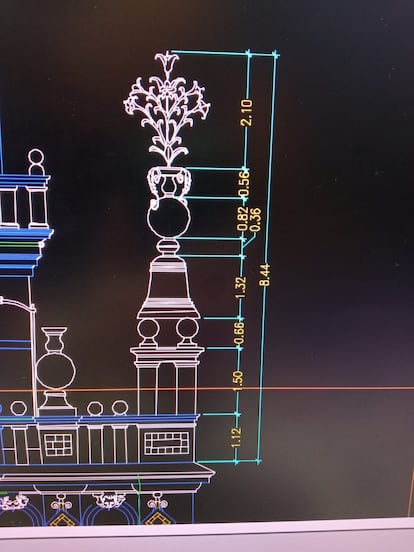
The strong winds of more than 70 kilometers per hour that accompanied the storm Leonardo This morning as they passed through Seville they caused the fall of one of the four lilies that escort the Giralda bell tower, just below the Giraldillo. The stone and bronze structure, weighing about 120 kilos, fell at 6:15 in the morning from a height of 69 meters, without causing any personal injury. The council, after carrying out a technical inspection by its technical team, has decided to open the tower to visitors normally, maintaining a security perimeter.
“The defect that led to this incident, since it was a hidden defect, was undetectable,” explained the conservative architect of the Seville Cathedral, Miguel Ángel López, in a video released by the council. The structure that has fallen is part of a set of four stone spheres, which support a bell made of the same material from the 16th century, on which rests another sphere, called aeolipile – which served as a cauldron to introduce pyrotechnic elements – and to which, in 1751, branches of metal lilies were incorporated, which, in 1980, were replaced by similar ones made of bronze to better resist corrosion. What fell this morning is one of those eolipiles and the lilies that crown it, weighing 120 kilos and measuring 3.85 meters.
The architect has indicated that the problem that caused the detachment occurred inside the stone bell on which the collapsed structure rests and that “therefore it could not be controlled by the reviews that are carried out periodically in the cathedral’s preventive conservation plan.” This plan includes four annual inspections, three of which are visual, “in which noticeable variations can be detected,” according to López, and a fourth that is carried out before Easter and in which “a check is carried out of all the elements that could present a danger of detachment” and in which other vertical work companies participate.
The few Sevillians who passed around the cathedral this afternoon, while observing the secured perimeter and looking up to the sky to identify the lilies, which normally tend to go unnoticed, could not help commenting jokingly: “The Giralda withstood the Lisbon earthquake, but Leonardo was able to handle it,” in reference to the 1755 earthquake that violently shook the Andalusian capital.
“I’m surprised that this has happened,” says José Miguel Puerta Víchez, professor of Art History at the University of Granada and one of the leading experts on Andalusian culture, who has closely followed the recent restoration work on the Giralda. “The winds have been very strong and we hope that this will serve as experience to secure the elements that may present some risk, because these types of winds are going to be repeated,” he indicates, to emphasize “the professionalism and seriousness” of the experts who work in the cathedral.
José Manuel Baena, president of the Sevillian association for the defense of the Ben Baso heritage, highly critical of the registration of the cathedral by the Church and that the Patio de los Naranjos is not publicly accessible, questions the prevention measures. “It is clear that this has been an accident and no one expected this storm that we are going through, but there are spaces that should be more controlled,” he maintains, to claim that, beyond the directing capacity that the council has over the cathedral and the Giralda, since it is a heritage property of humanity, its decisions should have some supervision by the Ministry of Culture. A reflection that is also defended by many experts in the case of the cathedral mosque of Córdoba and that resurfaced after the fire last August.
The cathedral’s technical team, made up of the architect, an engineer and the security director, this morning carried out a technical and visual inspection of the rest of the Giralda’s tops, to verify that, after the fall of the lily, there were no “other apparent defects”, according to López. This analysis has led them to recommend the opening of the 12th century Almohad tower which, with 2.2 million in 2025, is the most visited monument in Seville. Sources from the council explain that this group of experts offers the archbishopric absolute guarantees to adopt this decision that does not need to be agreed with the City Council or with another administration, in order to guarantee citizen safety in the face of the storm. These professionals will carry out a more in-depth review with auxiliary means to rule out the existence of danger and, until then, the security perimeter around the old minaret will be maintained.
This Thursday, once the intense wind has swept away the rain from Leonardo, Tourists raise their eyes to the Giralda, but their gaze stops before the Giraldillo. “Probably, if we had not found out that the lily had fallen, we would not have noticed it,” says Magda Logan, a Scottish retiree who has been stranded in the capital longer than she would like because, after changing her AVE ticket for the plane last Saturday due to the high speed being cut off due to the Adamuz accident, yesterday she could not go to Córdoba, as planned, because the storm has forced Renfe to suspend all train routes in the province. Sevillian. “The rain in Seville is not being wonderful at all,” he jokes.
Although few notice, the group of four lilies, as Baena recalls, “symbolically is very important.” “The coat of arms of the Church in Seville is the Giralda with two bars of lilies on the sides. It is, like the Giraldillo or the bells, one of the most emblematic elements,” he indicates.
The detached lily, as the architect recalls, is integrated into the Renaissance finish that is pending administrative procedures for its restoration. It is the last part of the rehabilitation process of the Giralda that began in 2017. The fall of the structure this Thursday has made technicians consider the possibility of advancing the work and dismantling the three lilies that have remained standing as soon as weather conditions allow, according to the conservative architect of the cathedral.