
On February 1, 2003, the Goya gala, the most important awards in Spanish cinema, was held, like every year. The great winner was then Mondays in the sunby Fernando León de Aranoa, a film with strong social content; but beyond gags, celebrities and big-headed trophies, the evening is remembered as the one in which the world of cinema shouted “No to war”, leading one of the largest social protests in the recent history of Spain. The demonstration in Madrid against the invasion of Iraq, two weeks later, brought together two million people, according to the organization (650,000, according to the Government). “The impact of the gala was enormous, but that cry was already in the street,” says stage director Andrés Lima, who was in charge of the show: “A large part of Spain did not want that war.”
There was so much sympathy for the cause that now President Pedro Sánchez has tried to recover that slogan – and it is understood that that spirit – to convey his opposition to the illegal intervention of Donald Trump and Benjamin Netanyahu in Iran. For some it is a purely electoral message; For others, even if it coincides with the president’s interests, it is welcome. Furthermore, that night was a milestone in the already proverbial animosity on the part of the Spanish right towards the film industry: the “puppeteers”, the “sufferers”, the “subsidized”.
“The anti-war movement already existed before,” explains journalist Juan Sanguino, “but I, who was 19, and many others mobilized after the gala, in a time of optimism in which political commitment was not so well regarded.” Sanguino has just launched the new season of Delusions of Spainin Podium Podcast, dedicated precisely to the interludes of that gala and the citizen atmosphere that surrounded it. The animosity of the right towards Spanish cinema was not new either: “It was born in the Transition when, after so much dictatorship and the success of the Spanish ones, the filmmakers wanted to tell what had happened in the previous decades and in the Civil War,” says the journalist, who this weekend is holding two live events at the Gran Vía Theater in Madrid.
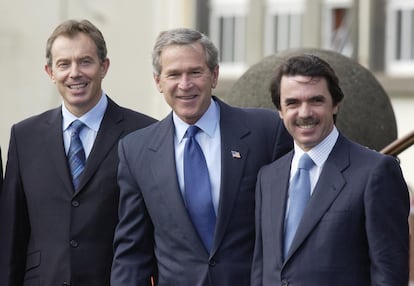
That tension, however, did not always operate. Sanguino relates in his podcast how, during the first term of José María Aznar, the president used to invite some relevant figures of Spanish cinema to dinner on Fridays (a period in which he also established cordial relations with nationalist forces) and how at that time the film industry received its largest subsidies. It was in the second term, already with an absolute majority, when he did not need such a conciliatory policy… and when he enrolled in the Iraq war. From there dates the famous photo of the Azores, with presidents George W. Bush and Tony Blair. In fact, according to Sanguino, part of the virulence against the president at the gala (“never, before or since, has a president been so openly criticized”) could be due to disenchantment after that brief idyll.
The story of the Goya gala begins when the Film Academy offers Alberto San Juan, Guillermo Toledo and Ernesto Alterio to serve as presenters, due to the popularity that the success of the comedy had earned them. The other side of the bedby Emilio Martínez-Lázaro. Alterio declines the offer, but the other two decide not only to present but also to ask to be in charge of the show through Animalario. That year the theater company had a play about the wedding between Ana Aznar, daughter of the president of the government, and Alejandro Agag (which was staged almost like a state wedding), and in the future it would premiere others as successful as Urtain.
Through that group passed, as in an original Dream Team, a good part of what later established itself as the best talent in Spanish cinema and theater: Javier Gutiérrez, Nathalie Poza, Roberto Álamo, Pilar Castro, Luis Bermejo, Fernando Tejero, Juan Cavestany, Juan Mayorga, etc. The Film Academy accepted the deal. “It was one of those rare occasions of democratic celebration in which a group of people spontaneously take over the public space to raise their voices against the violence of power and in favor of what is alive,” recalls Alberto San Juan, who entered the scene that night, going down the stairs of the auditorium with Toledo on a bicycle with the reckless clumsiness of the clowns. “Hey, Guillermo, you and I had said that if we did the Goya it was to jump into the pool,” he said on stage. And yes they threw themselves.
Thus, Animalario prepared a combative gala, but it didn’t stop there: “There was a script for the gala, perhaps excessive in terms of theatricality, in terms of surrealism; but what came later with the ‘speeches’ of the winners, was obviously not written. People felt free and the celebration fed back,” remembers screenwriter Cavestany. For example, the actor Luis Tosar, who was then beginning to taste the sweetness of success, took the opportunity in his speech for the Best Supporting Actor award to bring together two causes in a message to President Aznar: “If you want oil you just have to come to Galicia to pick it up,” in reference to the Prestige disaster. There were even the Sintel workers, then camped on Paseo de la Castellana to protest their dismissals. Javier Bardem, winner of the Best Actor award, wanted to “remind the rulers that winning the elections is not a blank check (…) they have the obligation to listen to the people, and we say: no to war.”
Another illegal war
Do we live in a similar time? The invasion of Iraq was an illegal action, but at least it tried to sell itself to the public as justified, even if it was using false excuses such as “weapons of mass destruction.” Today, leaders like Trump and Netanyahu also skip any national or international protocol, but they do not even show any intention of claiming legitimacy in a world in which it seems that the rules no longer work and the law of the strongest is imposed.
The historian Francisco J. Leira Castiñeira frames the “no to war” of 2003 in a pacifist current that starts from the “down with the villas” of the 19th century and goes through the anti-NATO movements, insubordination or rejection of ETA’s terrorism; see choral volume Pacifism in Spain from 1808 to the “no to war” in Iraq (Akal). Now he sees a different situation than 23 years ago. “Then there was a social conscience against a war that was not just any war, but one in which we actively participated,” he says. Other differences: the right in the government at that time had to defend a lie that was very difficult to defend, now the story of the extreme right shows notable strength in favor of strong and violent governments, and against pacifism and other emancipatory currents.
“It is more difficult for the cry of ‘no to war’ to triumph in these times: part of society focuses on the defense of Western culture and the internal enemy that it places in migration,” says the expert. Of course, the Iranian regime’s systematic violations of human rights also play a role, which, for many, legitimizes the attack, whatever it may be. And the level of social awareness is nowhere near the level it reached due to the Gaza genocide. Beyond that Goya gala, Leira wants to highlight a “solid base” of the pacifist movement in Spain, even if it goes through moments of boom and calm.
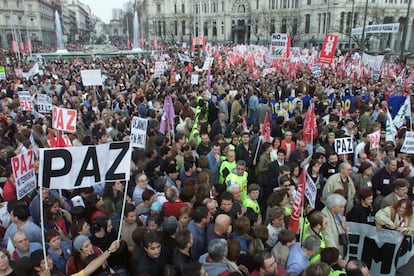
Just over a year after the Goya gala, and after the Atocha attacks (which many linked to Spain’s participation in the war), the Popular Party lost the elections and the first action of José Luis Rodríguez Zapatero, the new president, was to fulfill his promise to withdraw troops from Iraq.
Are protests in the world of culture still having that impact? “The truth is that they have already become a little predictable,” says Sanguino. For example, the last gala, on February 28, was a notable review of current politics and its injustices: the massacre in Palestine, the persecution of migrants by Donald Trump, Javier Milei’s cuts, gender violence, and even the figure of Francisco Franco. “I know that we are not going to change the world, but we cannot look the other way,” apologized the president of the Academy, Fernando Méndez-Leite.
Since the 2003 gala and the furious response it received from the political and media right, as Sanguino observes, a phenomenon that is common today, related to polarization, intensified: “Before, we could have agreed that there are things that are rejectable, such as war, climate change, gender violence or violence against the LGBT community… Now it is all left-wing or right-wing. There the germ was planted that there are no absolute certainties.”