
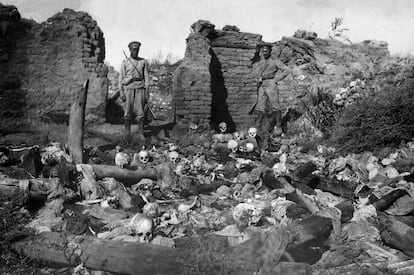
Books in Armenia are “like a member of the family,” says Katerina Poladjan. Therefore, when their parents were murdered by the Turks, Anahid and Hrant only took an old Bible with them in their escape. With her in their arms, the minors fled the Ottoman Empire in 1915. Afterwards, the “three” separated and did not see each other again. A century passed for the book—already smelling of wood dust, fungi and earth—to reach the hands of a foreign restorer. There, the woman began to wonder: who did it belong to? What happened to them? The type of questions that the German writer Poladjan (Moscow, 55 years old) asked herself about her own origin when writing this story for her novel Here are the lions (Armaenia), published in 2019 as There are lions here and recently translated into Spanish.
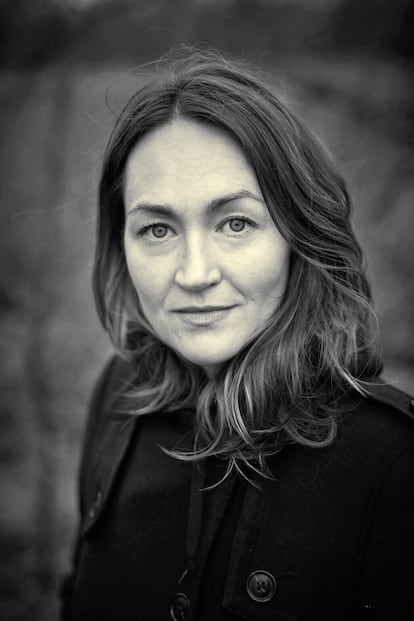
The life of the protagonist, Helen Mazavián, and that of the author “have a lot in common,” the writer admits in an interview during a recent visit to Madrid. Both have roots in the Soviet Union and their families emigrated to Germany, where they discovered that their last name was Armenian and not Russian. Although her work has autobiographical overtones, Poladjan states that, more than anything, she and the character share “the same questions about their past.” However, the book is not “so much about answers,” but about the “importance of origin and identity,” says the writer, who was awarded the Grand Prize of the German Literature Fund last year.
“I was not aware of this Armenian identity,” Poladjan acknowledges, although he grew up with the “Armenian genocide in my head.” He saw it—abstractly—in his father’s art. But it wasn’t until he was 14 when he learned that his last name was the only thing his grandfather had brought with him after his family “was murdered by the forces of the Ottoman Empire” during World War I. She never learned more about her past: the writer’s father never asked her grandfather about her story. She couldn’t do it either.
After publishing his first works —One night, somewhere else (2011) y Behind Siberia (2016), both by Rowohlt Verlag, Poladjan knew he had to write about Armenia. He did so through the story of the restoration of a family Bible, which, in turn, reconstructs the past of two exiled children. And, in part, Poladjan tries to answer his own questions about his family.
The idea arose after his visit to an exhibition in Armenia of “several Bibles that were left behind in the diaspora.” Poladjan discovered that at the back of the books “very personal things are noted,” including details about who copied the manuscript, when and where it was made, as well as prayers and stories from the owners. This is a type of colophon called Hishatakaranan Armenian term meaning “place of memory” or “memorial.” Bibles “were not just an object to put somewhere and pray, but they were like a kind of family member,” he says.
The language and the way to tell horrible things without being explicit is what is essential”
Katerina Poladyan
Although tragedy is present in most of Here are the lionsthe author insists that “I did not want to write a book that was only about genocide.” Even so, a question arose: “How to tell a misfortune while maintaining people’s dignity?”
“The language and the way to tell horrible things without being explicit is what is essential,” Poladjan acknowledges. In the novel, “one of the minors suffers a sexual assault and it is written in such a way that you don’t know it. It is not obvious. Still, it is important to tell it, but at the same time I wanted to protect her,” he points out. Children “are universal characters: they could be from Syria, Ukraine, Egypt or Sudan. I talk about genocide, but, above all, I talk about what people do to others. It is a question of humanity,” he adds. However, “with this book I did not want to make any accusations against Türkiye (which has explicitly denied that what happened a century ago was a genocide).”
The version of the Armenian people is that one and a half million people were killed by the Turks when the Ottoman Government ordered the deportation of Armenians – a Christian community – to the deserts of Syria. The persecution that followed culminated in what Pope Francis called “the first genocide of the 20th century.” Currently, between eight and 10 million people of Armenian descent live outside the country, according to UN data. It is something that “they will never forget,” the author notes, “and they shouldn’t.” “Imagine that you tell someone the story of your parents and grandparents and they tell you that everything is a lie. You are always in the situation where you have to prove to the entire world that they killed your family,” he laments.
Only 32 countries recognize what happened a century ago as genocide. Most did so 100 years later. Among them are the United States, Canada, Germany, France, the Vatican and Russia. Some recognize genocide in certain territories, such as Spain – Aragon, Balearic Islands, Basque Country, Catalonia, Navarra, La Rioja. The first country to do it in its entirety was Uruguay, in 1965. Armenia is a “very small” country, explains Poladjan. “It is very far from (international) politics and the (world) economy.”
“Many people have seen those images (of the Armenian victims) from the 20th century, but sometimes I think it’s not enough. We look at them and now it’s as if they were lost in time,” says Poladjan. “Unfortunately, all these terrible things still happen in the world,” and he asks: “How can we remember the real things and be aware?” “We must prevent the past from fading,” he says now more than ever, because “pressure from the right is increasing throughout Europe and the world. It is important to preserve history and memory again and again.” Especially in Armenia, a country that—according to the novel—“cares more about the past than the future.”
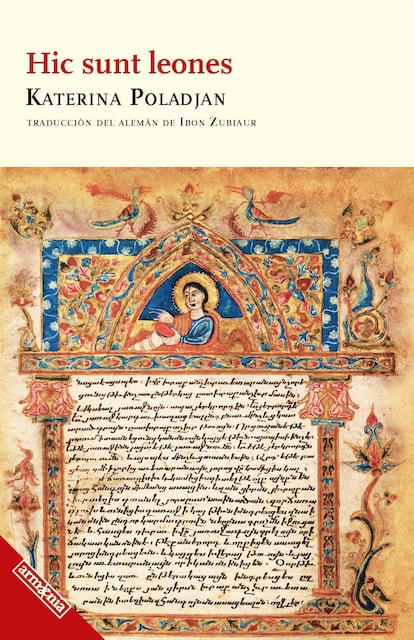
The author confesses that when she was in Russia she felt “more German.” And Germany, where she lives, always keeps her “between two other cultures.” That’s what his book is about: “an unknown land, something you don’t know about yourself,” says Poladjan. Identity is “a territory full of lions.” This is how medieval maps expressed it to mark unexplored or dangerous areas. They warned travelers that they were entering the unknown with the Latin phrase Here are the lions (There are lions here). For Poladjan, that place lived within herself.