
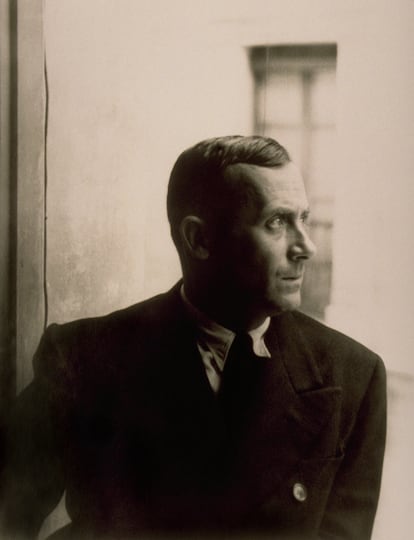
If the primary school teachers who sit children in front of the work of Joan Miró (Barcelona, 1893-Palma, 1983) thought of explaining his painting to them without reducing it to a game of shapes and colors, they would be risking their jobs, because the Catalan artist is one of the creators who took Picasso’s maxim the furthest: “Art is dangerous. If it is chaste, it is not art.” The next publication in France, on April 3, of Loeb-Miró. Correspondences 1926-1936 (Norma) will help to understand the intimate discomfort of an innocent-looking painter, that is, his struggle to reconcile the creative force of an untethered erotic drive with his need for order and balance.
The book brings together for the first time in full the letters exchanged between the artist and his French dealer, Pierre Loeb (1895-1950). The novelty is that, unlike the censoring management of other artistic legacies, the artist’s grandson, Joan Punyet Miró, has allowed access to previously hidden fragments that reveal the intimate side. “I am aware,” he says, “that the publication of these letters reveals part of the private life of each of the correspondents. It is important to highlight their spontaneity, since they wrote without fear of the judgment of posterity.”
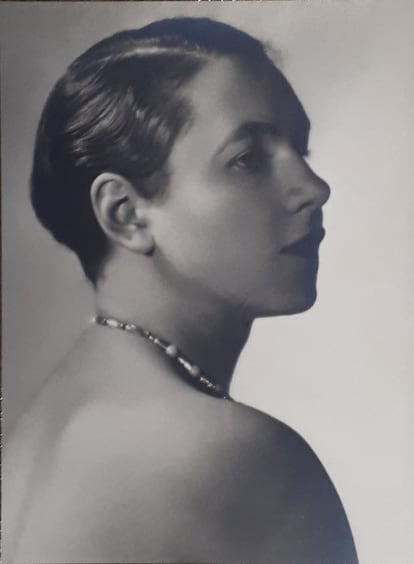
The letters do not have explanatory notes, but there are keys that help to unravel them. One of the enigmas that is definitively resolved is that they confirm his stormy relationship with the Polish painter Dorota Kucembianka, known as Dora Bianka, the Mme K. y Miss B., titles of two famous canvases by Miró from 1924, the year in which her husband, the Australian Charles J. Kelynack, significantly stopped sending chronicles from Paris to Sporting Globe from Melbourne.
Two years later, in 1926, Dora Bianka pursued Miró angrily. The fact that he demanded money to pay for a lawyer and an apartment, just on the dates in which his divorce from Kelynack was finalized, reinforces the idea that there was an unfulfilled promise of marriage or life together. The divorce is dated on the symbolic July 14. Five days earlier, Miró’s father died suddenly and the painter had to leave Paris in a hurry and take responsibility for the family farm and his widowed mother. “Do everything possible,” he pleaded with Loeb on October 31, “to get me out of this film of comic, tragic and annoying episodes. (…) In Spain everyone says that I am married (!) and that I presented Mme B. as my wife (!). This must be denied at all costs. If they talk to you about it in Paris, say that I no longer have anything to do with her.” The breakup involved the return of letters exchanged during the relationship, which the artist made sure to destroy himself.
A few months later, Miró became engaged in March 1927 to Pilar Tey, cultured, modern and athletic. The known letters documented that Miró suffered at this time from “an illness that has made me crazy and neurasthenic.” The fragment released now reveals that he had contracted a serious venereal disease. It is not a minor fact: that episode helps to understand some images of his work. “No doubt,” he writes to Loeb on July 6, 1927, “you will be surprised by my silence. These days I have been in a hurry trying to invent stories (…). Everyone believes that I have a great general weakness that must be treated.”
In November he was still ill. “I had to confess everything to my mother and my fiancée, and you know what that means in a bourgeois family. In short, everything has been settled; naturally, I will not get married until I return from Paris.” However, just two weeks before the date set for the wedding, in June 1928, Miró broke up with Pilar Tey and fled to Madrid. He also runs away from his mother: “Although, luckily, I have not married, I am still determined to create an independent life for myself as if I were, even with respect to my mother,” he tells Loeb. And he also flees from himself: “The fact of not having married means that I am far from that bourgeois balance, but, luckily, I have been able to escape my life being poisoned, which is extremely more important for me.”
On August 2 he seems to respond to a letter of reproach from Loeb that has not been revealed. “I speak to you,” he says, “as to a brother. You seem to question my loyalty when talking about my marriage. I have acted with extreme prudence; I should have broken up a year ago, but I wanted at all costs to avoid this catastrophe, until a very serious, but very foreseeable, event forced me to do so! I had a very clear idea, for a long time, that my happiness and that of others was very threatened (…). I was wrong to wait until the last days, a few days before my wedding. I should have listened to the wise advice that my family had been giving me for a long time, especially my mother, who is very clairvoyant. The “event” was a strong argument with his fiancée, who refused to live in Miró’s mother’s house.
The desperate search for a Madame Miró hid the desire for an orderly life. He is fed up—he confesses to Loeb—of “living in humid holes where my bones get wet little by little, and in ‘artists’ colonies’.” “I’m tired of living as an artist. Leave me alone. I would need a small apartment with one room, above all, where I can work to my liking. The greatest possible comfort, nothing bohemian, I’ve had enough!”
While his painting celebrated the liberation of the unconscious, he personally experienced unrest in the face of the uncontrollable. He needed order to subdue his wild inner demons. Falling in love was, for him, a source of inspiration and, at the same time, a risk of defocalization that he could not afford. “I must think about organizing my single life, which I wish to never see interrupted by new sentimental adventures. That they leave me alone and allow me to work,” he wrote, before finding definitive stability with Pilar Juncosa in 1929, a marriage encouraged by their respective mothers. “All human ideals seem to me to be a grotesque antics. It is ridiculous to want to live as an artist; one must accept to live as a man, humbly. (…) Gain human depth by facing life, accepting it humbly.”
Miró moved his phantoms towards maximum sublimation. Creating is, for him, an erotic act where the masculine and the feminine are magnetic poles, complementary energies of fertility and destruction. Faced with the fetishism of many surrealists – who transformed women into muse, object or Freudian symbol of the male unconscious -, Miró tried to recover something more primitive and sacred. In its iconography, female figures are not simple desired bodies; They embody ambivalent powers: mother and goddess, lover and monster, refuge and chaos, almost a cosmogony in which human evil is very present.
Even when he opens up to Loeb to expose his claim to be the leader of innovative art, he resorts to erotic images: “You should not paint with an English condom. If you get syphilis and die, then what are you going to do? With the condom, what beautiful prudence advises us, you don’t make children, my dear friend, and humanity would soon be liquidated, and those who intend to leave works for posterity, well screwed!”