

The decolonization project of the Anthropology and America museums enters the next phase. The work of the two committees of experts created by Ernest Urtasun, Minister of Culture, to “overcome and question the Eurocentrism” of these two institutions, has concluded after half a year of work with the delivery of two projects with specific guidelines to renew the museographic discourses of these institutions. That is, to include an anti-racist, gender perspective, with social justice and capable of eliminating all the biases with which until now these centers have told the story of a continent and a part of the history of humanity, as read in the proposals. The reports do not ignore, therefore, any of the terms that have entered into debate, if not into partisan conflict, since the Minister of Culture announced almost two years ago his intention to “overcome a colonial framework or one anchored in gender or ethnocentric inertia” for state museums.
In the presentation of the projects this Wednesday in Madrid, Urtasun stressed that “the objective is for national museums to be children of the present and builders of the future. They are going to explain cultures as something living and contemporary, which challenges us. And we are also going to recognize the agency of the native peoples.” What has become one of the great Culture projects has, in the words of the minister, also the goal of “being up to the democratic and cultural needs of societies and building a country project that responds to contemporary questions.”
The expert committees delivered their conclusions at the end of 2024 and since the beginning of this year the museums, in collaboration with Culture, have finalized two projects that will be put out to tender starting in December for 4.4 million euros, for Anthropology; and in 2026 for 9.2 million, for America. The forecast is that the definitive transformation of the rooms where the permanent collections are housed will be completed in 2028.
“This is a milestone,” says Mercedes Roldán, deputy general director of State Museums, “both had a clear and evident need to renew their museology with an average age of three decades.” That of America changed in the 1990s, but it did not include, to give an example valued by experts, “the impact of the trafficking of enslaved people.” In the case of Anthropology, created in the 19th century, “a comprehensive update was pending due to the way in which this discipline has been linked to the colonialism of that century,” the group of experts state. “They are the two installations of national museums that most show obsolescence and the need to update their stories,” adds Ángeles Albert, general director of Cultural Heritage and Fine Arts, “in this way narrative preparations and social justice are guaranteed in accordance with the new definition of museum approved by UNESCO.”
The Museum of America turns 85 in 2026, and has had the same permanent exhibition for 30 years, with small changes. “We must show the plurality of American cultures and put an end to the colonial gaze,” explains Andrés Gutiérrez, director of the museum. To achieve this, the institution will develop a program articulated in four sections with which it will try to change the imaginary built only from the so-called European collectors’ cabinets: all those objects brought from the American continent, configured as an illustrated encyclopedia, where a single reading of humans and natural resources was made.
That view has reached the present day through stereotypes such as those that were intentionally attached to women and that the museum defines as the result of “the coloniality of being typical of slavery.” “Barbaric, illiterate, savage,” remembers Gutiérrez, “racist prejudices that we intend to deconstruct in a critical and rigorous way.”
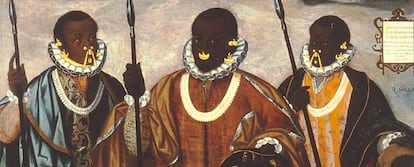
There was a first foray into this new decolonial path in 2024, when the museum changed 200 signs to make them “more respectful of some of the people and towns represented,” Urtasun explained then. Derogatory terms have already disappeared and proper names have begun to be used, as in the case of the emblematic painting The mulattoes of Esmeraldas, which for more than a year has been called Don Francisco de Arobe and his sons, chiefs of Esmeraldasremembers the director.
The resistance processes of the indigenous and Afro communities, the situation of control or dominance of women and “the violence exercised during the Conquest” will have a specific place in the museum. These stories will not be told chronologically, warns the director of the Museum of America, “the story based on temporal linearity is dispensed with.” “America does not begin or end with the Hispanic presence,” is stressed in the program for the center, which advances three sections that will deal with migrations and slavery – also contemporary ones –, how language and politics are used to rename and reappropriate meanings, “the business for Europe that was America” and how evangelization and scientific expeditions were also ways of “domination.”
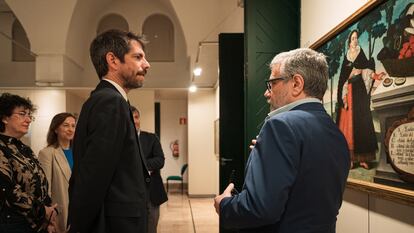
The National Museum of Anthropology has the ambition, in the words of its director, Fernando Sáez, to become a space for “community participation and social mediation.” This translates into the transformation of the three floors of the institution not only through a new arrangement of pieces, the use of technology and new ways of narrating through, for example, rotating display cases; but also with the intention of involving communities in “telling their own stories”, just when the center turns 150 years old.
“Anthropology itself throughout its evolution has developed and promoted theories with political and social interests that have legitimized a world order now in question,” says Sáez to situate the challenge faced by the museum he directs. It aims for the visitor to ask themselves all these questions when they enter the new permanent exhibition and, to the extent possible, offer them the answers with the version of the communities originating from different territories on topics such as “the plundering of natural resources, the hierarchization of people by their ethnic traits, raising whether race exists, the climate emergency and restoring the narratives marginalized by the Western gaze,” according to the project.
Their challenge even goes so far as to try to shed light on one of the concerns that the CIS includes in its barometers and that the extreme right has made a pillar of its campaigns: migration. “Human beings have always moved,” he remembers.
“We want to remedy the present with laboratories of social imagination,” bets Sáez, who has also been taking steps in this direction for months. The Anthropological Museum is the second with the most human remains in Spain, which have been removed in compliance with the Letter of commitment for the ethical treatment of human remains in state museums, of the Ministry of Culture.
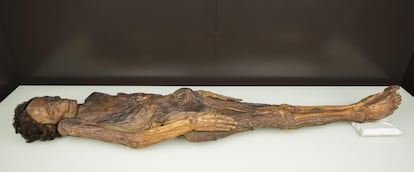
At the moment, neither of them faces the restitution and return of parts. “We do not believe that there are works of questionable origin,” says Sáez. Although the managers do not rule out possible requests and anticipate that, if they occur, these demands will be included and explained in the exhibitions. “There are ethical and legal claims and they must be raised as part of the discourse, regardless of what happens next. We have taken the bull by the horns,” adds Gutiérrez.
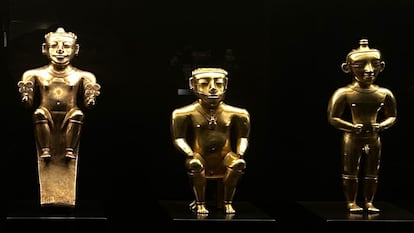
It is already happening with the Quimbaya Treasure, which is exhibited in the Museum of America. The collection of 122 pieces was claimed by the Government of Gustavo Petro in 2024, but has not received a response from the Spanish authorities, who have always settled this case because they considered the works national heritage as it was a gift from Colombian President Carlos Holguín to Queen María Cristina of Habsburg-Lorraine.
“All of these are not problems of the past, that is why we have a social responsibility that contemporary museology demands,” the managers agree. To bring these debates to the present, the two museums will receive works of contemporary art acquired by the Ministry of Culture. “We have been buying pieces for months to fill in gaps, always according to the reasoned requests of the museums,” says Ángeles Albert, who clarifies that a specific purchasing budget has not been allocated for these centers.