
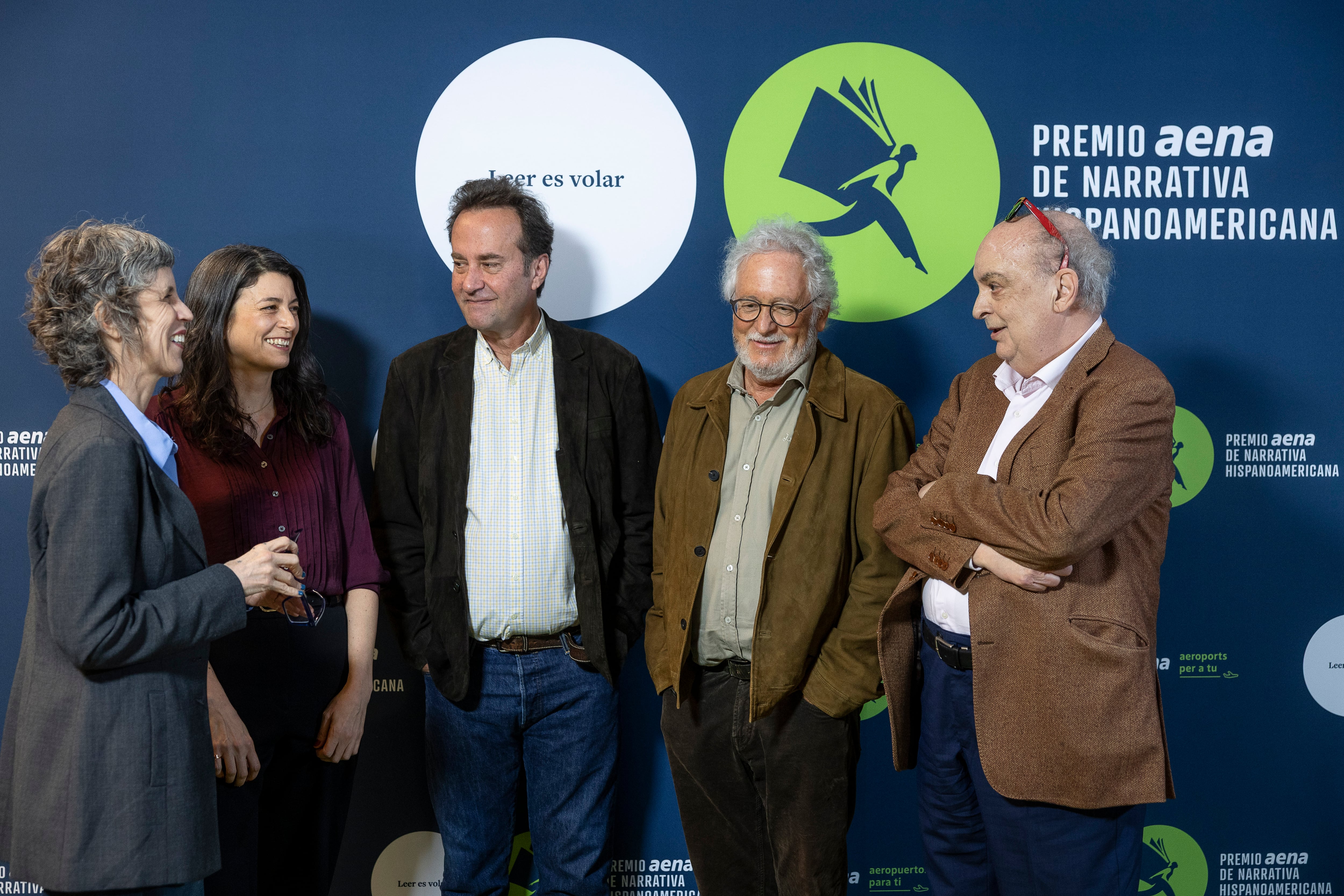
A little more than 24 hours after knowing the winner of the most discussed event in the current panorama of literature in Spanish, the five finalists meet at the Barcelona Maritime Museum. Since it was announced at the end of February, the Aena Prize for Hispanic American Fiction has not stopped raising controversy, due to the million euros in prize money (and another 30,000 for each of the finalists) and, above all, for the fact that it is promoted by an airport management company, 51% owned by the State, specifically by the Ministry of Transportation. Tomorrow, Wednesday, April 8, the winner will be announced at a gala, and until then the finalist writers Héctor Abad Faciolince, Nona Fernández, Marcos Giralt Torrente, Samanta Schweblin and Enrique Vila-Matas have a busy schedule. In the morning, they receive the media and in the afternoon they will visit President Salvador Illa at the Palau de la Generalitat.
Although it was not made public until later, the five finalists were already chosen when the award was announced to the press in February. A group of 10 pre-selectors linked to the literary world and from the media presented a set of works, to which a jury chaired by Rosa Montero and made up of Pilar Adón, Leila Guerriero, Luis Alberto de Cuenca, Jorge Fernández Díaz, José Carlos Llop, and Elmer Mendoza added more titles to then choose the five finalists.
Both the selection of the jury, which tomorrow Wednesday will spend the day meeting for deliberation, as well as the group of pre-selectors and the bases of the award have been carried out by Álvaro Colomer and Maria Jose Solano, both specialists in the literary sector and linked to Zenda, the magazine promoted by the writer Arturo Pérez-Reverte. Together with Maurici Lucena, president of Aena and the events company La Tropa, they have been in charge of organizing everything. “We have given ideas, but all the decisions have been collective; being an award with public participation, everything has gone through notaries and lawyers to guarantee that everything is correct from a legal point of view,” explains Colomer in a phone call.
According to the writer and journalist, with Solano they looked for names that will represent the two continents, of different ages and also a certain connection with the media, hence Sergio Vila-Sanjuan (La Vanguardia) and Jesús García Calero (ABC) serve as secretaries. It was also their decision to include the co-official languages “following the method of the FIL of Guadalajara”: they can participate as long as they are translated into Spanish: “Perhaps later they will consider adding specific awards for literature in those languages,” says Colomer. Another key decision, according to Colomer, is that the jury’s vote, which will take place during the gala, will be individual and secret: “My condition for participating was that the entire process be impeccable.”
In the media attention round, the topic has evidently been the controversy over the award, which according to Colomer was foreseeable for those who work in the sector, but not for the organizers, who “have arrived with the hope of patronage and have encountered the pessimism of our little world.” The finalists have resolved the criticism with serenity and even with humor, without entering into political issues or the public origin of the money, and understanding with a sector “accustomed to doubting everything,” said Héctor Abad Faciolince (author of the novel Now and in the hour).
Everyone agrees that any visibility strategy for literature is good news. Marcos Giralt (The illusionists) has explained that at 58 years old he has never managed to make a living from his books or be known among professors of Spanish literature: “In a small and corrugated world these absurd controversies arise, but out there there is a very wide outside world.” Both Giralt and Abad spoke about the precariousness of the writing profession, while the Argentinean Samanta Schweblin (The good evil) and the Chilean Nona Fernández (Marciano) emphasized the importance of the transatlantic bridge: “In South America the prizes have been constantly undermined, I have to constantly fight so that they do not disappear,” says Fernández. For his part, Enrique Vila-matas (Camera obscura canon) wanted to remember what according to him is a precedent for this award, Rómulo Gallegos, born in 1964 “with an endowment that at the time was also very high” and key in the consecration of the writers of the boom on both sides of the Atlantic, “suffered with political problems, but I have been informed by the artificial intelligence that continues to occur.”
Although the idea is that this jury changes every year, Colomer is not clear if this will be the case. In fact, both Colomer and Solano refrain from answering anything firm about future editions, subject to any political change. According to Solano, the idea is to maintain the annual call around Sant Jordi and always for published works, maintaining the amount of the prize. The organizer does not specify whether it will always be in Barcelona and points out that it is not written anywhere that the same author cannot receive the award more than once for different works.
And what will the finalists do with the million? Abad recites the poem The milkmaid by Félix María de Samaniego (“Do not be ambitious / for better or more prosperous fortune, / for you will live anxiously / without anything being able to satisfy you”) and talks about retirement; Fernández wants a dishwasher, Giralt a cell phone, Schweblin a steady salary, and everyone has time to read and write.