
In the lecture, the society’s secretary Issa Dashti said that among the oldest coins found in Kuwait is a Hellenistic coin excavated by the Danish archaeological mission on the island of Failaka in 1961 and again in 1984. The coin had images of the Macedonian king Antiochus and Alexander the Great.
Dashti explained that another early coin used in Kuwait was the “Tawila al-Hasa,” which circulated in the late 17th century in the Saudi Arabian city of Al-Ahsa. He added that Ottoman coins served as official currency in many countries until the end of World War I and were also used in Kuwait alongside other foreign currencies.
He noted that Persian thalers were widely used during the reign of Kuwaiti ruler Sheikh Jaber bin Abdullah Al-Sabah, as were Austrian thalers, known locally as “French thalers” or “dollars”. Other coins traded in Kuwait included the baisa of Oman and Zanzibar, which were exchanged primarily by money changers and merchants dealing with Oman and Zanzibar.
Highlighting a pivotal moment in Kuwait’s monetary history, Dashti said Kuwait’s Fifth Ruler, Sheikh Abdullah bin Sabah Al-Sabah, took a bold and visionary step to secure Kuwait’s independence by minting the first national currency. One side of the coin bore his signature, while the other side bore the inscription “Favored in Kuwait 1304 AH”. Named “baisa”, it corresponded to the copper coin in circulation at the time. These irregularly shaped coins varied in thickness and weight and circulated in Kuwait for only a short time.
Dashti added that in 1912 – known as the “year of plenty” due to the wealth brought by the booming pearl trade – French gold was used in Kuwait after a French ship from India bought pearls with gold coins.
He further explained that coins issued by the English East India Company started circulating from 1775, when the company established an office in Kuwait, marking the beginning of Kuwaiti-British relations. Gold currency coins were used for major transactions during the company’s existence, which ended in 1858 when minting responsibilities were transferred to the Government of India under British rule.
Dashti concluded that after Kuwait’s independence in 1961, the Indian rupee was replaced by Kuwaiti currency inscribed with “Emirate of Kuwait”. A year later, when the country’s name was changed to the State of Kuwait, the coin retained its current appearance.
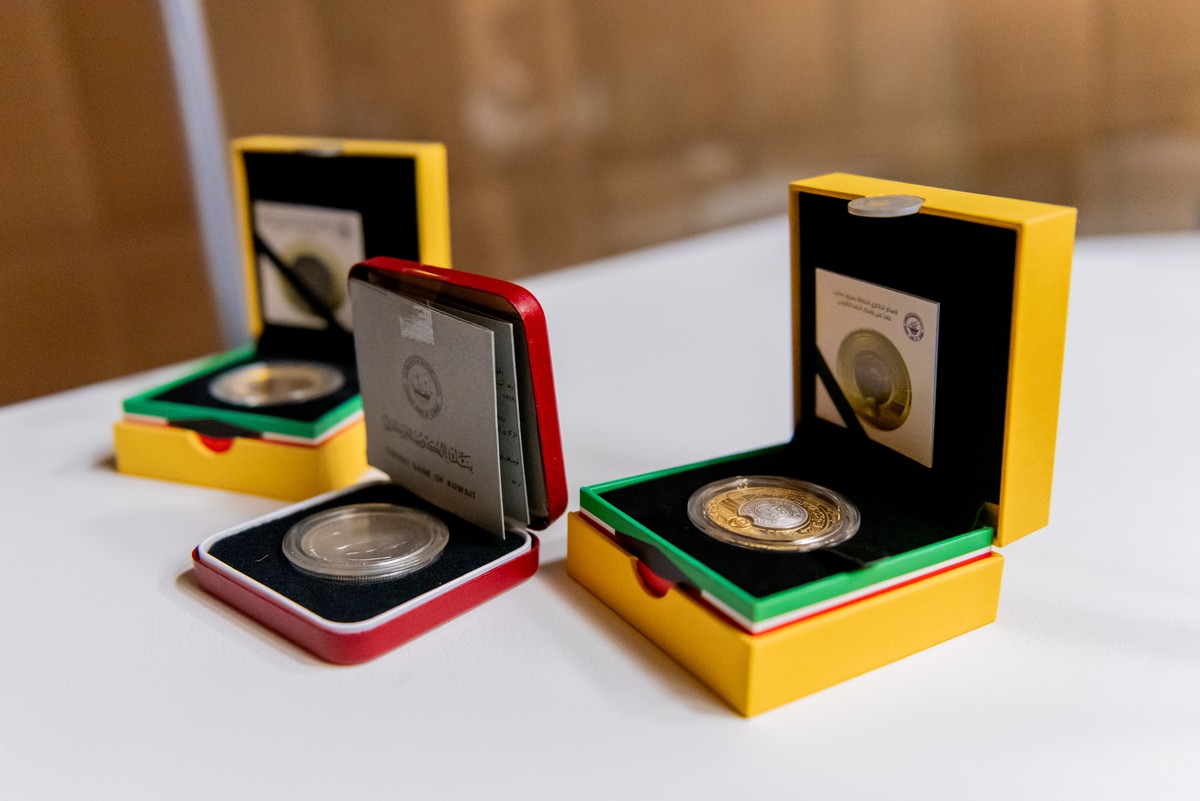
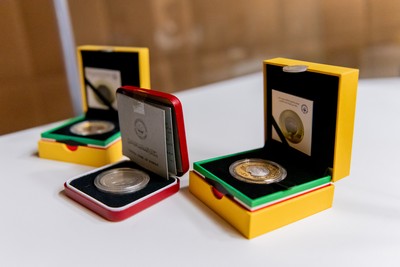
Several coins were on display during the lecture.