
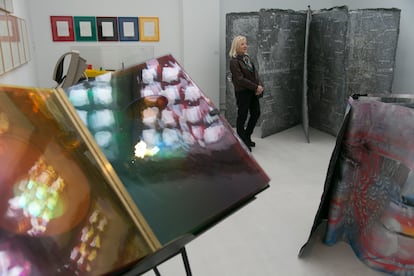
Art, books and architecture are the three pillars on which a new space is built that combines the project of Elena Foster’s Ivorypress publishing house with her husband’s Norman Foster Foundation. Located on Orfila Street in Madrid, in the same premises that housed two historic galleries in the city (Marlborough and Soledad Lorenzo), the new proposal includes an international bookstore, permanent exhibition rooms for the artist books that Ivorypress has published in the last three decades, and the expansion of the facilities for the Center for City Science, in the neighboring headquarters of the British architect’s foundation. A hybrid and multipurpose space that will host other activities such as talks, presentations and temporary exhibitions, and that will launch this Wednesday, the same day that the new edition of the ARCO fair begins with visits from professionals from the art world and collectors. Thus, this Wednesday at five in the afternoon the artist and writer Edmund de Waal will sign copies of an Archivethe book that has been published in the Arslibris collection by Ivorypress. The day before, this Tuesday, he offered a massive talk with which the new facilities were inaugurated.
Elena Foster served as master of ceremony and offered a few words of welcome to a packed auditorium, thanking the work of the team that has accompanied her these three decades and the presence in the auditorium of artists such as Olafur Eliasson, politicians such as Carmen Calvo, and museum directors Miguel Zugaza and Miguel Falomir. De Waal offered an emotional tour of his obsessive fixation with the archives that started at 63 rue Monceau in Paris, his family home at the beginning of the 20th century. The artistic director of the Serpentine in London, Hans Ulrich, also participated in the meeting, who congratulated the Fosters on the new space and explained that it brought to mind Umberto Eco’s house in Milan, packed with books. “He told me that we needed to create spaces for books and this is what Norman and Elena have done. Congratulations.”
The space on Orfila Street replaces the Ivorypress exhibition halls and small bookstore in the Tetuán neighborhood and seals the integration of the publishing house into the architect’s foundation. Ivorypress will be the cultural arm of the Norman Foster Foundation, which adds this new location to the headquarters on Montesquinza Street and the classrooms on Zurbarán Street, and creates a kind of urban campus.
“This merger is an organic evolution and it fills me with satisfaction that all the books I have created and the many others that make up the extensive Ivory Press library arrive here,” explained Elena Foster this Tuesday morning, after concluding a tour of the facilities with a group of guests and friends. “When I started I felt that something was missing from a publishing house without a bookstore,” he added, and recalled that his first client in the small bookstore at his former headquarters was, precisely, Soledad Lorenzo. “Arriving here seems like something of fate.”
Santi Burgos
Santi Burgos
Santi Burgos
Santi Burgos
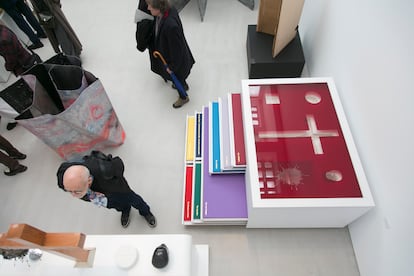
With direct access from the street, (continuous hours from 9 to 9 from Monday to Friday and on Saturdays from 10 to 2) the new bookstore specializes in books on art and architecture, includes sections on music, cinema and design, does not exclude children’s books and has a marked international touch. “Since Brexit, the supply of foreign books has decreased and it is something we want to focus on,” explains Valerie Maasburg, general coordinator of Ivorypress. There are catalogues, novels, essays, a careful selection of magazines and old books for sale.
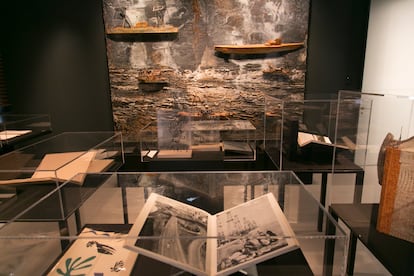
As soon as you cross the entrance to the bookstore, to the right, some display cases show an edition of Calder’s chess from Cahiers d’Art, originals by Bauhaus books and old editions of Towards a City y The City of Tomorrow, by Le Corbusier. There is no cafeteria, nor souvenirs. “I am a bookseller,” Foster emphasizes, and reveals that little by little they plan to expand the bookstore’s themes to the social sciences and perhaps also the calendar of activities for the public. For the moment, the talks and presentations will be held on Saturday mornings at 12 and the calendar includes a presentation of Sick Architecture by author Beatriz Colomina, Mark Wigley and Luis Fernández Galiano (March 7); a colloquium about the book by Guillermo Mora Interaction of with the editors of the This Side Up label, Bruno Lara and Cecilia Gandarias (March 14); or a debate on eco-constructivism between Gustav Düsing and Niklas Maak (March 28).
One floor below the bookstore and in several adjoining rooms is the permanent Ivorypress exhibition, which will be open to the public on Saturdays and where guided tours can also be arranged. There they are shown from the first artist’s book that Elena Foster made with Eduardo Chillida to the most recent, by Michal Rovner, passing through those by Francis Bacon (which occupy a room), and those by Olafur Eliasson, Ai Wei Wei, Maya Lin, Antony Caro Edmund de Waal or Anish Kapoor, among others. Also on display for the first time in Europe are all the artists’ books from MoMA’s Library Council, which has published works by Guillermo Kuitca and Gabriel Orozco, among others.
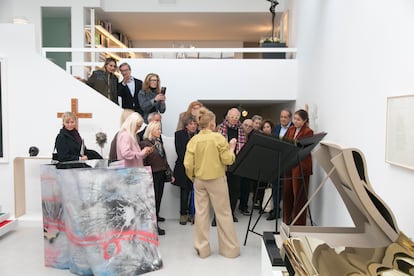
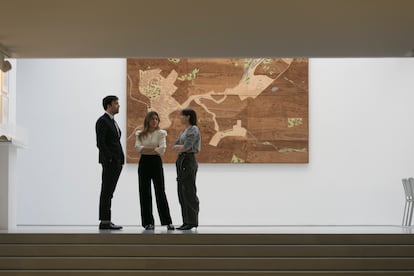
The Center for City Science of the Norman Foster Foundation, which has launched a master’s degree with the Autonomous University that is now in its third edition, as well as a consulting service for cities, occupies another wing. There are some models shown, such as an aerial view of Kharkiv, in Ukraine, and projects such as the drone airports that they developed with Jonathan Ledgard. “Our emphasis is on research in which cultural, philanthropic and technological aspects allow the improvement of problems. Cities are our starting point and that includes transportation, health and culture,” explains David González, general secretary of the foundation. The new center is betting in that direction and takes the broad issue of life in cities as its center, and books as one of its fundamental nerves.