
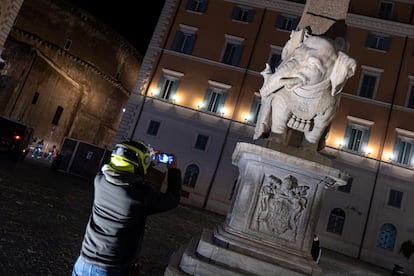
The iconic sculpture of the elephant designed by the great Italian baroque sculptor Gian Lorenzo Bernini that supports an obelisk in the central Piazza della Minerva in Rome appeared last night with one of its tusks broken. The alarm was raised this Tuesday at 9:00 p.m. local time when the municipal superintendence was alerted when it was found that one of the tusks was broken and the detached fragment could be found. The recovered part was handed over to the superintendency’s technicians and they will now analyze the damage and subsequent restoration.
This is not the first time that the elephant has undergone an intervention because on the night of November 13 to 14, 2016, the left tusk was also broken by unknown persons and abandoned on the ground. It remains to be determined whether the damage was due to intentional vandalism, an accident or due to weather conditions with heavy rain in recent days. The police have requested images from video surveillance cameras in the area; He will examine them in the coming days to accurately reconstruct what happened.
“It is unacceptable that the artistic and cultural heritage of the nation should once again suffer such serious damage,” declared the Minister of Culture, Alessandro Giuli, who assured that he will provide his support to the Superintendency of Rome “for the restoration of the sculpture: one of the most significant symbols of the capital, affected by an absurd act of barbarism.”
He little elephant as it is known in Rome, it holds an obelisk, it has a height of approximately 5.5 meters, but reaches 12 meters with the cross. It was designed by Gian Lorenzo Bernini and made in 1667 by his student Ercole Ferrata. Pope Alexander VII Chigi decided to place the statue in front of the church of the Dominican Fathers to remember the exaltation of Divine Wisdom. He chose the design of Gian Lorenzo Bernini, the greatest architect and sculptor of Baroque Rome, who proposed the construction of a statue in the shape of an elephant. The animal symbolized strength, as evoked by the inscription on the base: “Whoever observes the sculpted images of Egyptian wisdom on the obelisk carried by the elephant, the strongest of animals, realizes that a robust mind is needed to carry solid wisdom.”
The Dominicans, resentful of the pope’s decision, openly criticized Bernini: in their opinion, the elephant he had designed would have collapsed under the weight of the enormous obelisk, lacking a central support. The artist tenaciously opposed the construction of an element that would have ruined the aesthetics of the composition, but finally had to give in to the insistence of the pontiff, and the filling was placed under the belly of the elephant, but it had to be camouflaged. Bernini then sculpted a very elaborate harness that almost completely covered the animal and to take revenge for the interference of the Dominicans who had ruined his project, he oriented the animal’s voluminous rear towards his convent.