
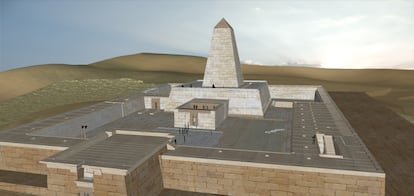
An Italian archaeological mission has unearthed for the first time in the vast necropolis of Abusir, south of Giza, the colossal valley temple that gave access to the unique sanctuary of the sun built by the pharaoh Nyuserra almost 4,500 years ago. Despite the importance that these complexes had during a brief period in ancient Egypt, only six are known to exist, only two have been discovered and only the Nyuserra complex remains standing, so the latest findings offer new clues about these peculiar buildings.
The sun temple of Nyuserra features a very common design from the Old Kingdom era and is divided into three main spaces: the valley temple, which is believed to have been located on the bank of the Nile and which remained buried until now, an ascending causeway, and the upper temple, which housed worship halls and open-air spaces. The latest excavations in the temple valley have unearthed parts of the main entrance porch, remains of the covering of some walls and several original architectural elements of the building.
“We expected something monumental, but not so much. If we look at other temples in the valley that we know in Giza, it seems that they were smaller buildings than the one (in) Nyuserra,” says Massimiliano Nuzzolo, co-director of the mission, who explains that the structure they have unearthed measures more than five and a half meters high without counting the roof or part of the exterior covering. “In the third millennium BC, when you approached the temple from the Nile or from the side canals, you would have been truly amazed,” he adds.
The first known signs of sun worship in ancient Egypt date back to the beginning of the fourth millennium before the Common Era, according to the Italian archaeological mission that studies solar temples. Later, this cult became the great official creed embraced by royalty, but it was not until the V Dynasty, to which Nyuserra belonged, that temples dedicated to the sun began to be built for the first time in the pharaonic civilization.
The fact that there are records of only six solar temples being built is because they were only built for about a century. During this relatively short period of time they played a key role in religious and economic life, but were suddenly abandoned at the end of the 5th Dynasty. It was not until after about a thousand years, with the religious reforms of the famous Pharaoh Akhenaten, that another type of similar building re-emerged with the temple of Karnak in Thebes, in present-day Luxor.
“The temple of the sun was a means for the deification, the solarization of the king. And this is quite unique; it is something that was only done in the V dynasty. These kings wanted to be worshiped, they wanted to be presented and remembered as children – physical, carnal – of the Sun god, which is very important in the ideology of the third millennium BC because nothing like this had been done before,” explains Nuzzolo. “There was the idea that the king was somehow divine,” he adds, “but no king had so explicitly and directly emphasized the connection with the Sun god.”
The valley temple of the Nyuserra solar sanctuary had been identified a century ago by the mission led in Abusir between 1898 and 1901 by the German archaeologist Ludwig Borchardt, but the high water table of the time had prevented them from unearthing it. Now, however, the groundwater is more than seven meters below the earth’s surface, says Nuzzolo, which has allowed it to be brought to light after discarding a thick layer of sediments.
Among the most notable objects found in the temple is a huge stone lintel with hieroglyphic inscriptions detailing a calendar of religious ceremonies at the sanctuary along with the name of Pharaoh Nyuserra. To the surprise of the team of archaeologists, they have also discovered a large number of ceramic pieces, many of them from the First Intermediate Period (more than 150 years after the 5th Dynasty), suggesting that the temple was transformed into a residential area after it ceased to function as a place of royal worship.
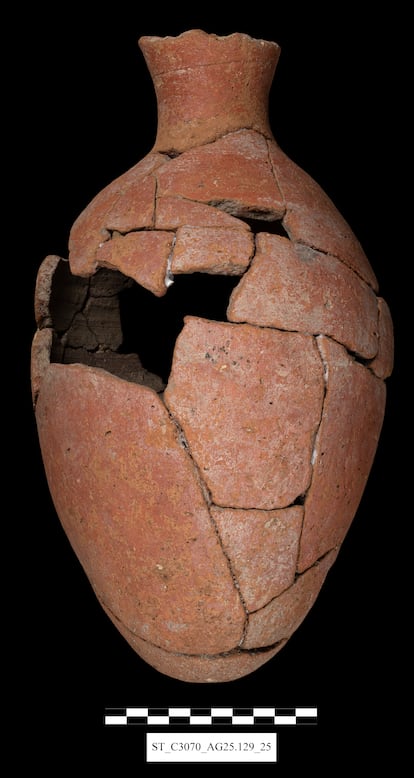
“Only a small part of the ceramics we found are real ceramics. The vast majority, I would say 90%, is common ceramics, for everyday use,” says Nuzzolo, who is especially fascinated by the discovery of a copy of the board game. promissory noteconsidered one of the oldest in the world. “People reused the temple, so they lived, cooked and played inside,” he notes, “it’s really incredible to be able to touch the daily life of the Egyptians.”
The reasons why these solar temples disappeared remain unclear, but Nuzzolo believes that resistance to a religious reform of this caliber and the enormous cost of daily provisioning of these sanctuaries could have contributed to their decline. “It was an idea that was basically developed by the kings of the V dynasty (and that) evidently was not very successful because it only lasted a hundred years and then was abandoned,” he concludes.