
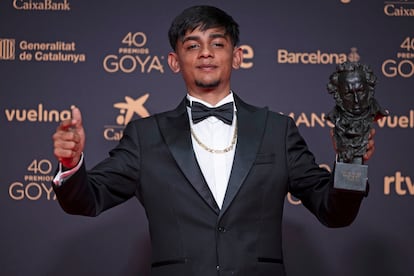
A few days ago, Wim Wenders said at the Berlinale that filmmakers should stay “out of politics.” At its 40th gala, the 2026 Goya Awards ceremony showed the filmmaker just the opposite. It was a party of high political tension in form, but above all in substance, in the film substrate. Beyond the aesthetics in the pins Free Palestine that were seen among the guests on the red carpet, gestures expected in this type of event, or the explicit calls against the genocide in Gaza that were repeated throughout the ceremony, the Spanish film awards confirmed, much as it may be to Wenders, that the personal is political. That quote from Kate Millet and the radical feminists of the 70s was remembered by producer Sandra Hermida when collecting the Goya for best film. Sundays. Even Albert Serra, the filmmaker who says that if you dedicate an award to your family it’s because your film is bad, knows it. In his speech upon winning the award for best documentary for Lonely afternoons, Schrödinger’s most catty and quantum film of this edition, because it is bullfighting or anti-bullfighting depending on who and where you ask, the director claimed how important and risky it is to make art “when the political and the ideological collide with intimacy.”
The forecasts were met and Sirât took six technical awards and Sundays those for best actress, supporting actress, original screenplay, direction and film. But it would be unfair to say that this ended up being the gala of Sundays y Sirât. That binary logic that dominates from the algorithms to the ideological positions of our conversations had also colonized the previous view of the ceremony and the harvest of 2025. A reductionist conception that was diluted as a gala flowed in which the diversity of views and new voices of the industry could also be celebrated beyond those two titles, especially in the acting awards, where two films were recognized in which intimacy is pure politics.
It was political that the co-official languages were integrated without being forced, as in the speeches in Basque of Nagore Aramburu as a perfidious nun in Sundays or Jose Ramon Soroiz for his role as a gay man who must return to the closet when he is admitted to a nursing home after suffering a stroke in Maspalomas (“Hopefully all Vincents will be happy”). Seeing a gypsy revelation actor, Toni Fernández Gabarre, hold a bobblehead for the first time, isn’t his cry of “Long live the Fernándezes!” in front of all that specific audience?” That Miriam Garlo used sign language when collecting her Goya as best new actress for Deaf. The milestone of seeing three women recognized in a technical category as historically masculinized as sound. Amanda Villavieja would not be on stage, but how important it was to hear Laia Casanovas and Yasmina Praderas ask that theirs not be “an exception.” Listen to Alauda Ruiz de Azúa affirm that “fear domesticates us and distances us from honesty” and that “talent does not understand gender but historical opportunities do.” To the Argentine Dolores Fonzi, director of BelenGoya to the Ibero-American film, predicting everything bad that can come (“I come from the future of a country where the president even put the water up for sale. And now we see that we have to defend the water. You who still have time, don’t fall into the trap”).
In a ceremony in which the most claimed emotion of the night was that of empathy, the feeling of the night was perfectly summed up by an emotional Susan Sarandon. “These days when the world is dominated by violence and cruelty, I look around me and see your president and many artists and I feel that they have the moral clarity to help me. I am in the midst of chaos and repression, seeing you helps me feel less alone and I thank you from the bottom of my heart.” Someone please tell Wim Wenders.