
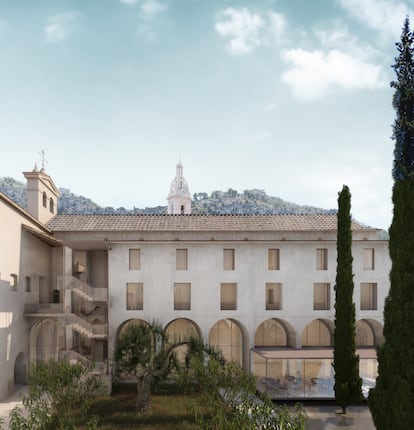
The Generalitat Valenciana, governed by the Popular Party, has decided not to collaborate in the restoration of the Royal Monastery of Santa Clara de Xàtiva to locate there the future Center Raimon d’Activitats Culturales (CRAC), named in honor of Raimon, a famous singer-songwriter linked to the anti-Franco struggles. The General Directorate of Local Administration has announced the non-renewal of the agreement that granted the project a budget of more than three million euros, in addition to demanding that the City Council reimburse the almost 400,000 euros already paid, plus late payment interest. The City Council believes that the decision is politically motivated and has announced that it intends to present allegations and continue with a project that could contribute to the revitalization of the old town. “The PP is waging a cultural battle,” says José Muñoz, a socialist deputy in the Valencian Parliament.
“As the end of the agreement has approached, we have seen a change in the attitude of the Generalitat, so it has not surprised us,” says Roger Cerdà, socialist mayor of Xàtiva. “I think it is a decision of a clear political nature that, in addition, generates quite a few administrative problems: the work was practically already awarded.”
The financing from the Generalitat, those three million, represented a third of the total investment. The other parts come from the City Council and the Provincial Council, so it is expected that the project will continue with subsidies that the Consistory has already requested from the Ministry of Housing and Urban Agenda (2% cultural aid for rehabilitation) and the Provincial Council. The center will be an important boost for the city, of about 30,000 inhabitants, especially taking into account that, in this inland town, a good part of tourism comes attracted by heritage and culture. “It is a strategic project for the future of Xàtiva,” says Cerdà.
The Generalitat argues that there is no opposition to the rehabilitation of the monastery, but rather to the approach to the agreement and the future connection to a private foundation. “In fact, the very design of the agreement implied that, if this foundation did not materialize, the City Council would be forced to repay the public funds invested by the Generalitat. Added to this issue is the non-compliance with the execution deadlines, since after more than four years the planned works have not begun,” say sources from the Ministry of the Presidency, the department that requests the reimbursement of the 400,000 euros. According to reports, a different approach is being sought: “A viable project, focused on the rehabilitation of the space and unrelated to any obligation linked to private entities.”
A personal but well-nourished collection
The now questioned project arose when Raimon (stage name of Ramón Pelegero Sanchis, 85 years old) gave the city his artistic collection gathered over decades, often based on gifts from the artists themselves, which includes works by Antoni Tàpies, Joan Miró, Antonio Saura, Eduardo Chillida, Eduardo Arroyo and Miquel Barceló, among others. A small, personal collection, but very well nourished.
The creation of a cultural center was then devised to collect the collection, celebrate the figure of Raimon and carry out a cultural program. It would happen in the Santa Clara monastery, declared an Asset of Cultural Interest (BIC), which had been acquired in 2016 by the City Council and where about 3,000 square meters were available. In addition, the Raimon Annalisa Foundation (by Annalisa Corti, the singer-songwriter’s partner and close collaborator) would be based there. Leading the project are the architects Ramón Esteve and Carlos Campos, who won the competition with a proposal titled Word and song (Word and song). “The center will move forward,” says the mayor, “but the fact that the Generalitat gives up is a blow in the process.”

“The Popular Party has always been against it,” denounces journalist Miquel Alberola, Raimon’s biographer, “in fact there is a trace from the Franco regime, which prohibited him from singing, to the PP, which has made it difficult for him to act. Even when they named him Favorite Son of the city (in 2015) they voted against.” Raimon was a central figure in the protest against the dictatorship and starred in historical moments, such as the recital at the Faculty of Economics of the Complutense, on May 18, 1968, one of the first examples of rejection of Francoism and the scarce reflections of the French May in Spain. Raimon has declined to comment to this newspaper.
His great success, Al ventcomposed when he was only 19 years old, is a cry for freedom in Valencian, without explicitly political lyrics, which overcame censorship and became a symbol for an entire movement. “No one called for such massive events against the Regime,” says the journalist. Or the concert in the pavilion of the Real Madrid Sports City, on February 5, 1976, the first after Franco’s death, with notable figures of the democratic opposition in the front row, such as Felipe González, Marcelino Camacho, Nicolás Sartorius, Antonio Garrigues Walker or Francisco Fernández Ordóñez. “And we are still in the same old war,” says Alberola, “the PP doesn’t like Raimon and, furthermore, wants to take advantage of it to damage the City Council and run a municipal campaign. The one who loses here is Xàtiva.”
An ideological decision
“In the Valencian Community, the Popular Party and Vox do not differ,” denounces socialist deputy José Muñoz, a supporter of the “cultural battle” explanation. “They go against, as happens in Madrid, everything that implies another way of understanding life other than their own, withdrawing subsidies from social and cultural entities to give them to their own or promoting things like the office for abused men. Those at Vox no longer know what to ask of them!”
A pattern can be found in the decisions of the Generalitat that includes the figure of Raimon, but also others such as those of Max Aub or Miguel Hernández, three figures who fought for freedoms in overlapping historical moments. The Max Aub Foundation, dedicated to the study of the writer’s work, is on the brink of the precipice after losing its contribution as patron of the presidency of the Generalitat. On the other hand, the cessation of the subsidy to The Path of the Poet, an event organized by the Miguel Hernández Cultural Foundation, with almost 30 years of history that, starting from Orihuela, annually visits the relevant places in the life of the Alicante poet. The Ministry of Culture supported this activity in response. Other cultural institutions affected are the Full Foundation, the Bromera Foundation and other initiatives related to the dissemination of the Valencian language.