
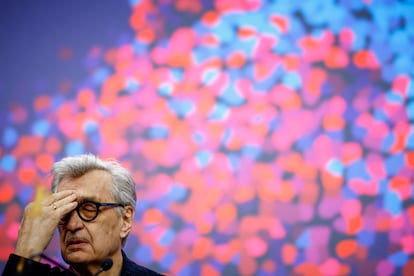
The Berlinale management issued a statement on Saturday night “in defense of our filmmakers, and especially our jury and its president”, after what it describes as a “media storm that has devastated the festival” during its first two days.
The text responds to the criticism against Wim Wenders and his fellow jurors, who on Thursday, at the press conference for his presentation, haggled over condemning the invasion of Gaza, comments that have even caused the cancellation of the presence at the Berlinale of the Indian writer Arundhati Roy. In that question, it was pointed out that the Berlinale has supported the Ukrainian and Iranian people (on the red carpets on Friday, photos of retaliated Persian filmmakers were shown and messages asking for their freedom; in addition to canceling, out of solidarity, a talk between Golden Bear winners Jafar Panahi and Mohammad Rasoulof), but nothing is said about the situation in Gaza.
One of the jurors, Polish producer Ewa Puszczyńska, immediately argued that the issue was not fair. “Films are not political in your sense of the word. Asking this question is a bit unfair. We use the phrase ‘change the world’, but of course we try to talk to each viewer, make them believe that we cannot be responsible for the decision they make: the decision to support Israel or the decision to support Palestine.” And he concluded: “There are many wars with genocides, and we don’t talk about that. It is a very complex question, and it is a bit unfair to ask us how we support our governments or not, because that is for politicians to decide.”
Wim Wenders came to support him: “We have to stay out of politics. We are the counterweight of politics, the opposite of politicians; we have to do the work of the people, not the work of politicians.” It was this response that has provoked numerous criticisms, which also recalled how in the last edition there was already friction between those who wanted to support the Gazan people publicly and the Berlinale, which wanted to avoid controversy.
Along with the statement, the festival director, Tricia Tuttle, has written a long “reflection” titled About speaking, cinema and politics, in which he responds to the number of times actors and filmmakers have been asked at press conferences to comment on political and social issues in the US, the Middle East and Germany: “Artists have the right to exercise freedom of expression as they wish. They should not be expected to comment on all general debates about a festival’s past or current practices, over which they have no control. Nor should they be expected to speak on all political issues raised before them, unless they wish to do so.”
In the official statement, you can read: “As the first 48 hours of this year’s contest begin, the Berlinale has been hit by a media storm. We believe it is important to raise our voice in defense of our filmmakers, and especially our jury and its president. Part of what is currently circulating is based on statements from press conferences, disconnected not only from the context of the conversations, but also from the trajectory and values that these artists represent (…). Our responsibility is to create a space in which diverse perspectives can be heard and respected, both in the films themselves and by those who make them, including those who work with strong political impulses.”
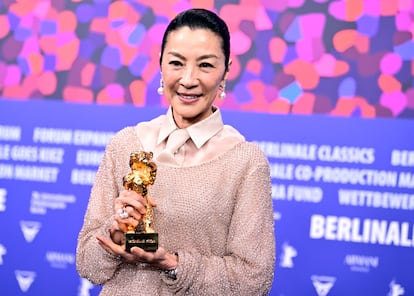
Because so far in the contest, there have already been several actors who have refused to talk about the current political situation, such as Honorary Golden Bear Michelle Yeoh. “Better not to talk about something I don’t know about,” he explained, although he did talk about the representation of minorities in cinema.
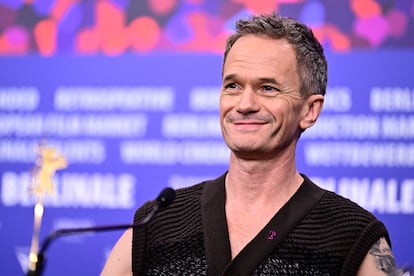
Or Neil Patrick Harris, a campaigner in the United States for equal rights for gays, who on several occasions haggled over political issues in his press conference. Like, for example, if cinema can combat fascism. “I think we live in a strangely algorithmic and divided world, and that’s why, as an artist, I’m always interested in doing apolitical things,” Harris responded. “Because we all, as humans, want to connect in some way.”
However, the questions were insisted on, since in the film in which he participates, Sunny Dancer, The team has had access to a US public cancer treatment center, in the middle of the Trump Government’s reduction of public health benefits. “Although I have my own political opinions,” he explained, “I think as an actor, especially in these types of films, I try to be as inclusive as possible. I never interpreted this script as a political statement.”
The Indian writer Arundhati Roy canceled her trip to Germany, where she was going to present a restored version, in the Berlinale Classics section, of the comedy In Which Annie Give It Those Ones (1989), by Pradip Krishen, whose script Roy wrote, and explained in a statement: “Hearing them say that art should not be political is astonishing (…). It is a way of silencing a conversation about a crime against humanity while it unfolds before us in real time, when artists, writers and filmmakers should be doing everything possible to stop it (…) The situation in Gaza is a genocide of the Palestinian people by the State of Israel.”