
There was a time when the act of photographing and being photographed, today so everyday and often banal, was a status symbol that fostered an authentic social event. Throughout the 19th century, artists adopted it as a means of representing themselves as members of their guild, adorned and accompanied by the attributes of their profession, thus reaffirming not only their work but also their own identity, captured with a realism until then unknown. Portraiture, a traditionally pictorial and sculptural genre, thus began to experiment not only with the unprecedented language offered by photography, but also with new supports and formats.
At the same time, the studios of the painters and sculptors also became protagonists of this new art, opening a window to the creative processes and inviting the viewer to enter true cabinets of wonders, spaces populated with works of art from which others emerged. The recently inaugurated exhibition at the Prado Museum is nourished by these images The artist’s universe before the camera (until July 5), which brings together 32 snapshots by professional and amateur photographers taken in the decades from 1850 to 1930. The exhibition, the second focused on photography after The multiplied Pradois part of the program open warehouse, an initiative to disseminate works from the 19th century that are rarely seen or that, like this case, cannot be permanently exhibited for conservation reasons.
The proposal occupies room 60 of the art gallery, dedicated since 2009 to the presentation of the 19th century collections, and is based on the catalog of more than 10,000 photographs that the Prado has been collecting throughout this 21st century, largely from donations, as highlighted by the curator, Beatriz Sánchez Torija, in the presentation to the media. “Almost two-thirds of the exhibition comes from donations,” explained the person in charge of the museum’s historical photography, some bequeathed by former colleagues of the institution and others by the Friends of the Museum Foundation or by descendants of the photographers or photographed artists.
The image that opens the tour functions not only as an exponent of the symbiotic relationship that the artists established with photography, but also serves as a historical document of what photographic studios were in the 19th century, completely glazed constructions to take advantage of natural light that were usually located on the roofs of buildings. Herein Artists in the photographer’s studio (1857-58) a group of students and their teachers from the Academy of Fine Arts of San Fernando pose for Ángel Alonso Martínez – among whom are Carlos Luis de Ribera, Carlos de Haes, Federico de Madrazo and Juan Antonio Ribera – in what was the most important studio in Madrid, located in the Murga passage, next to Montera street.
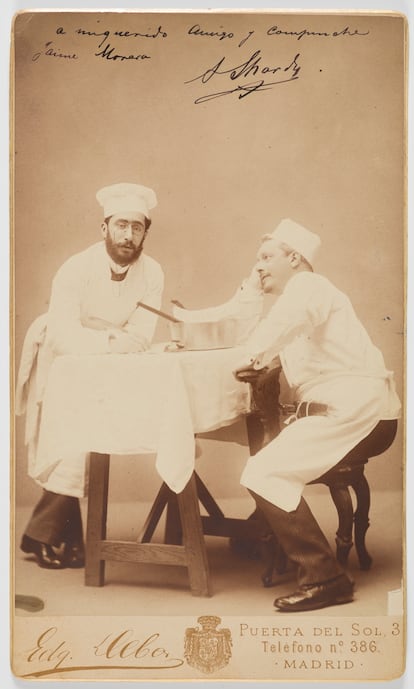
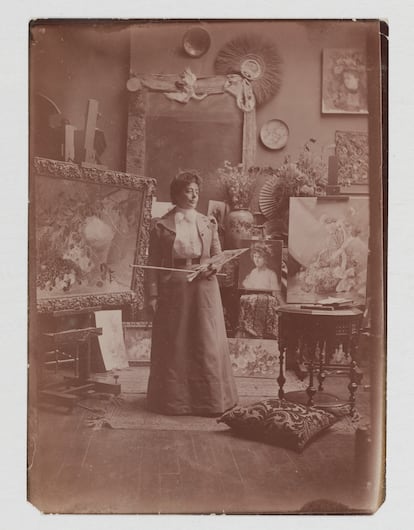
Among the artists portrayed in the exhibition—from Cecilio Pla to Raimundo de Madrazo, Jaime Morera and Agustín Lhardy, the latter also owner of the legendary Madrid restaurant in his name—the presence of several women stands out, such as Fernanda Francés and, especially, the still life and flower vase painter María Luisa de la Riva, immortalized around 1900 in her Paris studio by an unknown author. “This photo is in itself a declaration of intentions,” said the curator, “since, by being portrayed with the attributes of a painter in her hands, it was emphasized that she was not an amateur, but a professional.” In other photographs, several women are also seen as students in the artists’ studios, which served not only as places of work but also as teaching places, and there are images that follow the artists to outdoor settings, since in the 19th century they began to paint outdoors.
Represented as a woman with a camera in her hands, the allegory of photography itself jumps from one of these images to another, from its representation on the façade of Altobelli and Molins’ studio in Rome to the backs of many snapshots, where the photographers also included mentions of the awards they had received during their careers. These supports show the evolution of photographic technology, from images on iron and colored glass to paper, and are presented in some of the formats that stood out at the time, such as visiting card, the card promenade and the Paris card for portraits, where in some, like that of Cecilio Pla, the manners of the photo booth were already intuited.
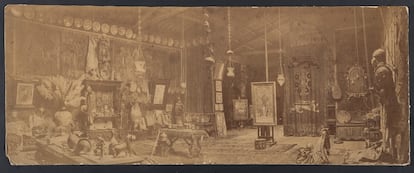
Many of the photographers of that time had training in Fine Arts, so their vision was nourished by the pictorial tradition, on the basis of which they experimented with the new photographic language. For the panoramic view of Mariano Fortuny’s studio in Rome, two juxtaposed photographs were used that also show, as the curator emphasized, that those spaces full of objects were in themselves “areas of artistic quality”, as beautiful and curated as an exhibition. At the same time, cameras were used to document the work processes of painters and sculptors, such as transferring a sketch to canvas or enlarging a sculpture in size. “The photo was an ally,” the curator summarized the spirit of the exhibition. “But not only, but already in the 19th century it itself achieved the status of art.”