
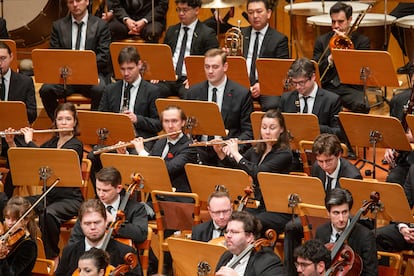
“This is not Wagner,” someone from the audience seemed to shout on December 5 at the National Center for the Performing Arts in Beijing, during a concert by The ring without words of Wagner conducted by Teodor Currentzis at the head of his musicAeterna orchestra. The unfortunate incident – which forced the concert to be interrupted to remove the person who was rebuking from the room – was attributed by the blog Klassikom to the controversy aroused in China by the unconventional readings of the great repertoire by the Greco-Russian director.
In this case, however, that was not the case. The ring without words It is not a reinterpretation of Wagner, but a compilation of orchestral passages, halfway between pastiche and medley, from the tetralogy The Ring of the Nibelung by Richard Wagner. The arrangement was made in 1987 by the director, composer and violinist Lorin Maazel for a recording project by the Telarc label with the Berlin Philharmonic: compressing the nearly fourteen hours of music from the four Wagnerian dramas into a continuous orchestral suite without singers that would fit on a single compact disc. Maazel took the result to the concert hall in 1990, in Pittsburgh, and the work has ended up becoming a kind of Wagner for dummies.
It is possible that the protest at the Beijing concert had another origin. Perhaps that person was reacting to listening to an orchestra financed by a Kremlin-linked bank, conducted by a musician who carefully avoids speaking out about the Russian invasion of Ukraine. The excellent musicAeterna ensemble remains financially controlled by the European Union-sanctioned Russian bank VTB, whose president, Andrei Kostin, is an oligarch closely linked to Vladimir Putin. In addition, in recent years the orchestra has had the sponsorship of the gas company Gazprom and the nuclear corporation Rosatom.
To operate in countries where this support is unacceptable, Currentzis has created a functional variant of musicAeterna called Utopia, with less politically committed partners, such as the Austrian DM Private Foundation for Art and Culture, linked to the late co-founder of Red Bull, Dietrich Mateschitz. In practice, the Greco-Russian director today divides his activity into two very different geographies, depending on the degree of local tolerance towards sponsorships linked to the Kremlin: in the north of Europe (Germany, Austria, the Netherlands and Belgium) he acts under the umbrella of Utopia – also in Greece – while in the south (Spain and Italy) his presence is accepted with musicAeterna.
The current tour of The ring without words is an eloquent demonstration of this double moral accounting. It began on November 3 at the Berlin Philharmonie fronting Utopia, followed by concerts in Munich, Hamburg, Rotterdam, Antwerp and Athens. At the end of the month and in December, Currentzis changed orchestras to begin a tour with musicAeterna through China and Russia, with performances in Saint Petersburg, Moscow and Perm. Already in February, the work has returned to Western Europe with musicAeterna for a tour of Spain and Italy: it started on February 2 at the Auditori in Barcelona, passed through Zaragoza the next day and will arrive on the 5th at the National Auditorium in Madrid and on the 7th at the Teatro de la Maestranza in Seville, before continuing to Brescia, Modena and Florence.
In the notes of the aforementioned album, Maazel links the origin of his arrangement The ring without words to his experience as musical director at the Bayreuth Festival. In 1960, when rehearsing for his debut with Lohengrinheard the composer’s grandson, Wieland Wagner, an inspiring phrase: “Everything is in the orchestra, it is the text behind the text, the universal subconscious that unites Wagner’s characters with each other and with the protoego of the legend.” His experience directing stage productions of the Ring in 1965, in Berlin, and later in 1968, in Bayreuth, made him delve deeper into the idea of a compressed symphonic version of the tetralogy.
To anticipate criticism, the American master nevertheless established four unavoidable criteria: a fluid arrangement, without altering the order of the work or introducing interruptions; harmonious and justifiable transitions; exclusive use of original orchestral music, although with occasional vocal lines on an “imaginable” instrument; and that all the notes came strictly from Wagner. The result, however, has always been debatable and problematic.
In addition to sacrificing the dramatic development of the Ringthe arrangement incurs creaky transitions—like the one that links Donner’s hammer blow, at the end of Rhine goldwith the storm that opens The valkyrie—and omits fundamental melodies, such as Siegmund’s spring song in The valkyrie or Brünnhilde’s melody of peace in Siegfried (later included in the famous Idyll of Siegfried). The biggest problem, however, is the excessive density of the ensemble: orchestral cuts and driving motifs as compressed as they are juxtaposed, without room to breathe.
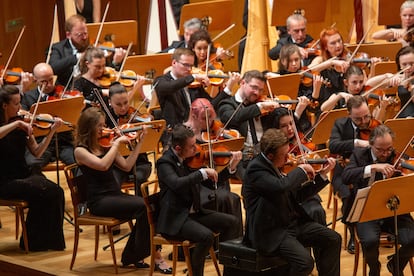
Now, judging by what was heard last February 3 at the Zaragoza Auditorium, the technical demands and musical superficiality of Teodor Currentzis’s conducting significantly facilitate the digestion of this very problematic arrangement. The Greco-Russian maestro maintains at the head of his musicAeterna ensemble the orchestral excellence that originated this project with the Berlin Philharmonic. And his way of conducting measure by measure and passage by passage, completely unconcerned with the great arc of dramatic tensions of the work, favors the fluidity of the seventy minutes without pause, which pass without leaving a trace.
At the beginning of Rhine goldwith that E flat sustained by the double basses for 136 measures, there was never the impression of witnessing the birth of the world or the primordial flow of the river. Currentzis achieved, however, millimeter precision of the eight horns and crystalline clarity of the string. The most successful part of the prologue was the interlude of the descent into Nibelheim, where well-managed tension was added to that precision.
The transition to The valkyrie was resolved from spectacularity: Donner’s hammer blow, followed by an exaggerated articulation in cellos and double basses of the storm motif, carried the dynamic arc from the fortissimo with wood to a practically inaudible pianissimo. Dynamic feats interested the Greco-Russian conductor more than the meaning of music, as was clear in his way of crushing Alexey Zhilin’s loving cello solo. The second act passed without any buildup of tension, and everything was geared toward a frenetic ride of the Valkyries. The best of this first day was, by far, Wotan’s farewell to Brünnhilde, held by a thick and exquisite rope.
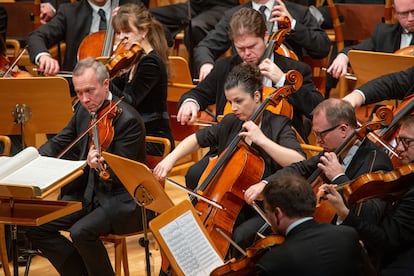
Again, the transition to Siegfried turned out to be absurd: Loge’s magic of fire that closes The valkyrie linked seamlessly with the forge of the sword. The first act of this second day was consumed quickly again, but in the forest murmurs of the second act Currentzis offered a new example of musicAeterna string excellence, accompanied by notable flute, clarinet and oboe solos. After the death of the dragon Fafner, the entire third act is deleted and we go directly to the dawn of The twilight of the gods.
It is revealing that almost half of the arrangement is concentrated in this last day of the Ringfocused on the two most famous orchestral passages: Siegfried’s journey along the Rhine and the Siegfried’s funeral marchwith brief inserts of Hagen’s call and the hero’s death. In these fragments the powerful Russian metal stood out, although Siegfried’s brilliant calls were performed offstage by the Valencian trumpet player Jairo Gimeno. The funeral march once again impressed with its precision, tension and intensity, but fell short of depth and true drama. The jump to the end of the tetralogy allowed Currentzis to offer the best of the entire evening: a closing of great sound control, crowned by a beautiful motif of Brünnhilde’s redemption for love.
However, although such a concert may serve as a first approximation to Wagner’s sound, the Saxon was much more than an orchestral composer. This arrangement does not allow access to the dramatic essence of the Ringwhich begins with Alberich renouncing love for power and culminates with Brünnhilde renouncing power in favor of love, as the dramatic axis shifts from Wotan to Siegfried. It is not surprising, therefore, that someone exclaims “this is not Wagner”, especially when we have just heard a truly unforgettable Isolde in Barcelona.
XXXI Season of Great Concerts
Richard Wagner: The ring without words (compiled by Lorin Maazel)
MusicAeterna. Teodor Currentzis, director.
Zaragoza Auditorium. Mozart Room. February 3.