
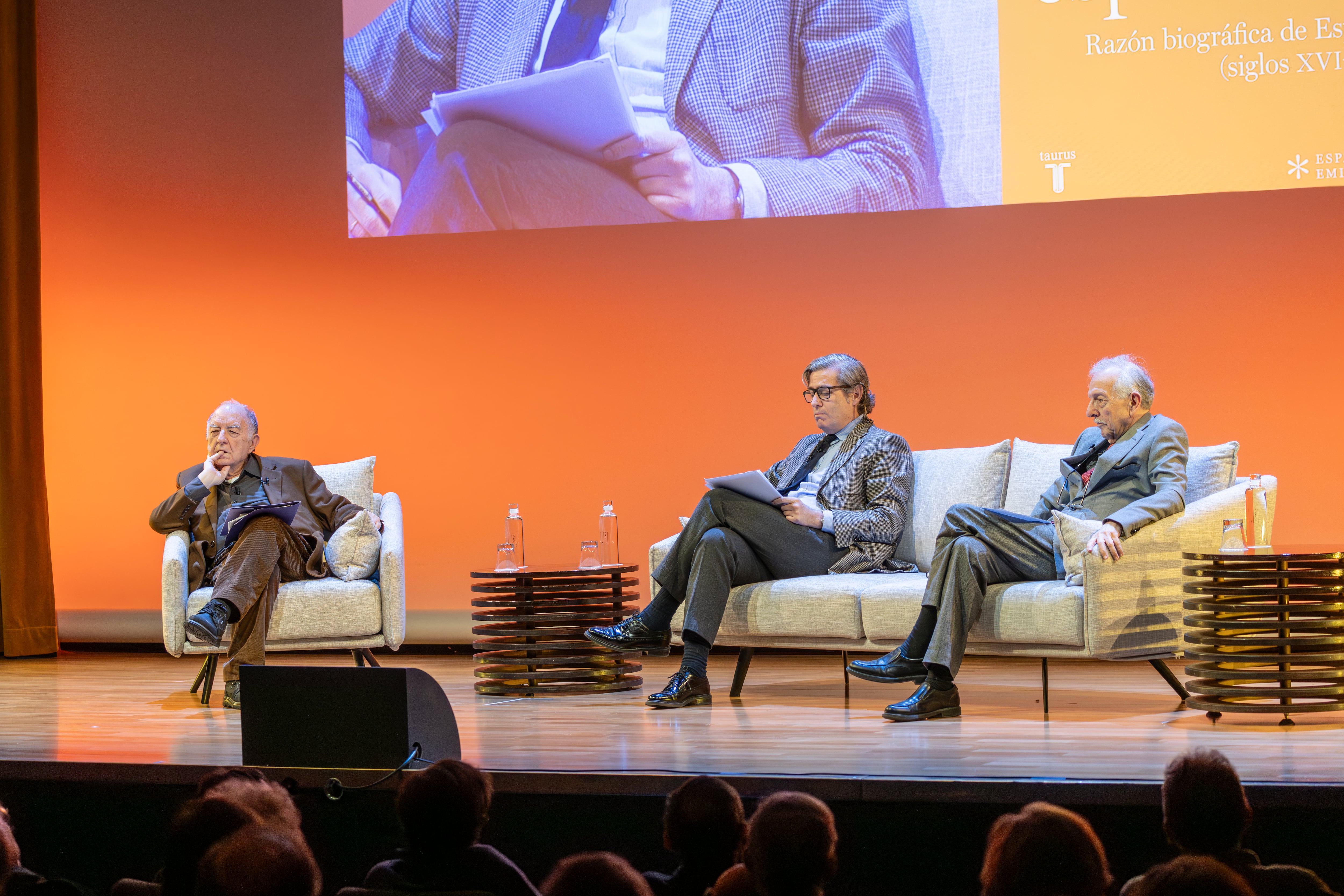
The renowned historians and researchers Juan Pablo Fusi and Ricardo García Cárcel have been involved in an editorial controversy for a couple of days after the critic José Luis García Martín accused them of writing their latest book, Spanish lives. Biographical reason of Spain (16th-20th centuries), with the help of artificial intelligence. In a review titled A bad example The critic listed several errors and typos that he attributed not to editing errors, but to the use of artificial intelligence for his writing.
Taurus, the publisher that publishes the book, now flatly denies it: “The critics mix very diverse accusations, ranging from the conception of the volume to interpretive discrepancies and outright typos,” says Miguel Aguilar, literary director of the publishing house. Can you guarantee that Artificial Intelligence has not been used? “We have tools to detect it, but in this case it was not necessary,” he responds. They are, he concludes, simple typos, “a fact in the world of publishing, something that we try to minimize with varying success.” For this reason, it sees no reason to withdraw the nearly 2,000 printed copies and plans to correct the errors for the second edition, if it needs to be published. In any case, according to the director, the errors only show that the “correctors are human.”
The historians’ text is one more installment of a project created by Javier Gomá, director of the Juan March Foundation, titled Eminent Spaniardswhich aims to create biographies of relevant personalities in the country. This volume, published less than 15 days ago, provides a global review of 50 relevant figures: from Juan de Austria to Feijoo, from Jovellanos to Goya. The controversy increased as these were two capital figures of Spanish historiography. The two are members of the Royal Academy of History and have been dedicated to research for decades. García Cárcel is also the National History Prize winner in 2012.
For the Asturian critic, however, “this book,” he tells EL PAÍS, “neither Fusi, nor Gomá (director of the Juan March Foundation), nor anyone in the publishing house has read it. They have scored a huge goal.” And he accuses them at the same time of an artificial scheme: “It is a scam, an editorial product made by anonymous people who perhaps charge 1,000 euros a month at the Taurus publishing house. And then the Foundation pays a lot to those who give the name.” Why do you say it with such certainty? “Because there are errors that come directly from Wikipedia, one of the sources of AI, and they copy errors that are directly there,” he answers. Any other explanation, he continues, would leave those involved worse off: “Talking about AI is the nicest thing I can say. If that book was written by Fusi, it’s to take away the title. He can’t do anything anymore, he’s already lost his mind,” he says bluntly.
Fusi, who will turn 81 this year, attributes the typos to his original manuscript, which, he says, he also wrote by hand before transcribing it into the computer. “I have no relationship with AI; I am not subscribed to any program and I do not use it. Yes, on the other hand, dictionaries, encyclopedias and reference books – ancient and modern, in Spanish, English and French – on paper are excellent,” he answers. He does not directly blame the publisher, which made a “very thorough” correction, and rather speaks of a reading problem: “I read it very badly because I read it on my mobile phone due to a desynchronization problem between the email on my mobile phone and that same email on the computer, a desynchronization that I have been told is irreversible.”
What types of errors are found in the text and why have they caused such a stir? Well, they are varied. Wrong dates, wrong names and biographical inaccuracies that in a text of historical rigor take on special relevance. García Martín identifies two types. The first are obvious typographical errors. For example, there is talk of paintings by Velázquez that are kept “in the Pardo” when in reality they refer to the Prado Museum. Or from a book published by Antonio Machado entitled Hidden pagesand not Selected pages. According to the critic, they are the product of an autocorrect. “An expert proofreader finds those errors. But not an automatic proofreader, which we all know changes some words into others that are nonsense. We know that the automatic proofreader makes mistakes and you cannot send a book to the printer having only passed it through the automatic proofreader. Someone has to look at it. It’s nonsense,” he argues.
The other types of errors are more imperceptible, but perhaps more serious. For example, the authors write that Jovellanos wrote his comedy The honest criminal in 1773, although he premiered it in Madrid in 1767. They contradict each other with a phrase away. “They are errors that come directly from the Wikipedia biography,” says the critic. The same error is found, indeed, when consulting Jovellanos’s entry on Wikipedia. “I’m not saying that. They are objective data. The sources are mechanical sources, because, in addition, there is a bibliography at the end, each article leads to some texts, but you see that the article cites texts that sometimes are not in the bibliography. What I mean is that the bibliography does not respond to the material used either,” he concludes.
The director of the March Foundation, which commissioned the work, has been the most vehement in criticizing García Martín, although he has no direct relationship with the correction of the text. “It is a slander that can be resolved in a criminal or civil court,” he tells this newspaper. “That he points out errors is applauded (although he acknowledges that he would have preferred to be informed privately) because it teaches you to produce a better-made edition, but to say that these gentlemen, who are around 80 years old, two illustrious historians, with an extraordinary education and who have done school themselves, use AI to deceive readers, is a slander susceptible to criminal relevance.” He himself has advised the publisher to consider legal action, and although Taurus does not completely rule it out, they do not see it as feasible either.
Gomá puts his hand in the fire for those who are also his friends and regular collaborators of the March. “I have attended the gestation of the book, I regularly received advances of the text. It was delivered, they did their job. Are there typos? Yes. Maybe more than necessary and that the publisher did not identify, okay, but nothing more. What has to happen now is for the publisher to correct the errors and the author of the criticism to retract.” The second does not seem close, and the corrections will arrive when the 2,000 copies are sold out.