
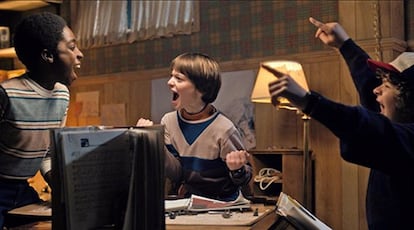
Three friends meet in a house in Madrid, after finishing the Netflix series Stranger Things. At the end of the last season they were carried away by the tempting impulse to try Dungeons and Dragons, the role-playing game that the series’ protagonists enjoy so much, known as D&D. Now they are gathered, with a large open box on one side: D&D: Heroes of the Borderlands, reads the colorful cover of the most recent version of the game. None of the three have ever played anything like it.
After a decade since it began to be broadcast, Stranger Things has left an interest in the role. The iconic board game is so intertwined with the DNA of the series, created by the Duffer brothers, that it opened its first chapter (back in 2016) with the protagonist children playing a campaign of D&D —the narrative adventures in which users participate over time. Little by little, the success of the series also triggered interest in D&D, which today experiences unprecedented visibility: after a niche period, and even accusations of satanism that sought to banish it, it has caught the attention of the general public. And those responsible for the game seek to retain that attention with their new simplified edition, although not so much: it is still necessary to get the books, learn the rules, or have to convince and coordinate a group of people to be able to play it.
The action of Stranger Things starts in 1983. At that time, Dungeons and Dragons He was almost a decade old. Created in 1974 by Gary Gygax and Dave Arneson, it is considered the first commercially available role-playing game. Players generate their characters based on a variety of races (elves, humans, or dragonborn) and classes such as paladin, sorcerer, or druid—Holly the Heroic, a cleric and Mike’s sister, is mentioned in the series; or Will the Wise, a magic user and alter ego of Will Byers. Each game also has a dungeon mastersomeone who does not play, but acts as a storyteller, guiding the narrative of what happens to others (this is what the character Mike Wheeler did in the first season, and then the tragic Eddie Munson at the head of the Hellfire Club in the fourth season).
According to Wizards of the Coast, the company that publishes D&D since the mid-nineties, in 2020 more than 50 million people had experienced adventures in this shared universe since its launch. Stranger Things It has been viewed, as of December 2025, more than 140 million times, according to Netflix data.
From “satanic game” to bestseller
But Dungeons and Dragons It did not achieve that popularity without problems. In the 1980s, the role-playing game became known as “Satanic Panic.”atanic Panic), name promoted, mainly, by conservative sectors of the United States. This current described the role, the dice and their mentions of sects and demons that the players face as a gateway for young people to Satanism, a prejudice that also affected the heavy metal. From that panic came a variety of multimedia pieces that attempted to vilify D&D, but perhaps the most interesting is a movie made for television in 1982, titled Mazes and Monsters: In his first leading role, actor Tom Hanks plays a young man who gets lost in the game’s narrative, which he confuses with reality, endangering his life.
From those combative beginnings, the saga grew, furtively expanding its influence on popular culture, until in recent years it rose to the forefront. mainstream: with the movie Dungeons and Dragons: Honor among thieves; the great animated series Vox Machina, which adapts the campaigns of the role-playing group Critical Role on Prime Video; or the highly acclaimed video game Baldur’s Gate 3 (BG3), which has sold more than 20 million copies and was crowned the best title of the year in 2023. Even the creators of Stranger Things they cited BG3 as an influence in resolving their own story.
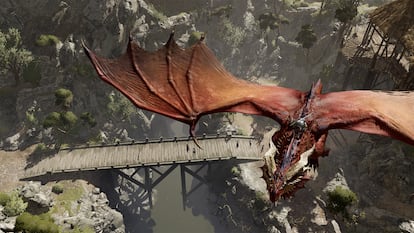
All of these creations do not represent, even close to, the entire expansion of Dungeons and Dragonswhich also benefits from a sector, that of board games, which has experienced a real boom since the pandemic lockdown forced people to find homemade ways to pass the hours.
New horizons, simplified
A classic board game like Monopoly o Catan tells you what you can do; D&D, instead, it asks you what you want to do. But that freedom, combined with the number of manuals and paraphernalia required to run a campaign, is detrimental to its accessibility. That’s why the saga has now delved into a middle ground: a board game with the same freedom as an adventure, but self-contained, like a kind of ready-made playful The recent D&D: Heroes of the Borderland is that creation, which allows players to assemble their characters and dungeon master Choose a packaged adventure, and start playing like kids from Stranger Things.
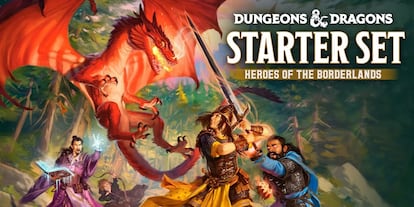
There is also a version with a patina more typical of the universe of Once, Vecna and the demogorgon (characters from Stranger Thingsthe last two borrowed in turn from D&D by the protagonists of the series). It is about Dungeons and Dragons: Welcome to the Hellfire Club, which takes the same ready-to-play formula from Heroes of the Borderlandsbut he paints it Stranger Things, as if a game was being played directed by Eddie Munson himself.
The three players from Madrid leave their dice and pencils on the table. Outside, in reality, night has fallen and it is time to put everything away and for the participants to go home. Someone promises to “role” more next time (act with the mannerisms of their characters, their voices, actions and motivations). They compare the experience with what they have seen in the show Netflix and discuss with each other what to do in the next session.