
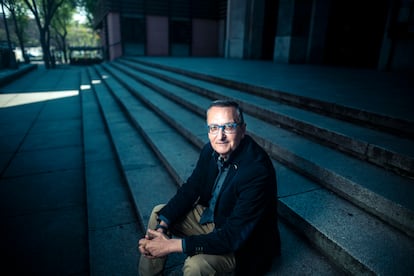
Anyone would say that this novel is inspired by Ábalos, Koldo, Jorge Fernández Díaz or the national grotesque characters that we see on the bench these days, but in reality it was thought of and written before. “It could be my last novel,” proclaims its author, Salvador Gutiérrez Solís, in the final pages of The impostor strategy (Almuzara), Jaén Novel Award. This writer of thrillercultural manager and advisor to politicians, including one who lives in La Moncloa, took refuge in writing a political and criminal plot when he had already begun to deal with a ferocious cancer. And one thing has nothing to do with the other, but both mark his life today. He was born in Córdoba, in 1968.
Ask. He dedicates his book to his oncologist.
Answer. It has saved my life. I arrived in a very delicate situation and he found the combination so that I could move forward and write this book. I thought I would never be able to.
P. It portrays corruption and anticipates Ábalos case: corruption, sex, money and politics intended to serve those who exercise it. How could it be anticipated?
R. It is a constant that occurs especially in Spain, a very sexist policy of repeating primary roles that include prostitution, binge eating and what we are seeing, unfortunately.
P. How has it been documented?
R. I have worked for almost 20 years with politicians, I have written for many of them, especially from Andalusia, and I know the sayings in the world such as: “It’s very cold outside”, “spend a season in the desert”, “you have to do it yesterday” or “get a 035”, which means having to become self-employed. I narrate situations that I have experienced because I have been lucky enough to live with a president of Andalusia and advisors, I have had very direct dealings. And in La Moncloa, where I have collaborated with speeches.
P. What have you learned about politics from making speeches?
R. There are politicians who set the guidelines for you very clearly and you just have to fill in the gaps, as if you were writing a novel with a plot they have given you. And others who know that you have the ideology in your head and let it happen. There are those who do not use the speech at all or only as a guide if they get lost, there are those who add home-grown blood sausages that they intersperse with something more formal and formal. Some just want ideas, others improvise.
P. Have your speeches gotten worse?
R. (Laughs). Yes. It is a constant complaint of the writers who make speeches, when the politician tells you: “Damn, it’s very literary, I’m not going to the Cervantes Prize but to inaugurate a factory, why are you quoting I don’t know who.” The appointment is very bad, it has to be very accurate for them to accept it. In political discourse there is little imagination, little originality, everything is very squared and those of us who write would have liked to be more daring, sometimes you throw in a twist to see if it sticks.
P. The bad thing you have seen in politics?
R. The bad thing is the tendency, especially in the PP and the PSOE, to reward plumbers capable of controlling groups and assemblies with powerful positions so that everything goes smoothly in a congress and that the numbers add up. It is a mistake because many times these people use tricks and manipulations that are not very healthy for democracy and end up in very important positions of responsibility without qualifications.
P. Are there too many plumbers?
R. There are quite a few, there are small ones that control a local group, but they serve as a gear for a larger plumber who controls several groups controlled by the same ones he controls. It’s a pyramid scheme.
P. The Koldos of life.
R. But politics also has a lot of very wild tightrope walking, very talented people who work hard and who are expelled or made invisible for not being on the “correct” side of the party, like Eduardo Madina or Soraya Sáenz de Santamaría, who should have a very strong weight and it was not their talent that failed them, but rather the mistake of not being on the side. “correct” of what was demanded in their organizations.
P. Has politics disappointed you?
R. No, I love politics. As happens with young people, people always repeat that they are the worst, a disaster, and then the years put some in their place, like Adolfo Suárez or Felipe González. The politician is a representation of the society of the moment. Some very specific ones are chorizos, but they are scarce. I have met very hard-working and dedicated politicians. I once worked for Micaela Navarro (socialist politician) and I have never eaten more sandwiches in my life, we never went to restaurants.
P. He often says that he doesn’t want cancer to be the center of your life. Do you get it?
R. Yes. It is a question of will, an exercise. When I was diagnosed, I had two days of shockon the third I went to a psychologist and the first thing she told me and that I have carried to the letter was: “Don’t make cancer your life. Cancer is not your life.” I recommend everyone to go to a psychologist because it gives you tools. The first chemo was hellish, lasting six or seven hours because I was very advanced, you have to learn to walk and almost write, and I couldn’t get any sun. I had to spend 12 or 14 hours at home, so I decided to start writing this novel, which I did as if someone were dictating it to me every day. Cancer is a kind of Marie Kondo of life, remember that horrible Japanese woman who tidied her houses? I got a rash every time I saw it, but cancer has a lot of Marie Kondo: you learn to select things in a brutal way. You stop giving importance to things that you thought were important, you know who your friends are, who loves you, who you have to dedicate your time to, and if at any time you have a bad streak because the chemo is hitting you hard, you can lie down and watch series and not try to prove that you are stronger than cancer. This is not a battle or a competition, it is a disease that can be cured with science, with medicine, with a good oncologist, you do not take out a sword and say: “Where is the cancer that I am going to hit with my sword?” I don’t do everything I did before, but I do 80% and some days 20% and nothing happens. Before I had a conscience when I was lying down, now I don’t. I’ve seen a lot of movies, a lot of music.
P. Has sharing it on networks helped you?
R. Very, very much. I asked the psychologist and I liked what she told me: “Save, if you don’t become an obsessive pain in the ass who talks about cancer all the time…”. I keep talking about books and movies and from time to time I post something. And I know that it has helped many because they have written to me telling me about their case. But no one, with what Twitter is, has written to me in a rude or negative way.
P. Do you still think it could be your last novel, as you say at the end?
R. No. I already have another one written that I hope will be published soon and I have another one in my head to follow.