
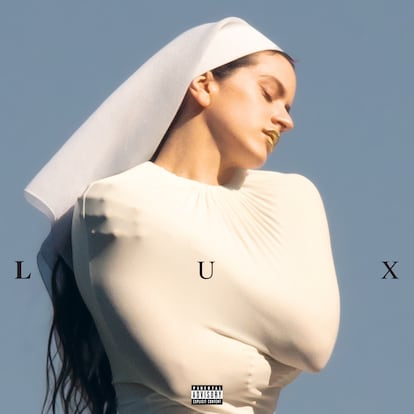
Nobody saw these two things coming: Rosalía’s conversion from a slum motomami to the immaculate nun, and that half the planet is currently listening to the sublime violins of the London Symphony Orchestra, the sound architecture on which it ascends Lux. Rosalía (Barcelona, 33 years old) has four albums in her still short career, each delivering a different adventure: in Los Angeles (2017) gave herself to more or less primary flamenco from the vision of a twenty-something and with the Spanish punk guitar of Refree; in The Bad Want (2018) contributed to the modernization of Spanish roots music to talk about harmful love; in Motomami (2022) embraced the Caribbean and urban business trends, and now offers Lux, which has nothing to do with the above and may even collide with his past works. I smelled for her. To realize how radically restless this artist is, it is enough to remember that in the beginning she was called a “cantaora” and then she was absurdly accused of “cultural appropriation.” Where was that now… It is clear that with Rosalía life is dizzying.
Lux, which he has worked on for three years, is accompanied by a media campaign that portrays the sign of the times: an overwhelming digital and media noise, the realization that there are always cracks even in the most severe planning and how fun this circus ends up being. An example of this entertaining chaos is this review. It should not have been published until Friday (album release day) according to the record company’s promotional requirements, but due to leaks in the last few hours (first a few songs, then the entire album), the company informed the media this afternoon that the track was free.
The strengths of Rosalía’s fourth and new work, Lux, There are many, but perhaps the importance of the place from which it is conceived should be put first. We are talking about a daring, brave, complex, arrogant and fascinating work, an album without choruses, with hardly any memorizable rhythms, dense and extensive. Let’s call it anti-commercial, but at the same time it can be considered pop. Rosalía does this from the pinnacle of pop music, from a position as a world star. Would it have been more profitable to record a Desperate and also keep your company’s managers happy? Obviously, yes. Making a rare album from the margins of the industry is much easier, but putting together this mystical epic from the throne she occupies offers the image of an artist with radical courage.
Lux It is going to test the Catalan’s broad base of followers. There are no commercial hooks to cling to here. We are facing a sensory adventure that aims not to be heard in pieces, which even suggests an intimate immersion of an hour without distractions, with the mobile phone in airplane mode and without domestic interruptions. Some will fall by the wayside, and it will be a shame, because it pays to at least listen to it in these delivery conditions once. Then, you can snack, although there is not much genre in this field. Another of the weapons of Lux It is the vocal exhibition of the protagonist, overflowing, with continuous inflections, expressing herself in operatic, flamenco or trapper codes and always showing prodigious qualities.
The album is divided into four acts, three fewer songs in the platform version. Other boutade of the artist: put the vinyl on top instead of the digital copy, which she knows well is the one that will be consumed the most. But there remains the gesture.
He doesn’t invent anything Lux. Everything it contains has been in operation for years: the long albums, the conceptuality, the orchestral pop, the combination of languages, the search for spirituality in art… But Rosalía faces it with a captivating personality, capturing the listener’s attention from the first verses (“who could live between the two / first love the world and then love God”, from the song Sex, violence and tires) and levitating him to the end, Magnoliaswhere she evokes the death of the protagonist and her fusion with God (or is she herself God?): “Gasoline, red wine, cigars and chocolate, we dance with love on top of my corpse.” When he sings Chocolate his voice turns to cuplé. It’s as if Concha Piquer appeared just to say that word, chocolate. Prodigious. Perhaps those who lack the feeling of transcendence that the album proposes feel a certain sensation of modest and even conservative discourse, and very possibly they are right. Here everyone chooses their path.
It’s not just an orchestral album, although the prodigies of the London Symphony hardly rest. Lux It sounds modern even when it resorts to classic operatic concepts, because here and there they break with the orthodoxy of modern sounds, rapped sounds, digital noises and forays into flamenco, as in early in the morning o The rumba of forgiveness, with Estrella Morente and Silvia Pérez Cruz. There are three references in the work that not even the protagonist will deny: on the one hand, Björk (who participates in the preview Berghain) and Kate Bush, two women who have sublimated strange and life-giving pop during model careers; and, on the other hand, Enrique Morente, the bold and risky singer from Granada.
As was the case with Motomami, Sometimes a feeling of hodgepodge prevails, of including too many things without artistic justification. An example of this occurs with the use of up to 13 languages, all intoned by the protagonist. This was already invented by another colonizing singer, Julio Iglesias, who recorded his works in several languages (even in Japanese), but while the objective of the creator of life goes on the same was the conquest of markets, in Lux It is sold to us as a narrative resource to make sense of the story. That is to say, if Rosalía has been inspired for a piece by the holy German abbess (as well as a philosopher and poet) Hildegard of Bingen, the logical thing for her is that that part of the theme be expressed in German; and if in another phase the reference is the mystic and activist Simone Weil, well here, you guessed it, French is used. Seeing how the polyglot frivolity fits into the album, it seems more of a pretentious resource than anything else. “If I could, I would have sung in all the languages of the world,” Rosalía said this week in Mexico, and this statement sounded like those maximalist proclamations of the aforementioned Julio Iglesias when he was expanding his musical domain back in the mid-eighties.
With this work, Rosalía stands out brilliantly from the rest of the pop stars of the moment. Compare Lux With many albums that top the most listened to lists, it is like pretending that admiring the sea is the same as looking at a blue piece of cardboard. And allow me, in conclusion, to return to the end of the critique of Motomami that this same chronicler made: the most exciting thing about Lux is that the next one will be a completely different musical story.