
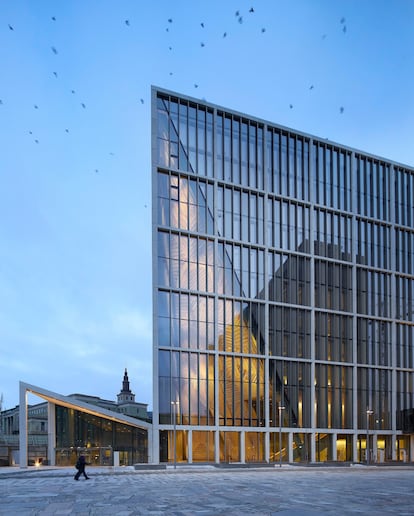
On July 22, 2011 Anders Breivik lost his mind. 78 people lost their lives. A terrorist attack, a car bomb on the building that contained most of the ministries, shattered the political heart of Oslo. Eight people died in that place. In the midst of the confusion, Breivik managed to flee, disguised as a police officer, to the island of Utoya, 40 kilometers from the Norwegian capital. On that island there was a summer camp, organized by the Labor Party, in which 650 young people had gathered. Many trusted the police officer and did what he told them, to get together. Once he had them collected, he started shooting.
With shots and machetes, Breivik ended the lives of 69 of those young people. He then turned himself in to the real police. Today he is serving a 21-year prison sentence (the maximum reviewable in Norway). He has not shown any regrets. But, in these 15 years, the country has faced rebuilding the scene of the events, its political heart. How to do it?
Jens Stoltenberg, the then prime minister of Norway, spoke that fateful night on television. He said the response to the attack had to be more democracy, more transparency and more humanity. Gudmund Stokke, the founder of the Nordic Office of Architecture studio, now remembers it in a video that serves as a presentation of the new official headquarters of the Norwegian government in Oslo. This property is not only physically new, it seeks to renew the relationship between politics and citizens. Let’s see how he tries it.
Transparency and security. Closeness and professionalism. “It was very important to recover this urban area as a place capable of transmitting those values,” explain the architects. How to combine security with openness? The power with transparency?
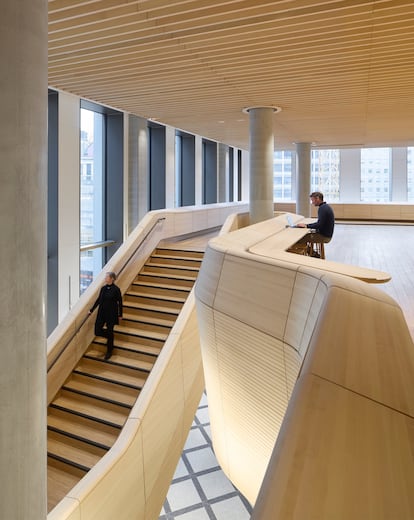
In the first phase that they completed this month, three of the five buildings connected by a campus have been inaugurated. The next phase will conclude in 2030 and complete the project. Today, the urban fabric has been repaired and changed. The ministries are all going to be connected. Transparency occurs in the curtain walls of the large central building, of course, but above all it is felt in the access—new pedestrian paths and bicycle lanes—that citizens have to new areas of rest and recreation inside the campus. Next to the ministries there are now cafes open to the public and a memorial museum that will remember the history of the fateful July 22, 2011.
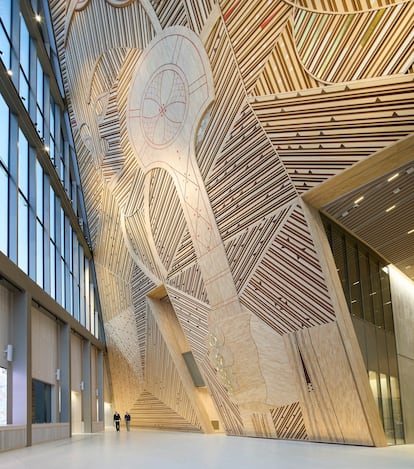
Some buildings could be saved, as well as many of the works of art that were exhibited there. But the face of the new center, in addition to the intentions, is new. The identity of the building is built not from symbols or shapes but from the message of materials. They are all local. It is the gray Norwegian stone that does the talking on the façade, along with the glass. Inside, the birch—from the forests of Nordmarka, north of Oslo—builds open, flexible spaces, and, the architects trust, adaptable to changes. Of course there is surveillance, but it is difficult to perceive it: citizens and visitors feel more welcomed than watched.

“New squares and transparency are essential to communicate democracy,” the architects insist. The project is, thus, strong but open, importance is given to the materials and from them a story is explained, a story of resistance, reconstruction and resilience.